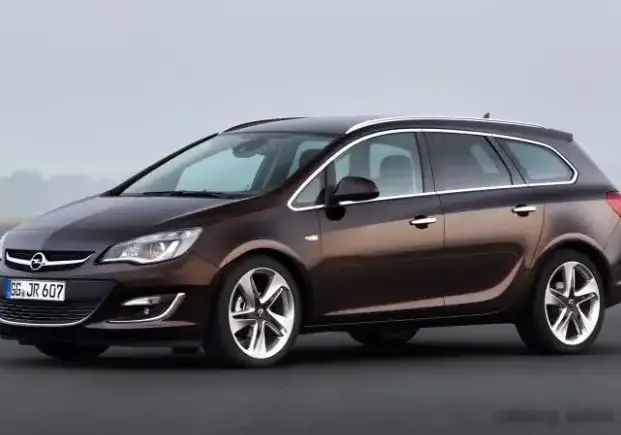
The Opel Astra J Sports Tourer (facelift, produced from 2012 to 2015) represented a significant evolution of Opel’s compact wagon, offering a blend of practicality, fuel efficiency, and modern features. Within the J series, the 2.0 CDTI (165 hp) Ecotec variant occupied a mid-range position, appealing to buyers seeking a balance between performance and economy. This model was primarily marketed in Europe, where station wagons, or “estate” cars, maintain a strong presence due to their versatility and cargo capacity. The facelift brought styling updates and refinements to the already popular Astra J, enhancing its appeal in a competitive segment.
Technical Specifications
| Brand | Opel |
| Model | Astra |
| Generation | Astra J Sports Tourer (facelift 2012) |
| Type (Engine) | 2.0 CDTI (165 Hp) Ecotec |
| Start of production | 2012 |
| End of production | 2015 |
| Powertrain Architecture | Internal Combustion engine |
| Body type | Station wagon (estate) |
| Seats | 5 |
| Doors | 5 |
| Fuel consumption (urban) | 6.2-6.3 l/100 km (37.9 – 37.3 US mpg) |
| Fuel consumption (extra urban) | 4.1-4.3 l/100 km (57.4 – 54.7 US mpg) |
| Fuel consumption (combined) | 4.9-5.0 l/100 km (48 – 47 US mpg) |
| CO2 emissions | 129-133 g/km |
| Fuel Type | Diesel |
| Acceleration 0 – 100 km/h | 9.5 sec |
| Acceleration 0 – 62 mph | 9.5 sec |
| Acceleration 0 – 60 mph | 9 sec |
| Maximum speed | 212 km/h (131.73 mph) |
| Emission standard | Euro 5 |
| Power | 165 Hp @ 4000 rpm |
| Torque | 350 Nm @ 1750-2500 rpm (258.15 lb.-ft. @ 1750-2500 rpm) |
| Engine layout | Front, Transverse |
| Engine Model/Code | A20DTH |
| Engine displacement | 1956 cm3 (119.36 cu. in.) |
| Number of cylinders | 4 |
| Engine configuration | Inline |
| Cylinder Bore | 83 mm (3.27 in.) |
| Piston Stroke | 90.4 mm (3.56 in.) |
| Number of valves per cylinder | 4 |
| Fuel injection system | Diesel Commonrail |
| Engine aspiration | Turbocharger, Intercooler |
| Engine oil capacity | 4.5 l (4.76 US qt | 3.96 UK qt) |
| Coolant capacity | 6.9 l (7.29 US qt | 6.07 UK qt) |
| Trunk (boot) space – minimum | 500 l (17.66 cu. ft.) |
| Trunk (boot) space – maximum | 1550 l (54.74 cu. ft.) |
| Fuel tank capacity | 56 l (14.79 US gal | 12.32 UK gal) |
| Max. roof load | 100 kg (220.46 lbs.) |
| Length | 4698 mm (184.96 in.) |
| Width | 1814 mm (71.42 in.) |
| Width with mirrors folded | 1831 mm (72.09 in.) |
| Width including mirrors | 2013 mm (79.25 in.) |
| Height | 1535 mm (60.43 in.) |
| Wheelbase | 2685 mm (105.71 in.) |
| Front track | 1541 mm (60.67 in.) |
| Rear track | 1551 mm (61.06 in.) |
| Ride height (ground clearance) | 165 mm (6.5 in.) |
| Minimum turning circle | 11.4 m (37.4 ft.) |
| Drivetrain Architecture | Front wheel drive |
| Number of gears | 6 |
| Gearbox type | Manual transmission |
| Front brakes | Ventilated discs |
| Assisting systems | ABS (Anti-lock braking system) |
| Steering type | Steering rack and pinion |
| Power steering | Electric Steering |
| Tires size | 215/50 R17 |
| Wheel rims size | 17 |
Powertrain & Engine Architecture
The heart of the Astra J Sports Tourer 2.0 CDTI was the A20DTH engine, a 1.956-liter inline-four cylinder diesel. This engine was a member of Opel/Vauxhall’s Ecotec family, known for its focus on efficiency and refinement. The A20DTH utilized a common rail direct injection system, delivering fuel at extremely high pressures for optimized combustion. A turbocharger with an intercooler further enhanced performance, providing increased air intake to the engine. The engine produced 165 horsepower at 4000 rpm and a substantial 350 Nm (258 lb-ft) of torque between 1750 and 2500 rpm. This torque output was a key characteristic, providing strong pulling power for everyday driving and when carrying loads. The engine also featured a diesel particulate filter (DPF) to reduce emissions, complying with Euro 5 standards. The 2.0 CDTI was paired with a six-speed manual transmission, offering precise gear changes and contributing to the vehicle’s overall fuel efficiency.
Driving Characteristics
The 2.0 CDTI-equipped Astra J Sports Tourer offered a composed and comfortable driving experience. The engine’s torque delivery meant that strong acceleration was readily available from relatively low engine speeds, making it well-suited for overtaking and merging onto highways. While not a sports car, the 9.5-second 0-62 mph acceleration time was respectable for a diesel wagon. The six-speed manual transmission allowed drivers to maintain optimal engine speeds for efficiency or performance. Compared to the base 1.4-liter petrol engine, the 2.0 CDTI provided significantly more power and torque, but at the expense of some refinement. It was quieter and smoother than earlier diesel iterations, but still possessed the characteristic diesel clatter. Compared to higher-output versions of the 2.0 CDTI (some reaching 170 hp), the 165 hp variant offered a slightly more balanced approach, prioritizing fuel economy without sacrificing too much performance.
Equipment & Trim Levels
The 2.0 CDTI Sports Tourer typically came with a good level of standard equipment. This included air conditioning, electric front windows, a CD/MP3 stereo system, and alloy wheels. Higher trim levels, such as ‘Sport’ or ‘Elite’, added features like climate control, parking sensors, a touchscreen infotainment system, and upgraded upholstery. Interior upholstery was typically cloth, with leather options available as an upgrade. The dashboard layout was functional and well-designed, with a focus on ergonomics. Optional extras included a panoramic sunroof, navigation system, and adaptive cruise control.
Chassis & Braking
The Astra J Sports Tourer featured a MacPherson strut front suspension and a multi-link rear suspension, providing a comfortable ride and good handling characteristics. The suspension was tuned to balance comfort and stability, making it suitable for both city driving and long-distance journeys. The 2.0 CDTI models typically had slightly stiffer suspension components compared to lower-powered variants to handle the increased weight and power. Braking was handled by ventilated discs on the front wheels and either discs or drums on the rear wheels, depending on the trim level. Anti-lock braking system (ABS) was standard, enhancing safety and control during emergency braking situations. Electric power steering provided light and precise steering feel.
Market Reception & Comparison
The Opel Astra J Sports Tourer 2.0 CDTI was generally well-received by automotive critics. It was praised for its practicality, fuel efficiency, and comfortable ride. The 2.0 CDTI engine was considered a good compromise between performance and economy, making it a popular choice for fleet buyers and private customers alike. Compared to rivals like the Ford Focus Estate and Volkswagen Golf Estate, the Astra J offered a competitive package in terms of price, features, and fuel economy. However, some critics noted that the interior materials weren’t quite as premium as those found in some competitors.
Legacy
The A20DTH engine proved to be a relatively reliable unit, although, like all diesel engines, it required regular maintenance, including oil changes and DPF regeneration. The Astra J Sports Tourer 2.0 CDTI remains a popular choice on the used car market, offering a practical and economical option for buyers seeking a versatile family vehicle. Its combination of space, fuel efficiency, and reasonable running costs continues to make it an attractive proposition. While modern cars offer more advanced technology, the Astra J Sports Tourer 2.0 CDTI represents a well-rounded and dependable vehicle from a bygone era of automotive design.