
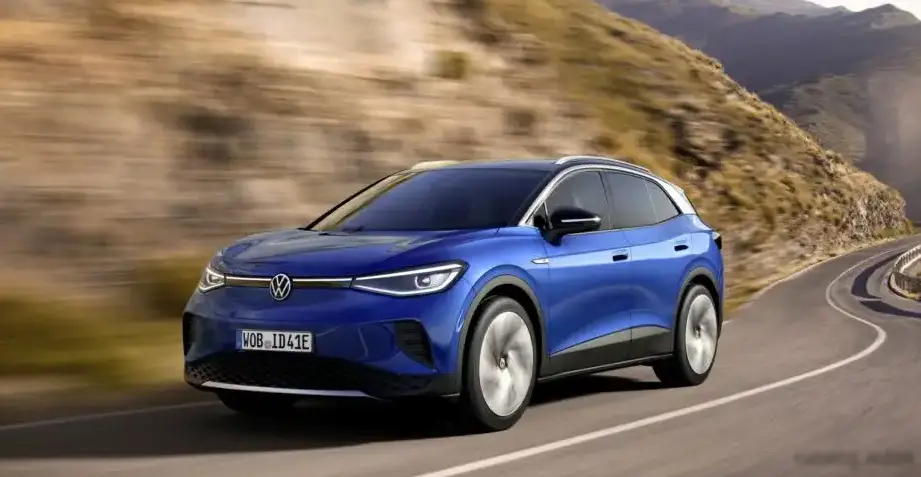
The Volkswagen ID.4 55 kWh, producing 170 horsepower, represents the entry point into Volkswagen’s all-electric crossover SUV lineup, launched in 2021. Positioned as a key model in VW’s push towards electrification, the ID.4 aims to deliver accessible electric mobility with a focus on practicality and range. This variant, equipped with a 55 kWh battery pack, serves as the foundation for the ID.4 range, offering a balance between affordability and usability within the broader ID. family, which also includes larger battery options and higher-performance trims. It’s built on Volkswagen’s Modular Electric Drive Toolkit (MEB) platform, designed specifically for electric vehicles.
Technical Specifications
| Brand | Volkswagen |
| Model | ID.4 |
| Generation | ID.4 |
| Type (Engine) | 55 kWh (170 Hp) |
| Start of production | 2021 |
| Powertrain Architecture | BEV (Electric Vehicle) |
| Body type | SUV |
| Seats | 5 |
| Doors | 5 |
| Fuel Type | Electricity |
| Acceleration 0 – 100 km/h | 9 sec |
| Acceleration 0 – 62 mph | 9 sec |
| Acceleration 0 – 60 mph | 8.6 sec |
| Maximum speed | 160 km/h (99.42 mph) |
| Weight-to-power ratio | 11.1 kg/Hp |
| Weight-to-torque ratio | 6.1 kg/Nm |
| Gross battery capacity | 55 kWh |
| Net (usable) battery capacity | 52 kWh |
| Battery technology | Lithium-ion (Li-Ion) |
| Battery location | Below the floor |
| All-electric range (WLTP) | 345 km (214.37 mi) |
| Average Energy consumption (WLTP) | 16.8 kWh/100 km (27.04 kWh/100 mi) |
| Average Energy consumption | 15.6 kWh/100 km (25.11 kWh/100 mi) |
| Electric motor power | 170 Hp |
| Electric motor Torque | 310 Nm (228.64 lb.-ft.) |
| Electric motor location | Rear axle, Transverse |
| Electric motor type | Synchronous |
| System power | 170 Hp |
| System torque | 310 Nm (228.64 lb.-ft.) |
| Kerb Weight | 1890 kg (4166.74 lbs.) |
| Max. weight | 2470 kg (5445.42 lbs.) |
| Max load | 580 kg (1278.68 lbs.) |
| Trunk (boot) space – minimum | 543 l (19.18 cu. ft.) |
| Trunk (boot) space – maximum | 1575 l (55.62 cu. ft.) |
| Max. roof load | 75 kg (165.35 lbs.) |
| Permitted trailer load with brakes (8%) | 1200 kg (2645.55 lbs.) |
| Permitted trailer load with brakes (12%) | 1000 kg (2204.62 lbs.) |
| Permitted trailer load without brakes | 750 kg (1653.47 lbs.) |
| Permitted towbar download | 75 kg (165.35 lbs.) |
| Length | 4584 mm (180.47 in.) |
| Width | 1852 mm (72.91 in.) |
| Width including mirrors | 2108 mm (82.99 in.) |
| Height | 1640 mm (64.57 in.) |
| Wheelbase | 2770 mm (109.06 in.) |
| Front track | 1587-1597 mm (62.48 – 62.87 in.) |
| Rear (Back) track | 1562-1572 mm (61.5 – 61.89 in.) |
| Ride height (ground clearance) | 163 mm (6.42 in.) |
| Drag coefficient (Cd) | 0.28 |
| Minimum turning circle (turning diameter) | 10.2 m (33.46 ft.) |
| Approach angle | 17.5° |
| Departure angle | 21.2° |
| Ramp-over (brakeover) angle | 17.1° |
| Drivetrain Architecture | One electric motor drives the rear wheels. |
| Drive wheel | Rear wheel drive |
| Number of gears and type of gearbox | 1 gears, automatic transmission |
| Front suspension | Independent type McPherson, Transverse stabilizer |
| Rear suspension | Independent multi-link suspension, Transverse stabilizer |
| Front brakes | Ventilated discs |
| Rear brakes | Drum |
| Assisting systems | ABS (Anti-lock braking system) |
| Steering type | Steering rack and pinion |
| Power steering | Electric Steering |
| Tires size | 235/60 R18; 235/55 R19 |
| Wheel rims size | 8J x 18; 8J x 19 |
Powertrain & Engine Architecture
The ID.4 55 kWh utilizes a permanently magnetized synchronous electric motor located on the rear axle. This motor produces 170 horsepower and 310 Nm (228.64 lb.-ft.) of torque. The motor is powered by a 55 kWh lithium-ion battery pack situated under the vehicle floor, contributing to a low center of gravity. The battery pack is actively cooled to maintain optimal operating temperatures. The single-speed automatic transmission is a direct-drive system, typical of electric vehicles, providing seamless acceleration. The power electronics manage the flow of energy between the battery, motor, and other vehicle systems. The ID.4 does not employ regenerative braking settings that are adjustable by the driver, but it does feature automatic regenerative braking when decelerating.
Driving Characteristics
The 170 hp and 310 Nm of torque provide adequate, though not exhilarating, performance. Acceleration from 0-60 mph takes approximately 8.6 seconds. The rear-wheel-drive configuration contributes to a balanced feel, but the weight of the battery pack (approximately 340 kg) is noticeable, particularly during cornering. Compared to the higher-output versions of the ID.4 (like those with the 77 kWh battery and more powerful motors), the 55 kWh model feels less responsive. The single-speed transmission delivers smooth, linear acceleration, and the lack of gear changes contributes to a quiet and refined driving experience. The focus is on efficiency and comfortable cruising rather than sporty handling.
Equipment & Trim Levels
The ID.4 55 kWh typically comes standard with features like a 10-inch touchscreen infotainment system with Apple CarPlay and Android Auto compatibility, a digital instrument cluster, LED headlights, and a suite of driver-assistance features including forward collision warning, automatic emergency braking, and lane-keeping assist. Interior upholstery is typically cloth, with options for leatherette available. Trim levels often include “Pro” and “Pro S” variants, with the “Pro S” adding features like a panoramic sunroof, upgraded audio system, and adaptive cruise control. Optional extras include a hands-free power tailgate and premium paint colors.
Chassis & Braking
The ID.4 utilizes an independent McPherson strut suspension at the front and a multi-link suspension at the rear, optimized for ride comfort and handling. Stabilizer bars are included on both axles to reduce body roll. The braking system features ventilated discs at the front and drum brakes at the rear, a cost-saving measure for the entry-level model. Anti-lock braking system (ABS) is standard. The steering is electric power-assisted, providing light and precise control. The ID.4’s relatively low center of gravity, thanks to the underfloor battery pack, contributes to its stability.
Market Reception & Comparison
The ID.4 55 kWh was generally well-received by critics as an affordable and practical electric SUV. Its range of approximately 214 miles (WLTP) was considered adequate for daily commuting and shorter trips. Fuel economy, expressed as MPGe, is around 125 MPGe combined. Compared to the 77 kWh version, the 55 kWh model offers a lower price point but sacrifices range and performance. It competes with other entry-level electric SUVs like the Hyundai Kona Electric and the Nissan LEAF, offering a more spacious interior and a more conventional SUV shape than some of its rivals.
Legacy
The ID.4 55 kWh served as a crucial entry point for Volkswagen into the competitive EV market. While the 77 kWh versions have become more popular, the 55 kWh model remains a viable option for buyers prioritizing affordability and a smaller battery size. Long-term reliability appears to be generally good, with few widespread issues reported. As the used EV market matures, the ID.4 55 kWh is expected to hold its value reasonably well, appealing to buyers seeking a practical and efficient electric vehicle.
