Technical Specifications
| Brand | Opel |
| Model | Astra |
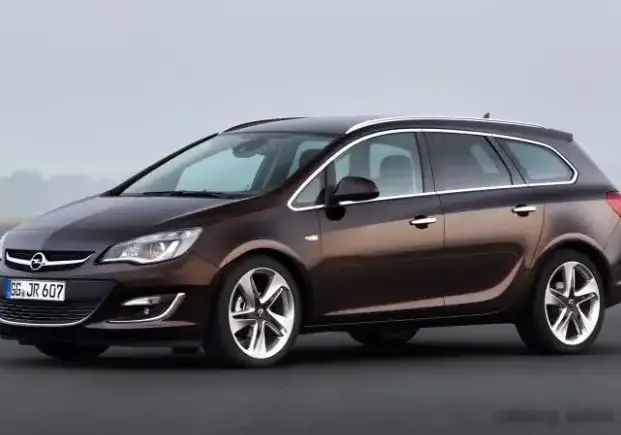
| Generation | Astra J Sports Tourer (facelift 2012) |
| Type (Engine) | 2.0 CDTI (195 Hp) BiTurbo Ecotec start/stop |
| Start of production | 2012 |
| End of production | 2015 |
| Powertrain Architecture | Internal Combustion engine |
| Body type | Station wagon (estate) |
| Seats | 5 |
| Doors | 5 |
| Fuel consumption (urban) | 6.2 l/100 km (37.9 US mpg, 45.6 UK mpg, 16.1 km/l) |
| Fuel consumption (extra urban) | 4.4 l/100 km (53.5 US mpg, 64.2 UK mpg, 22.7 km/l) |
| Fuel consumption (combined) | 5.1 l/100 km (46.1 US mpg, 55.4 UK mpg, 19.6 km/l) |
| CO2 emissions | 134 g/km |
| Fuel Type | Diesel |
| Acceleration 0 – 100 km/h | 8.9 sec |
| Acceleration 0 – 62 mph | 8.9 sec |
| Acceleration 0 – 60 mph | 8.5 sec |
| Maximum speed | 224 km/h (139.19 mph) |
| Emission standard | Euro 5 |
| Weight-to-power ratio | 7.4 kg/Hp, 135.4 Hp/tonne |
| Weight-to-torque ratio | 3.6 kg/Nm, 277.8 Nm/tonne |
| Power | 195 Hp @ 4000 rpm |
| Power per litre | 99.7 Hp/l |
| Torque | 400 Nm @ 1750-2500 rpm (295.02 lb.-ft. @ 1750-2500 rpm) |
| Engine layout | Front, Transverse |
| Engine Model/Code | A20DTR |
| Engine displacement | 1956 cm3 (119.36 cu. in.) |
| Number of cylinders | 4 |
| Engine configuration | Inline |
| Cylinder Bore | 83 mm (3.27 in.) |
| Piston Stroke | 90.4 mm (3.56 in.) |
| Number of valves per cylinder | 4 |
| Fuel injection system | Diesel Commonrail |
| Engine aspiration | BiTurbo, Intercooler |
| Engine oil capacity | 4.5 l (4.76 US qt | 3.96 UK qt) |
| Coolant | 6.9 l (7.29 US qt | 6.07 UK qt) |
| Kerb Weight | 1440 kg (3174.66 lbs.) |
| Max. weight | 2080 kg (4585.62 lbs.) |
| Max load | 640 kg (1410.96 lbs.) |
| Trunk (boot) space – minimum | 500 l (17.66 cu. ft.) |
| Trunk (boot) space – maximum | 1550 l (54.74 cu. ft.) |
| Fuel tank capacity | 56 l (14.79 US gal | 12.32 UK gal) |
| Max. roof load | 100 kg (220.46 lbs.) |
| Length | 4698 mm (184.96 in.) |
| Width | 1814 mm (71.42 in.) |
| Width with mirrors folded | 1831 mm (72.09 in.) |
| Width including mirrors | 2013 mm (79.25 in.) |
| Height | 1535 mm (60.43 in.) |
| Wheelbase | 2685 mm (105.71 in.) |
| Front track | 1541 mm (60.67 in.) |
| Rear (Back) track | 1551 mm (61.06 in.) |
| Ride height (ground clearance) | 165 mm (6.5 in.) |
| Minimum turning circle | 11.4 m (37.4 ft.) |
| Drivetrain Architecture | Front wheel drive |
| Number of gears and type of gearbox | 6 gears, manual transmission |
| Front brakes | Ventilated discs |
| Assisting systems | ABS (Anti-lock braking system) |
| Steering type | Steering rack and pinion |
| Power steering | Electric Steering |
| Tires size | 235/45 R18; 235/40 R19 |
| Wheel rims size | 18; 19 |
The Opel Astra J Sports Tourer (facelift, introduced in 2012) 2.0 CDTI BiTurbo Ecotec, producing 195 horsepower, represented a high-performance variant within the Astra J wagon lineup. Produced from 2012 to 2015, this model aimed to combine the practicality of a station wagon with a significantly enhanced driving experience, appealing to buyers seeking both space and performance. It sat towards the top end of the Astra J Sports Tourer range, positioned above the lower-powered diesel and gasoline options, but below any potential performance-focused OPC (Opel Performance Center) models. The facelift brought styling updates and technological improvements to the J series, solidifying its position in the competitive European compact wagon segment.
Powertrain & Engine Architecture
The heart of this Astra Sports Tourer is the A20DTR, a 2.0-liter four-cylinder diesel engine. This engine is notable for its bi-turbo configuration, employing two turbochargers – a smaller, more responsive unit for low-end torque and a larger one for high-end power. This setup significantly reduces turbo lag, providing a broader, more usable powerband than a single-turbo diesel. The engine utilizes a common rail direct injection system, delivering fuel at extremely high pressure for optimized combustion and reduced emissions. The engine also featured an intercooler to further cool the intake air, increasing density and power output. The Start/Stop system, standard on this variant, automatically shuts off the engine when the vehicle is stationary to improve fuel economy. The engine is transversely mounted, driving the front wheels. The six-speed manual transmission was the standard offering, providing precise gear changes and contributing to the overall driving experience.
Driving Characteristics
The 195 horsepower and 400 Nm (295 lb-ft) of torque delivered by the A20DTR engine provided a noticeable performance boost compared to lower-spec Astra J Sports Tourer models. Acceleration from 0-60 mph was achieved in approximately 8.5 seconds, and a top speed of 139 mph was attainable. The bi-turbo setup ensured strong acceleration throughout the rev range, making overtaking maneuvers effortless. The manual transmission allowed for greater driver control, while the relatively short gear ratios kept the engine within its optimal power band. Compared to the 1.4L gasoline versions, the 2.0 CDTI offered significantly more torque, resulting in stronger pulling power, especially when fully loaded. While not a dedicated sports car, this variant provided a confident and engaging driving experience for a family wagon.
Equipment & Trim Levels
The 2.0 CDTI BiTurbo typically came with a generous level of standard equipment. This included features like air conditioning, alloy wheels (typically 17 or 18-inch), a touchscreen infotainment system with Bluetooth connectivity, and a multi-function steering wheel. Higher trim levels offered upgrades such as leather upholstery, heated front seats, a panoramic sunroof, and advanced driver-assistance systems like adaptive cruise control and lane departure warning. Interior upholstery was generally a cloth or a combination of cloth and leatherette, depending on the specific trim package. Dashboard configuration was consistent across the Astra J range, featuring a clean and modern design.
Chassis & Braking
The Astra J Sports Tourer utilized a MacPherson strut front suspension and a multi-link rear suspension, providing a good balance between ride comfort and handling. The suspension was tuned to accommodate the increased power and weight of the 2.0 CDTI engine. Front brakes were ventilated discs, providing ample stopping power, while rear brakes were typically solid discs. Anti-lock Braking System (ABS) was standard, enhancing safety and control during emergency braking. Stabilizer bars were fitted to both the front and rear axles to reduce body roll during cornering.
Market Reception & Comparison
The Astra J Sports Tourer 2.0 CDTI BiTurbo was generally well-received by automotive critics. It was praised for its strong performance, refined engine, and spacious interior. Fuel economy was also a strong point, with combined figures around 55 mpg (UK) making it an economical choice for long-distance travel. Compared to rivals like the Ford Focus Estate and Volkswagen Golf Estate, the Astra offered a compelling combination of practicality, performance, and value. Some critics noted that the ride could be slightly firm on rough roads, but this was generally considered a worthwhile trade-off for the improved handling.
Legacy
The A20DTR engine, while generally reliable, is known to require regular maintenance, particularly regarding the diesel particulate filter (DPF) and turbochargers. Proper servicing and the use of high-quality oil are crucial for long-term durability. Today, used examples of the Astra J Sports Tourer 2.0 CDTI BiTurbo represent a good value proposition for buyers seeking a practical and capable wagon. The engine’s strong torque and relatively good fuel economy continue to make it a desirable choice, but potential buyers should be aware of the maintenance requirements associated with a modern diesel engine.