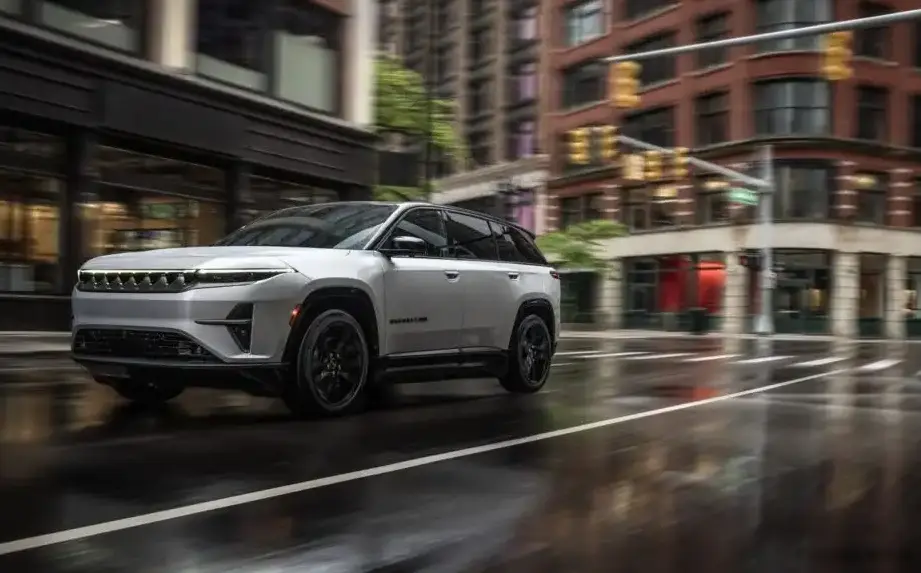
The Jeep Wagoneer S, launched in May 2024, represents Jeep’s entry into the premium mid-size electric SUV segment. Positioned as a technologically advanced and performance-oriented offering, the Wagoneer S is built upon a dedicated BEV platform and aims to compete with established electric SUVs like the Tesla Model Y and the BMW iX. It’s the second all-electric model from Jeep, following the larger Wagoneer EV, and signifies the brand’s commitment to electrification. The Wagoneer S is a five-passenger, five-door SUV designed to blend Jeep’s traditional off-road capability with the efficiency and performance of an electric powertrain.
Technical Specifications
| Brand | Jeep |
| Model | Wagoneer S |
| Generation | Wagoneer S |
| Type (Engine) | 100.5 kWh (608 Hp) 4WD Electric |
| Start of production | May, 2024 |
| Powertrain Architecture | BEV (Electric Vehicle) |
| Body type | SUV |
| Seats | 5 |
| Doors | 5 |
| Fuel Type | Electricity |
| Acceleration 0 – 60 mph | 3.4 sec |
| Maximum speed | 200 km/h (124.27 mph) |
| Weight-to-power ratio | 4.2 kg/Hp, 236.5 Hp/tonne |
| Weight-to-torque ratio | 3.1 kg/Nm, 325.6 Nm/tonne |
| Gross battery capacity | 100.5 kWh |
| Battery voltage | 400 V |
| Battery technology | Lithium nickel manganese cobalt oxides (Li-NMC) |
| Battery location | Below the floor |
| All-electric range | 482.8 km (300 mi) |
| Average Energy consumption | 21.2 kWh/100 km (34.12 kWh/100 mi, 99 MPGe, 4.7 km/kWh, 2.9 mi/kWh) |
| Electric motor power (Front) | 340 Hp |
| Electric motor location (Front) | Front axle, Transverse |
| Electric motor type (Front) | Synchronous |
| Electric motor power (Rear) | 340 Hp |
| Electric motor location (Rear) | Rear axle, Transverse |
| Electric motor type (Rear) | Synchronous |
| System power | 608 Hp |
| System torque | 837 Nm (617.34 lb.-ft.) |
| Kerb Weight | 2571 kg (5668.08 lbs.) |
| Max. weight | 3039 kg (6699.85 lbs.) |
| Max load | 468 kg (1031.76 lbs.) |
| Trunk (boot) space – minimum | 866 l (30.58 cu. ft.) |
| Trunk (boot) space – maximum | 1727 l (60.99 cu. ft.) |
| Permitted trailer load with brakes (12%) | 1542 kg (3399.53 lbs.) |
| Length | 4886 mm (192.36 in.) |
| Width | 1900 mm (74.8 in.) |
| Width including mirrors | 2123 mm (83.58 in.) |
| Height | 1645 mm (64.76 in.) |
| Wheelbase | 2870 mm (112.99 in.) |
| Front track | 1636 mm (64.41 in.) |
| Rear (Back) track | 1639 mm (64.53 in.) |
| Ride height (ground clearance) | 162 mm (6.38 in.) |
| Drag coefficient (Cd) | 0.29 |
| Minimum turning circle (turning diameter) | 12.2 m (40.03 ft.) |
| Approach angle | 19.2° |
| Departure angle | 23.4° |
| Ramp-over (brakeover) angle | 14° |
| Drivetrain Architecture | One electric motor drives the front wheels, one electric motor drives the rear wheels. |
| Drive wheel | All wheel drive (4×4) |
| Number of gears and type of gearbox | 1 gears, automatic transmission |
| Front suspension | Independent type McPherson |
| Rear suspension | Independent multi-link suspension |
| Front brakes | Ventilated discs, 354×28 mm |
| Rear brakes | Ventilated discs, 350×22 mm |
| Assisting systems | ABS (Anti-lock braking system) |
| Steering type | Steering rack and pinion |
| Power steering | Electric Steering |
| Tires size | 235/50 R20 XL |
| Wheel rims size | 8.5J x 20 |
Powertrain & Engine Architecture
The Wagoneer S utilizes a dual-motor all-wheel-drive (AWD) powertrain, with one synchronous electric motor powering the front axle and another powering the rear. Each motor produces 340 horsepower, combining for a total system output of 608 horsepower and 837 Nm (617.34 lb.-ft.) of torque. The powertrain is powered by a 100.5 kWh lithium-nickel-manganese-cobalt (Li-NMC) battery pack located under the vehicle floor, contributing to a low center of gravity. The battery operates at 400V. The single-speed automatic transmission is inherent to electric vehicle architecture, providing seamless power delivery. The electronic power control system manages energy flow between the battery, motors, and other vehicle systems, optimizing efficiency and performance.
Driving Characteristics
The dual-motor setup delivers impressive acceleration, with a 0-60 mph time of just 3.4 seconds. The instant torque characteristic of electric motors provides strong off-the-line responsiveness. The all-wheel-drive system enhances traction and stability in various driving conditions. While specific gear ratios aren’t publicly detailed, the single-speed transmission is optimized for both acceleration and highway cruising. Compared to a potential future internal combustion engine (ICE) Wagoneer S variant, the electric model offers significantly quieter operation and a more refined driving experience. The low center of gravity contributes to confident handling, and the regenerative braking system allows for one-pedal driving in certain situations.
Equipment & Trim Levels
Details on specific trim levels and standard equipment for the Wagoneer S are still emerging. However, it is expected to come standard with a large touchscreen infotainment system, advanced driver-assistance systems (ADAS) such as adaptive cruise control and lane-keeping assist, and premium interior materials. Available options are likely to include a panoramic sunroof, upgraded audio system, and ventilated/massaged front seats. The interior design emphasizes a modern and minimalist aesthetic, with a focus on technology integration. The Wagoneer S aims to provide a luxurious and comfortable cabin experience.
Chassis & Braking
The Wagoneer S features an independent suspension system, with McPherson struts at the front and a multi-link setup at the rear. This configuration is designed to provide a balance of ride comfort and handling performance. Ventilated disc brakes are used on all four wheels, providing ample stopping power. The anti-lock braking system (ABS) is standard, enhancing safety and control during emergency braking situations. The vehicle’s relatively low ride height (162 mm / 6.38 in.) suggests a focus on on-road performance, although Jeep’s traditional off-road DNA is expected to be incorporated through features like selectable drive modes and optimized traction control.
Market Reception & Comparison
Initial reception to the Wagoneer S has been positive, with reviewers praising its performance, technology, and styling. Its range of 482.8 km (300 miles) is competitive within the mid-size electric SUV segment, though slightly less than some rivals like the Tesla Model Y Long Range. The Wagoneer S’s energy consumption of 21.2 kWh/100 km (34.12 kWh/100 mi) is typical for a vehicle of its size and performance. Compared to a potential gasoline-powered Wagoneer S, the electric model offers significantly lower running costs due to the reduced price of electricity compared to gasoline, and reduced maintenance requirements. The higher initial purchase price of the electric model is a potential drawback for some buyers.
Legacy
The Wagoneer S represents a significant step forward for Jeep in the electric vehicle market. Its success will be crucial in establishing Jeep as a major player in the rapidly growing EV segment. The long-term reliability of the powertrain remains to be seen, but the use of proven Li-NMC battery technology and robust electric motors suggests a high level of durability. As the electric vehicle market matures, the Wagoneer S is expected to hold its value well, particularly among buyers seeking a premium and technologically advanced electric SUV with Jeep’s brand heritage.