
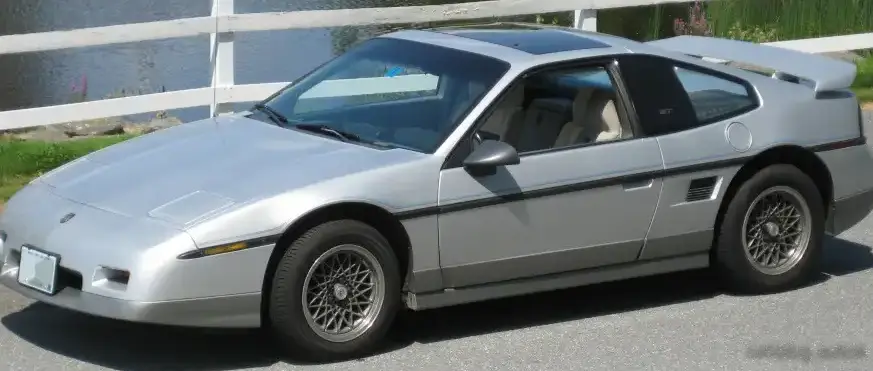
The Pontiac Fiero 2.8L V6 Automatic, produced from 1983 to 1988, represented a significant step up in performance and refinement for the Fiero model line. Introduced as a more powerful alternative to the base four-cylinder engine, the 2.8L V6 variant aimed to broaden the Fiero’s appeal, attracting buyers seeking a sporty, yet comfortable, two-seater coupe. This configuration occupied the mid-range position within the Fiero lineup, offering a balance between affordability and performance, slotting above the base model and below the later, more potent GT trim. The Fiero, as a whole, was Pontiac’s answer to the growing popularity of sports cars like the Mazda RX-7 and Toyota MR2, and the 2.8L V6 was crucial to establishing its credibility in that market.
Technical Specifications
| Brand | Pontiac |
| Model | Fiero |
| Generation | Fiero |
| Type (Engine) | 2.8 V6 (137 Hp) Automatic |
| Start of production | August, 1983 |
| End of production | August, 1988 |
| Powertrain Architecture | Internal Combustion engine |
| Body type | Coupe |
| Seats | 2 |
| Doors | 2 |
| Fuel Type | Petrol (Gasoline) |
| Weight-to-power ratio | 9.2 kg/Hp, 108.2 Hp/tonne |
| Power | 137 Hp |
| Power per litre | 48.3 Hp/l |
| Engine layout | Middle, Transverse |
| Engine Model/Code | L44 |
| Engine displacement | 2837 cm3 / 173.12 cu. in. |
| Number of cylinders | 6 |
| Engine configuration | V-engine |
| Cylinder Bore | 89 mm / 3.5 in. |
| Piston Stroke | 76 mm / 2.99 in. |
| Number of valves per cylinder | 2 |
| Fuel injection system | Multi-port manifold injection |
| Engine aspiration | Naturally aspirated engine |
| Valvetrain | OHV |
| Engine oil capacity | 4.3 l / 4.54 US qt | 3.78 UK qt |
| Coolant | 13 l / 13.74 US qt | 11.44 UK qt |
| Kerb Weight | 1266 kg / 2791.05 lbs. |
| Fuel tank capacity | 38 l / 10.04 US gal | 8.36 UK gal |
| Length | 4190 mm / 164.96 in. |
| Width | 1750 mm / 68.9 in. |
| Height | 1191 mm / 46.89 in. |
| Wheelbase | 2372 mm / 93.39 in. |
| Front track | 1516 mm / 59.69 in. |
| Rear (Back) track | 1527 mm / 60.12 in. |
| Drag coefficient (Cd) | 0.37 |
| Drivetrain Architecture | The Internal combustion engine (ICE) drives the rear wheels of the vehicle. |
| Drive wheel | Rear wheel drive |
| Number of gears and type of gearbox | 3 gears, automatic transmission |
| Front suspension | Independent coil spring |
| Rear suspension | McPherson |
| Steering type | Steering rack and pinion |
| Tires size | 215/60 R14 |
| Wheel rims size | 14 |
Powertrain & Engine Architecture
The heart of the Fiero 2.8L Automatic is the L44 2.8-liter (173.12 cubic inch) V6 engine. This engine, a member of Pontiac’s “Family II” V6 series, featured a 60-degree V-angle and overhead valve (OHV) valvetrain. The L44 utilized a multi-port fuel injection system, improving fuel efficiency and throttle response compared to earlier carbureted designs. The engine produced 137 horsepower and 170 lb-ft of torque. The engine was mounted transversely behind the driver and passenger, contributing to a favorable weight distribution. The three-speed automatic transmission, a TH125C, was chosen for its durability and relatively compact size. While not known for blistering acceleration, the automatic transmission provided smooth and comfortable shifts, making it a popular choice for drivers prioritizing ease of use.
Driving Characteristics
The Fiero 2.8L Automatic offered a distinct driving experience. While the V6 provided a noticeable performance increase over the four-cylinder models, the automatic transmission did impact acceleration. The 0-60 mph time was typically in the 9-10 second range, slower than the manual transmission equipped versions. The automatic’s gear ratios were geared more towards cruising comfort than outright performance. However, the mid-engine layout provided excellent handling balance, making the Fiero feel nimble and responsive in corners. The steering, a rack-and-pinion system, was precise and well-weighted. The overall driving experience was one of a sporty coupe that was easy to drive and comfortable for everyday use.
Equipment & Trim Levels
The 2.8L Automatic Fiero typically came standard with features such as air conditioning, power steering, and a basic AM/FM radio. Interior upholstery was typically cloth, with options for leather available. Dashboard configuration was relatively simple, with clearly marked gauges for speed, tachometer, fuel level, and coolant temperature. Optional extras included upgraded sound systems, cruise control, power windows and locks, and a sunroof. The Fiero’s interior, while functional, was often criticized for its somewhat basic design and materials. However, the focus was on providing a driver-centric environment.
Chassis & Braking
The Fiero’s chassis was a space frame construction, utilizing steel tubes welded together to create a lightweight and rigid structure. This design contributed to the car’s excellent handling characteristics. The front suspension was independent, utilizing coil springs and shock absorbers. The rear suspension employed a McPherson strut design. Braking on the 2.8L Automatic Fiero typically consisted of power-assisted front disc brakes and rear drum brakes. Anti-lock brakes (ABS) were not standard equipment, but were available as an option. The suspension was tuned to provide a balance between ride comfort and handling performance.
Market Reception & Comparison
The Fiero 2.8L Automatic received generally positive reviews from automotive critics. It was praised for its unique mid-engine layout, sporty handling, and comfortable ride. However, some critics noted the automatic transmission dulled the car’s performance potential compared to the manual transmission models. Compared to the base four-cylinder Fiero, the 2.8L V6 offered a significant performance upgrade, making it a more appealing option for enthusiasts. Compared to the later GT model, the 2.8L Automatic was less powerful and lacked some of the GT’s performance-oriented features, such as a more aggressive suspension and upgraded brakes. Fuel economy was reasonable for the time, averaging around 19 mpg city and 27 mpg highway.
Legacy
The Pontiac Fiero, despite its relatively short production run, has gained a devoted following among automotive enthusiasts. The 2.8L V6 Automatic variant remains a popular choice in the used car market, prized for its reliability and ease of maintenance. The L44 V6 engine is known to be a durable powerplant, capable of lasting for many years with proper care. However, like all older vehicles, the Fiero is susceptible to age-related issues, such as corrosion and rubber component deterioration. Today, the Fiero 2.8L Automatic represents a unique and affordable entry point into the world of mid-engine sports cars, offering a distinctive driving experience and a nostalgic connection to the 1980s.
