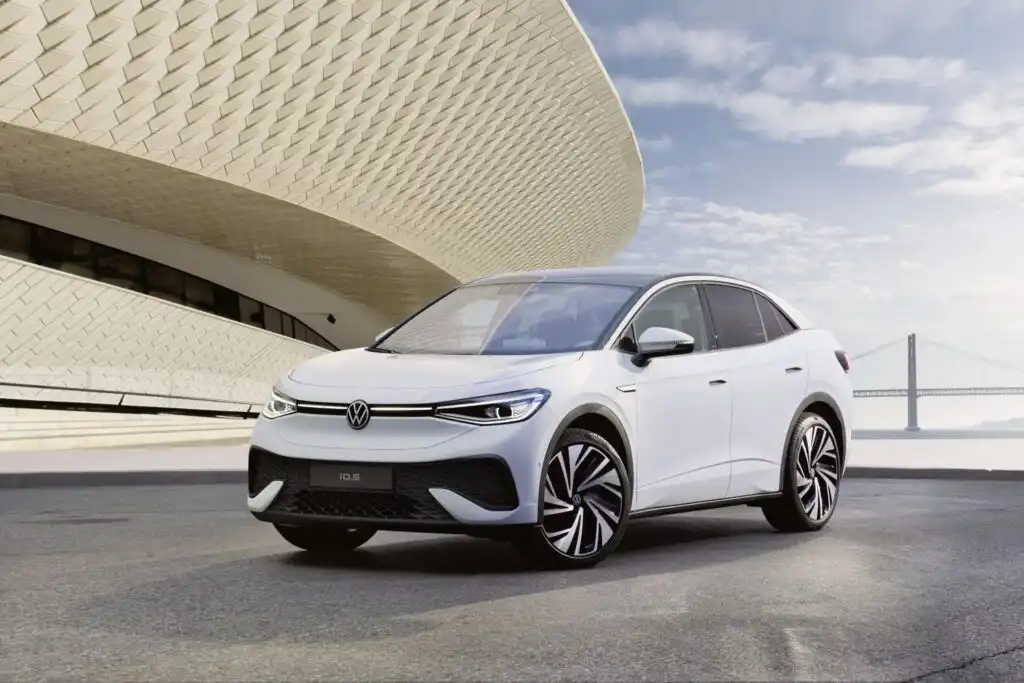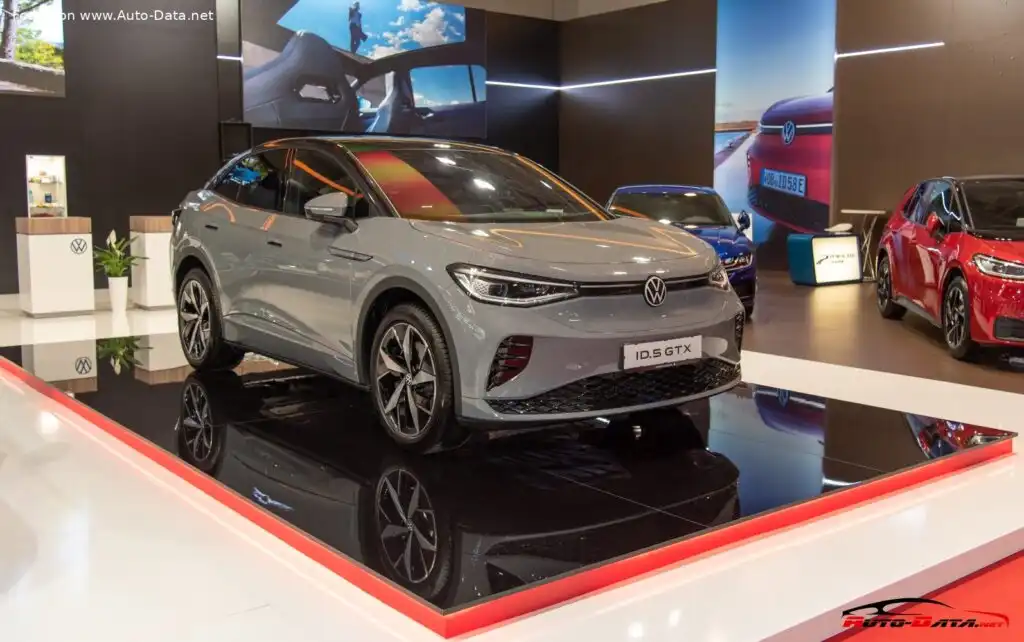
The Volkswagen ID.5 GTX 82 kWh (299 hp) 4MOTION is an all-electric, all-wheel-drive coupe SUV produced from 2022 through October 2023. Positioned as the performance-oriented variant within the ID.5 lineup, the GTX builds upon the foundation of Volkswagen’s Modular Electric Drive Matrix (MEB) platform, offering increased power and a more dynamic driving experience compared to the standard ID.5 models. It represents Volkswagen’s push into the growing electric vehicle market, specifically targeting consumers seeking a blend of practicality, style, and performance in a zero-emission package. The ID.5 itself is a derivative of the ID.4, distinguished by its sloping roofline and coupe-like profile.
Technical Specifications
| Brand | Volkswagen |
| Model | ID.5 |
| Generation | ID.5 |
| Type (Engine) | GTX 82 kWh (299 Hp) 4MOTION |
| Start of production | 2022 |
| End of production | October, 2023 |
| Powertrain Architecture | BEV (Electric Vehicle) |
| Body type | Coupe, SUV |
| Seats | 5 |
| Doors | 5 |
| Fuel Type | Electricity |
| Acceleration 0 – 100 km/h | 6.3 sec |
| Acceleration 0 – 62 mph | 6.3 sec |
| Acceleration 0 – 60 mph | 6 sec |
| Maximum speed | 180 km/h (111.85 mph) – Electronically limited |
| Weight-to-power ratio | 7.2 kg/Hp, 138 Hp/tonne |
| Weight-to-torque ratio | 4.7 kg/Nm, 212.3 Nm/tonne |
| Gross battery capacity | 82 kWh |
| Net (usable) battery capacity | 77 kWh |
| Battery technology | Lithium nickel manganese cobalt oxides (Li-NMC) |
| Battery weight | 495 kg (1091.29 lbs) |
| Battery location | Below the floor |
| All-electric range (WLTP) | 491 km (305.09 mi) |
| Average Energy consumption (WLTP) | 17.9 kWh/100 km (28.81 kWh/100 mi) / 117 MPGe / 5.6 km/kWh (3.5 mi/kWh) |
| Average Energy consumption | 17.1 kWh/100 km (27.52 kWh/100 mi) / 122 MPGe / 5.8 km/kWh (3.6 mi/kWh) |
| Electric motor 1 power | 204 Hp |
| Electric motor 1 Torque | 310 Nm (228.64 lb.-ft.) |
| Electric motor 1 model/code | EBJA |
| Electric motor 1 location | Rear axle, Transverse |
| Electric motor 1 type | Synchronous |
| Electric motor 2 power | 109 Hp |
| Electric motor 2 Torque | 162 Nm (119.49 lb.-ft.) |
| Electric motor 2 model/code | EBR |
| Electric motor 2 location | Front axle, Transverse |
| Electric motor 2 type | Asynchronous |
| System power | 299 Hp |
| System torque | 460 Nm (339.28 lb.-ft.) |
| Kerb Weight | 2167 kg (4777.42 lbs) |
| Max. weight | 2750 kg (6062.71 lbs) |
| Max load | 583 kg (1285.29 lbs) |
| Trunk (boot) space – minimum | 549 l (19.39 cu. ft.) |
| Trunk (boot) space – maximum | 1561 l (55.13 cu. ft.) |
| Max. roof load | 75 kg (165.35 lbs) |
| Permitted trailer load with brakes (8%) | 1400 kg (3086.47 lbs) |
| Permitted trailer load with brakes (12%) | 1200 kg (2645.55 lbs) |
| Permitted trailer load without brakes | 750 kg (1653.47 lbs) |
| Permitted towbar download | 75 kg (165.35 lbs) |
| Length | 4582 mm (180.39 in) |
| Width | 1852 mm (72.91 in) |
| Width including mirrors | 2108 mm (82.99 in) |
| Height | 1615 mm (63.58 in) |
| Wheelbase | 2771 mm (109.09 in) |
| Front track | 1587-1597 mm (62.48 – 62.87 in) |
| Rear (Back) track | 1567-1573 mm (61.69 – 61.93 in) |
| Ride height (ground clearance) | 163 mm (6.42 in) |
| Drag coefficient (Cd) | 0.27 |
| Minimum turning circle (turning diameter) | 11.57 m (37.96 ft) |
| Drivetrain Architecture | One electric motor drives the front wheels, one electric motor drives the rear wheels. |
| Drive wheel | All wheel drive (4×4) |
| Number of gears and type of gearbox | 1 gears, automatic transmission |
| Front suspension | Independent, type McPherson with coil spring and anti-roll bar |
| Rear suspension | Independent multi-link spring suspension with stabilizer |
| Front brakes | Ventilated discs |
| Rear brakes | Drum |
| Steering type | Steering rack and pinion |
| Power steering | Electric Steering |
| Front wheel tires | 235/50 R20; 235/45 R21 |
| Rear wheel tires | 255/45 R20; 255/40 R21 |
| Front wheel rims | 8J x 20; 8.5J x 21 |
| Rear wheel rims | 9J x 20; 9J x 21 |
Powertrain & Engine Architecture
The ID.5 GTX utilizes a dual-motor all-wheel-drive system. The rear motor (EBJA) is a permanent magnet synchronous motor producing 204 hp and 310 Nm (228.64 lb-ft) of torque, while the front motor (EBR) is an asynchronous motor delivering 109 hp and 162 Nm (119.49 lb-ft) of torque. Combined, the system generates a total output of 299 hp and 460 Nm (339.28 lb-ft). The 82 kWh (gross) / 77 kWh (net) lithium-ion battery pack is located under the vehicle floor, contributing to a low center of gravity and improved handling. The battery employs Lithium Nickel Manganese Cobalt Oxide (Li-NMC) chemistry. The GTX features a single-speed automatic transmission, typical of electric vehicles, as the electric motors provide instant torque across a wide range of speeds. The car’s electronic control unit manages power distribution between the front and rear motors, optimizing for efficiency and traction.
Driving Characteristics
The ID.5 GTX offers brisk acceleration, achieving 0-60 mph in approximately 6 seconds. The dual-motor setup provides confident all-wheel drive traction, particularly in adverse weather conditions. Compared to the rear-wheel-drive ID.5 variants, the GTX delivers a more planted and secure feel. While the single-speed transmission simplifies the driving experience, it lacks the gear changes found in traditional automatic transmissions. The power delivery is immediate and linear, characteristic of electric motors. The GTX’s suspension is tuned for a balance between comfort and handling, offering a reasonably compliant ride without sacrificing agility. The car’s weight (2167 kg / 4777.42 lbs) is noticeable, but the instant torque of the electric motors mitigates some of the effects of the mass.
Equipment & Trim Levels
The GTX trim level included a number of standard features designed to enhance both comfort and sportiness. These typically included sport seats upholstered in a combination of fabric and ArtVelours (a microfiber material), a multi-function steering wheel, a large touchscreen infotainment system with navigation, and a digital instrument cluster. Exterior styling cues differentiating the GTX from other ID.5 models included unique bumpers, badging, and dark-tinted rear windows. Optional extras included a panoramic sunroof, premium sound system, and advanced driver-assistance systems such as adaptive cruise control and lane-keeping assist.
Chassis & Braking
The ID.5 GTX utilizes an independent suspension system, with a McPherson strut setup at the front and a multi-link arrangement at the rear. Stabilizer bars are fitted to both axles to reduce body roll during cornering. The braking system features ventilated discs at the front and drum brakes at the rear, a cost-saving measure common in electric vehicles where regenerative braking handles a significant portion of the deceleration. Anti-lock braking system (ABS) and electronic stability control (ESC) are standard safety features. The steering system is an electric power-assisted rack and pinion setup, providing precise and responsive steering feel.
Market Reception & Comparison
The ID.5 GTX was generally well-received by automotive critics, who praised its performance, spacious interior, and modern technology. However, some reviewers noted the relatively high price compared to other electric SUVs and the somewhat unconventional infotainment system. Compared to the standard ID.5 models, the GTX offered a significant performance upgrade, justifying the price premium for buyers seeking a more engaging driving experience. In terms of fuel economy (energy consumption), the ID.5 GTX achieved approximately 17.9 kWh/100 km (28.81 kWh/100 mi) on the WLTP cycle, translating to a range of around 491 km (305.09 mi). This placed it competitively within the electric SUV segment.
Legacy
The Volkswagen ID.5 GTX represents an important step in Volkswagen’s transition to electric mobility. While relatively new to the market, early reports suggest that the powertrain is proving to be reliable. The MEB platform, upon which the ID.5 is based, is expected to underpin a wide range of future Volkswagen Group electric vehicles. As the used car market matures, the ID.5 GTX is likely to become a desirable option for buyers seeking a stylish, practical, and high-performing electric SUV. The longevity of the battery pack and the availability of charging infrastructure will be key factors influencing its long-term value.