
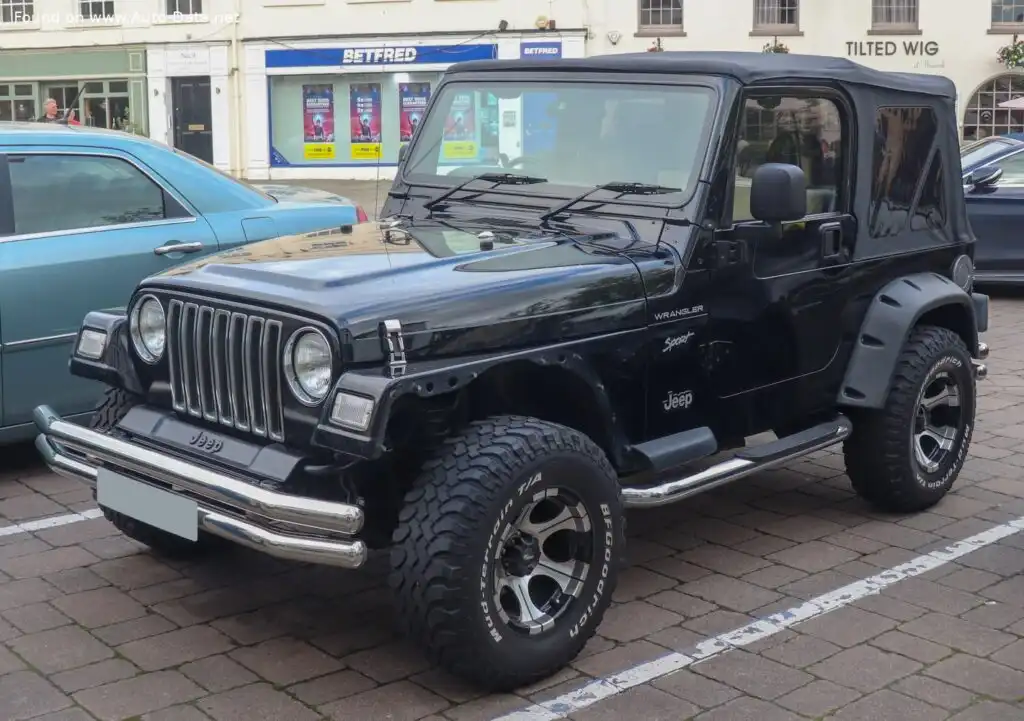
The Jeep Wrangler TJ, produced from 1997 to 2006, represented a significant leap forward for the iconic off-road vehicle. The 2.4-liter inline-four cylinder engine variant, introduced in 2003 and continuing through 2006, offered a more fuel-efficient alternative to the larger, more powerful engines available in the TJ lineup. This configuration, paired exclusively with a four-speed automatic transmission, was positioned as the entry-level Wrangler, appealing to buyers prioritizing affordability and everyday usability over extreme off-road performance. It was a key part of the TJ generation, built on the 1HX platform, and aimed to broaden the Wrangler’s appeal beyond its core enthusiast base.
Technical Specifications
| Brand | Jeep |
| Model | Wrangler |
| Generation | Wrangler II (TJ) |
| Type (Engine) | 2.4 i 16V (147 Hp) Automatic |
| Start of production | 2003 |
| End of production | 2006 |
| Powertrain Architecture | Internal Combustion engine |
| Body type | Off-road vehicle |
| Seats | 5 |
| Doors | 2 |
| Fuel consumption (urban) | 14 l/100 km (16.8 US mpg, 20.2 UK mpg, 7.1 km/l) |
| Fuel consumption (extra urban) | 8.3 l/100 km (28.3 US mpg, 34 UK mpg, 12 km/l) |
| Fuel consumption (combined) | 10.4 l/100 km (22.6 US mpg, 27.2 UK mpg, 9.6 km/l) |
| Fuel Type | Petrol (Gasoline) |
| Acceleration 0 – 100 km/h | 13 sec |
| Acceleration 0 – 62 mph | 13 sec |
| Acceleration 0 – 60 mph | 12.4 sec |
| Maximum speed | 155 km/h (96.31 mph) |
| Weight-to-power ratio | 10.9 kg/Hp, 91.6 Hp/tonne |
| Weight-to-torque ratio | 7.2 kg/Nm, 139.6 Nm/tonne |
| Power | 147 Hp @ 5200 rpm |
| Power per litre | 60.5 Hp/l |
| Torque | 224 Nm @ 4000 rpm (165.21 lb.-ft. @ 4000 rpm) |
| Engine layout | Front, Longitudinal |
| Engine Model/Code | ED1 |
| Engine displacement | 2429 cm3 (148.23 cu. in.) |
| Number of cylinders | 4 |
| Engine configuration | Inline |
| Cylinder Bore | 87.5 mm (3.44 in.) |
| Piston Stroke | 101 mm (3.98 in.) |
| Compression ratio | 9.5:1 |
| Number of valves per cylinder | 4 |
| Fuel injection system | Multi-port manifold injection |
| Engine aspiration | Naturally aspirated engine |
| Engine oil capacity | 4.7 l (4.97 US qt | 4.14 UK qt) |
| Coolant | 8.5 l (8.98 US qt | 7.48 UK qt) |
| Kerb Weight | 1605 kg (3538.42 lbs.) |
| Max. weight | 2000 kg (4409.25 lbs.) |
| Max load | 395 kg (870.83 lbs.) |
| Trunk (boot) space – minimum | 320 l (11.3 cu. ft.) |
| Trunk (boot) space – maximum | 1045 l (36.9 cu. ft.) |
| Fuel tank capacity | 57 l (15.06 US gal | 12.54 UK gal) |
| Length | 3883 mm (152.87 in.) |
| Width | 1694 mm (66.69 in.) |
| Height | 1750 mm (68.9 in.) |
| Wheelbase | 2373 mm (93.43 in.) |
| Front track | 1473 mm (57.99 in.) |
| Rear (Back) track | 1473 mm (57.99 in.) |
| Drive wheel | All wheel drive (4×4) |
| Number of gears and type of gearbox | 4 gears, automatic transmission |
| Front suspension | Coil spring |
| Rear suspension | Coil spring |
| Front brakes | Ventilated discs |
| Rear brakes | Drum |
| Power steering | Hydraulic Steering |
| Tires size | 215/75 R15 |
| Wheel rims size | 15 |
Powertrain & Engine Architecture
The heart of this Wrangler variant is the 2.4-liter (2429 cc) inline-four cylinder engine, designated the ED1 code by Jeep. This engine, while not as powerful as the 4.0-liter inline-six or the 4.7-liter V8 options, was designed for improved fuel economy and a smoother driving experience. It features a single overhead camshaft (SOHC) design with four valves per cylinder, operated by a timing chain. Fuel delivery is managed by a multi-port fuel injection system, providing precise fuel metering for optimal combustion. The engine produces 147 horsepower at 5200 rpm and 165 lb-ft of torque at 4000 rpm. The four-speed automatic transmission, a 42RLE unit, was the sole transmission offering for this engine. This transmission is known for its relatively smooth shifts but lacks the responsiveness of a manual gearbox. The engine is longitudinally mounted, a common configuration for four-wheel-drive vehicles, and drives all four wheels through a part-time four-wheel-drive system.
Driving Characteristics
The 2.4-liter Wrangler TJ Automatic delivers a noticeably different driving experience compared to its more powerful siblings. Acceleration is modest, taking around 13 seconds to reach 60 mph. The automatic transmission, while convenient, contributes to a less engaging driving feel. The gear ratios are optimized for low-end torque, making it suitable for moderate off-road trails and everyday driving. However, it can feel strained when climbing steep inclines or carrying heavy loads. Compared to the manual transmission versions, the automatic suffers from some power loss due to the torque converter. The 42RLE transmission also lacks the overdrive gear found in some other automatic transmissions, which can result in higher engine speeds at highway speeds.
Equipment & Trim Levels
The 2.4-liter Wrangler TJ typically came equipped as a base model, offering essential features. Standard equipment included air conditioning, a basic audio system, and manually adjustable seats. The interior featured durable, washable materials designed to withstand the rigors of off-road use. Optional extras included power windows and locks, upgraded audio systems, and a removable hardtop. The interior trim was generally basic, with a focus on functionality rather than luxury. The dashboard layout was straightforward, with clearly labeled controls. Upholstery was typically cloth, with vinyl or leather options available as upgrades.
Chassis & Braking
The Wrangler TJ utilizes a body-on-frame construction, providing excellent durability and off-road capability. The suspension consists of coil springs at all four corners, offering a comfortable ride on and off-road. The front suspension features a stabilizer bar to reduce body roll during cornering. Braking duties are handled by ventilated discs at the front and drum brakes at the rear. The braking system is adequate for everyday use but can feel overwhelmed when towing or carrying heavy loads. The steering is hydraulically assisted, providing relatively easy maneuverability. The 2.4L models typically had a slightly softer suspension setup compared to the heavier, more powerful Wranglers.
Market Reception & Comparison
The 2.4-liter Wrangler TJ Automatic was generally well-received as an affordable and fuel-efficient entry point into the Wrangler family. Critics praised its improved fuel economy compared to the larger engines, but noted its lack of power and performance. Compared to the 4.0-liter inline-six, the 2.4-liter engine offered significantly less horsepower and torque, making it less capable in demanding off-road situations. However, the 2.4L offered better fuel economy, achieving around 22.6 mpg combined, compared to the 4.0L’s 16-18 mpg. The 2.4L was also more affordable to purchase and maintain. It appealed to buyers who primarily used their Wrangler for commuting and light off-roading.
Legacy
The 2.4-liter Wrangler TJ Automatic has proven to be a relatively reliable powertrain. The ED1 engine is known for its durability, and the 42RLE transmission, while not without its flaws, can withstand years of use with proper maintenance. Today, these Wranglers are popular in the used car market, offering an affordable and capable off-road vehicle. While not as sought after as the more powerful models, the 2.4-liter variant remains a viable option for buyers looking for a classic Wrangler experience without breaking the bank. Common maintenance issues include oil leaks and corrosion, particularly in areas exposed to harsh weather conditions. Overall, the 2.4L TJ represents a practical and accessible entry point into the world of Jeep ownership.
