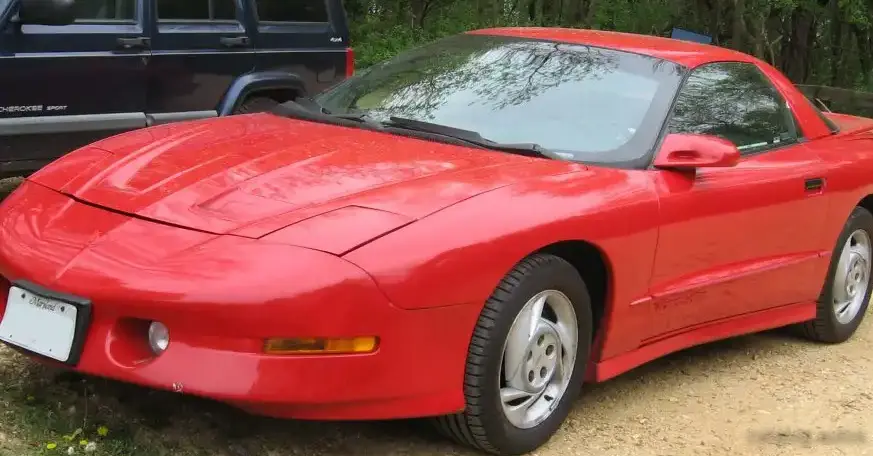
The Pontiac Firebird IV 3.4i V6, produced from November 1992 through 1995, represented a key iteration of the fourth-generation Firebird (1993-2002). Positioned as an entry-level to mid-range offering within the Firebird lineup, it provided a more accessible price point compared to the higher-performance V8 models. This variant was part of the broader effort to modernize the Firebird, sharing its platform – the F-body – with the Chevrolet Camaro. The 3.4i V6 aimed to balance affordability with a respectable level of performance and modern features, appealing to buyers seeking a sporty coupe without the expense of the flagship engines.
Technical Specifications
| Brand | Pontiac |
| Model | Firebird |
| Generation | Firebird IV |
| Type (Engine) | 3.4i V6 (148 Hp) |
| Start of production | November, 1992 |
| End of production | 1995 |
| Powertrain Architecture | Internal Combustion engine |
| Body type | Coupe |
| Seats | 4 |
| Doors | 3 |
| Fuel consumption (combined) | 8.8 l/100 km (26.7 US mpg, 32.1 UK mpg, 11.4 km/l) |
| Fuel Type | Petrol (Gasoline) |
| Maximum speed | 207 km/h (128.62 mph) |
| Weight-to-power ratio | 10.3 kg/Hp, 96.9 Hp/tonne |
| Weight-to-torque ratio | 5.9 kg/Nm, 168.2 Nm/tonne |
| Power | 148 Hp @ 4600 rpm |
| Power per litre | 44.1 Hp/l |
| Torque | 257 Nm @ 3150 rpm (189.55 lb.-ft. @ 3150 rpm) |
| Engine layout | Front, Longitudinal |
| Engine Model/Code | L32 |
| Engine displacement | 3353 cm3 (204.61 cu. in.) |
| Number of cylinders | 6 |
| Engine configuration | V-engine |
| Cylinder Bore | 92 mm (3.62 in.) |
| Piston Stroke | 84 mm (3.31 in.) |
| Compression ratio | 9:1 |
| Number of valves per cylinder | 2 |
| Fuel injection system | Multi-port manifold injection |
| Engine aspiration | Naturally aspirated engine |
| Engine oil capacity | 4.7 l (4.97 US qt | 4.14 UK qt) |
| Coolant | 11.6 l (12.26 US qt | 10.21 UK qt) |
| Kerb Weight | 1528 kg (3368.66 lbs.) |
| Max. weight | 2000 kg (4409.25 lbs.) |
| Max load | 472 kg (1040.58 lbs.) |
| Trunk (boot) space – minimum | 366 l (12.93 cu. ft.) |
| Fuel tank capacity | 59 l (15.59 US gal | 12.98 UK gal) |
| Length | 4964 mm (195.43 in.) |
| Width | 1892 mm (74.49 in.) |
| Height | 1300 mm (51.18 in.) |
| Wheelbase | 2566 mm (101.02 in.) |
| Front track | 1542 mm (60.71 in.) |
| Rear (Back) track | 1539 mm (60.59 in.) |
| Drivetrain Architecture | The Internal combustion engine (ICE) drives the rear wheels of the vehicle. |
| Drive wheel | Rear wheel drive |
| Number of gears and type of gearbox | 5 gears, manual transmission |
| Front suspension | Double wishbone |
| Rear suspension | Coil spring |
| Front brakes | Ventilated discs |
| Rear brakes | Disc |
| Assisting systems | ABS (Anti-lock braking system) |
| Steering type | Steering rack and pinion |
| Power steering | Hydraulic Steering |
| Tires size | 215/60 R16 V |
Powertrain & Engine Architecture
The heart of the Firebird IV 3.4i was the 3.4-liter (3353 cc) L32 V6 engine. This engine, part of GM’s 60-degree V6 family, featured a cast iron block and aluminum cylinder heads. It utilized a multi-port fuel injection system, delivering fuel directly to each cylinder for improved efficiency and responsiveness. The engine produced 148 horsepower at 4600 rpm and 257 Nm (189.55 lb-ft) of torque at 3150 rpm. The L32 engine featured a 9:1 compression ratio and two valves per cylinder. The engine was mounted longitudinally in the front of the vehicle, driving the rear wheels. The standard transmission for this model was a 5-speed manual, although a 4-speed automatic transmission was also available as an option.
Driving Characteristics
The 3.4i V6 with the 5-speed manual transmission offered a reasonably engaging driving experience. While not as quick as the V8-powered Firebirds, it provided adequate acceleration for everyday driving. The gear ratios were tuned to prioritize fuel economy and smooth cruising, rather than outright performance. The automatic transmission, while offering convenience, noticeably dulled the car’s responsiveness. The rear-wheel-drive layout contributed to balanced handling, and the double wishbone front suspension and coil spring rear suspension provided a comfortable ride. However, the relatively modest power output meant that the 3.4i V6 felt somewhat underpowered when fully loaded or attempting more aggressive maneuvers.
Equipment & Trim Levels
The Firebird IV 3.4i typically came standard with features such as air conditioning, power windows and locks, and an AM/FM stereo. Interior upholstery was typically cloth, with options for leather available. The dashboard layout was relatively straightforward, with clearly marked gauges and controls. Optional extras included a premium sound system, cruise control, and a sunroof. The 3.4i trim generally occupied the entry-level to mid-range position in the Firebird lineup, offering a good balance of features and affordability. It lacked some of the more luxurious appointments found in the higher-end V8 models.
Chassis & Braking
The Firebird IV utilized a unibody construction for rigidity and weight reduction. The front suspension featured independent double wishbones with coil springs and shock absorbers. The rear suspension employed a solid axle with coil springs and shock absorbers. Braking duties were handled by ventilated discs at the front and solid discs at the rear. An Anti-lock Braking System (ABS) was standard equipment, enhancing safety and control during hard braking. The steering system was a rack-and-pinion setup with hydraulic power assistance, providing responsive and precise steering feel. The standard tire size was 215/60R16 V.
Market Reception & Comparison
The Firebird IV 3.4i V6 was generally well-received as an affordable and stylish coupe. Critics praised its comfortable ride and decent handling, but noted that its performance was not as exhilarating as the V8 models. Fuel economy was a strong point, averaging around 26.7 US mpg in combined driving. Compared to the Firebird V6 with the automatic transmission, the manual version offered a more engaging driving experience and slightly better fuel economy. The 3.4i V6 also represented a more economical alternative to the Camaro, which shared the same platform and powertrain options. However, some reviewers felt that the interior materials were somewhat basic compared to other coupes in its class.
Legacy
The L32 3.4L V6 engine proved to be a relatively reliable powertrain when properly maintained. While not known for exceptional longevity, it generally provided years of service with routine maintenance. Today, the Firebird IV 3.4i V6 represents an affordable entry point into the world of classic American muscle cars. Parts availability is generally good, and the relatively simple mechanical design makes it a suitable project car for enthusiasts. The 3.4i V6 models are often sought after by those looking for a stylish and comfortable coupe without the higher price tag and maintenance costs associated with the V8 variants. Its enduring appeal lies in its blend of affordability, practicality, and classic Firebird styling.