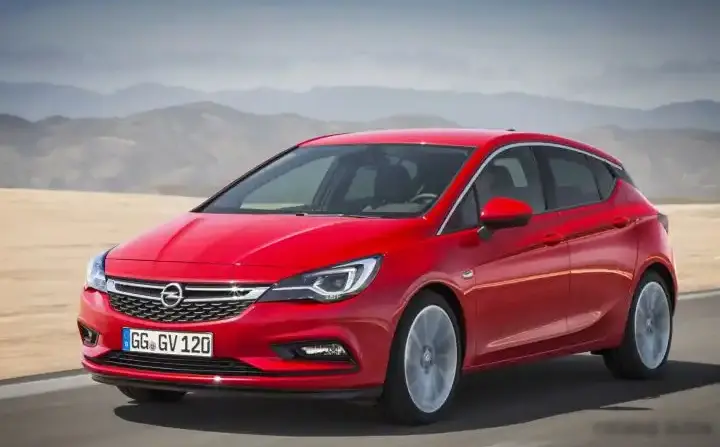
The Opel Astra K 1.4 Turbo (150 hp) was a popular variant of the Astra K generation, produced from 2018 through July 2019. Positioned as a mid-range offering within the Astra K lineup, it aimed to balance performance, fuel efficiency, and affordability. This model played a significant role in Opel’s European market strategy, offering a modern and competitive hatchback in the crucial C-segment. The Astra K, overall, represented a substantial step forward for Opel in terms of design, technology, and driving dynamics, and the 1.4 Turbo variant was a key component of its success.
Technical Specifications
| Brand | Opel |
| Model | Astra |
| Generation | Astra K |
| Type (Engine) | 1.4 Turbo (150 Hp) |
| Start of production | 2018 |
| End of production | July, 2019 |
| Powertrain Architecture | Internal Combustion engine |
| Body type | Hatchback |
| Seats | 5 |
| Doors | 5 |
| Fuel consumption (urban) | 7 l/100 km (33.6 US mpg, 40.4 UK mpg, 14.3 km/l) |
| Fuel consumption (extra urban) | 4.5-4.7 l/100 km (52.3 – 50 US mpg, 62.8 – 60.1 UK mpg, 22.2 – 21.3 km/l) |
| Fuel consumption (combined) | 5.4-5.6 l/100 km (43.6 – 42 US mpg, 52.3 – 50.4 UK mpg, 18.5 – 17.9 km/l) |
| CO2 emissions | 125-128 g/km |
| Fuel Type | Petrol (Gasoline) |
| Acceleration 0 – 100 km/h | 8.5 sec |
| Acceleration 0 – 62 mph | 8.5 sec |
| Acceleration 0 – 60 mph | 8.1 sec |
| Maximum speed | 215 km/h (133.59 mph) |
| Emission standard | Euro 6d-Temp |
| Weight-to-power ratio | 8 kg/Hp, 124.7 Hp/tonne |
| Weight-to-torque ratio | 5.2 kg/Nm, 191.2 Nm/tonne |
| Power | 150 Hp @ 5000-5600 rpm |
| Power per litre | 107.2 Hp/l |
| Torque | 230 Nm @ 2000-4000 rpm (169.64 lb.-ft. @ 2000-4000 rpm) |
| Engine layout | Front, Transverse |
| Engine Model/Code | D14XFT |
| Engine displacement | 1399 cm3 (85.37 cu. in.) |
| Number of cylinders | 4 |
| Engine configuration | Inline |
| Cylinder Bore | 74 mm (2.91 in.) |
| Piston Stroke | 81.3 mm (3.2 in.) |
| Compression ratio | 10:1 |
| Number of valves per cylinder | 4 |
| Fuel injection system | Direct injection |
| Engine aspiration | Turbocharger, Intercooler |
| Engine oil capacity | 4 l (4.23 US qt | 3.52 UK qt) |
| Coolant | 5.1 l (5.39 US qt | 4.49 UK qt) |
| Kerb Weight | 1203 kg (2652.16 lbs.) |
| Max. weight | 1815 kg (4001.39 lbs.) |
| Max load | 612 kg (1349.23 lbs.) |
| Trunk (boot) space – minimum | 370 l (13.07 cu. ft.) |
| Trunk (boot) space – maximum | 1210 l (42.73 cu. ft.) |
| Fuel tank capacity | 48 l (12.68 US gal | 10.56 UK gal) |
| Max. roof load | 75 kg (165.35 lbs.) |
| Permitted trailer load with brakes (12%) | 1450 kg (3196.7 lbs.) |
| Permitted trailer load without brakes | 620 kg (1366.87 lbs.) |
| Length | 4370 mm (172.05 in.) |
| Width | 1809 mm (71.22 in.) |
| Width with mirrors folded | 1871 mm (73.66 in.) |
| Width including mirrors | 2042 mm (80.39 in.) |
| Height | 1485 mm (58.46 in.) |
| Wheelbase | 2662 mm (104.8 in.) |
| Front track | 1544 mm (60.79 in.) |
| Rear (Back) track | 1558 mm (61.34 in.) |
| Minimum turning circle | 11.05 m (36.25 ft.) |
| Drivetrain Architecture | The Internal combustion engine (ICE) drives the front wheels of the vehicle. |
| Drive wheel | Front wheel drive |
| Number of gears and type of gearbox | 6 gears, manual transmission |
| Front brakes | Disc |
| Rear brakes | Disc |
| Assisting systems | ABS (Anti-lock braking system) |
| Steering type | Steering rack and pinion |
| Power steering | Electric Steering |
| Tires size | 205/55 R16; 225/40 R18 |
| Wheel rims size | 6.5J x 16; 7J x 16; 7.5 x 18 |
INTRODUCTION
The Opel Astra K 1.4 Turbo (150 hp) represented a significant upgrade over its predecessor, the Astra J. Introduced in 2015 and running through 2019, the Astra K was built on a new, lighter platform, resulting in improved handling and fuel efficiency. The 1.4 Turbo engine, designated with the engine code D14XFT, was a key component of this improvement. This variant offered a compelling balance between performance and economy, making it a popular choice for drivers seeking a practical and enjoyable daily driver. It sat comfortably in the middle of the Astra K range, offering more power than the base 1.0L engine but remaining more affordable than the higher-performance models.
Powertrain & Engine Architecture
The heart of the Astra K 1.4 Turbo is the D14XFT engine, a 1.4-liter, inline-four cylinder gasoline engine featuring direct injection and a turbocharger with an intercooler. This engine is part of Opel’s Small Displacement Gasoline (SDG) family. Direct injection allows for precise fuel delivery, optimizing combustion and improving efficiency. The turbocharger boosts power output by forcing more air into the cylinders. The engine produces 150 horsepower at 5000-5600 rpm and 230 Nm (169.64 lb.-ft.) of torque between 2000 and 4000 rpm. The engine utilizes a variable valve timing system to further enhance performance and efficiency. The Astra K 1.4 Turbo was typically paired with a six-speed manual transmission, although a six-speed automatic transmission was also available. The automatic transmission offered smooth shifts and enhanced convenience, but at the expense of some fuel economy and responsiveness compared to the manual.
Driving Characteristics
The Astra K 1.4 Turbo provided a surprisingly engaging driving experience. While not a sports car, the 150 hp engine offered sufficient power for confident overtaking and highway cruising. Acceleration from 0 to 60 mph took approximately 8.1 seconds. The turbocharger provided a noticeable boost in power, delivering a responsive feel. The six-speed manual transmission allowed drivers to maintain optimal engine speed for efficient and enjoyable driving. The automatic transmission, while convenient, could feel slightly less responsive, particularly during quick acceleration. The Astra K’s lighter chassis and well-tuned suspension contributed to its agile handling and comfortable ride quality. Compared to the base 1.0L engine, the 1.4 Turbo offered a significant improvement in performance, while remaining more economical than the higher-output variants.
Equipment & Trim Levels
The Astra K 1.4 Turbo was available in several trim levels, each offering a different level of equipment. Standard features typically included air conditioning, power windows, power mirrors, a touchscreen infotainment system with Bluetooth connectivity, and a suite of safety features such as ABS, ESP, and multiple airbags. Higher trim levels added features such as alloy wheels, a more advanced infotainment system with navigation, heated seats, a rearview camera, and parking sensors. Interior upholstery ranged from cloth to leatherette, depending on the trim level. Optional extras included a panoramic sunroof, adaptive cruise control, and a premium sound system.
Chassis & Braking
The Astra K utilized a MacPherson strut front suspension and a torsion beam rear suspension. This setup provided a good balance between ride comfort and handling. The Astra K 1.4 Turbo was equipped with disc brakes on all four wheels, providing ample stopping power. ABS (Anti-lock Braking System) and ESP (Electronic Stability Program) were standard features, enhancing safety and control. The steering was electrically assisted, providing a light and precise feel. The chassis was designed to be lightweight, contributing to the car’s agility and fuel efficiency.
Market Reception & Comparison
The Opel Astra K 1.4 Turbo was generally well-received by automotive critics. It was praised for its stylish design, comfortable interior, and engaging driving dynamics. The 1.4 Turbo engine was considered a good compromise between performance and fuel economy. Compared to rivals such as the Volkswagen Golf and Ford Focus, the Astra K offered a competitive package with a strong value proposition. Fuel economy figures of 5.4-5.6 l/100 km (43.6 – 42 US mpg) were competitive within its class. Reliability reports were generally positive, although some owners reported minor issues with the infotainment system.
Legacy
The Opel Astra K 1.4 Turbo remains a popular choice in the used car market. The D14XFT engine has proven to be relatively reliable, although regular maintenance is essential. Common issues include occasional turbocharger problems and oil leaks. The Astra K’s modern design and features continue to appeal to buyers seeking a practical and stylish hatchback. Its combination of fuel efficiency, performance, and affordability has ensured its enduring popularity. The Astra K 1.4 Turbo represents a significant step forward for Opel, and its legacy continues to be felt in the current generation of Astra models.