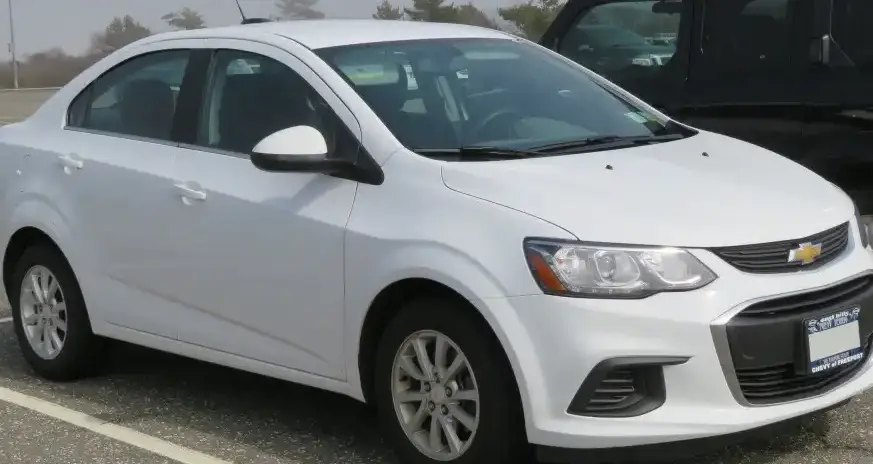
The Chevrolet Sonic I Sedan (facelifted in 2016) with the 1.8-liter engine producing 138 horsepower represents a key offering in Chevrolet’s subcompact car lineup during the 2016-2018 model years. Positioned as a step up from the base 1.4-liter turbocharged engine, the 1.8L variant aimed to provide a more accessible and traditionally powered option for buyers prioritizing simplicity and potentially lower maintenance costs. This model year saw a refresh of the Sonic, including updated front and rear styling, as well as interior enhancements. The Sonic, built on the Gamma II platform, was Chevrolet’s attempt to capture a larger share of the growing subcompact market, competing with vehicles like the Honda Fit, Toyota Yaris, and Ford Fiesta.
Technical Specifications
| Brand | Chevrolet |
| Model | Sonic |
| Generation | Sonic I Sedan (facelift 2016) |
| Type (Engine) | 1.8 (138 Hp) |
| Start of production | 2016 |
| End of production | 2018 |
| Powertrain Architecture | Internal Combustion engine |
| Body type | Sedan |
| Seats | 5 |
| Doors | 4 |
| Fuel consumption (urban) | 9 l/100 km (26.1 US mpg) |
| Fuel consumption (extra urban) | 6.7 l/100 km (35.1 US mpg) |
| Fuel Type | Petrol (Gasoline) |
| Weight-to-power ratio | 9.1 kg/Hp |
| Weight-to-torque ratio | 7.4 kg/Nm |
| Power | 138 Hp @ 6300 rpm |
| Power per litre | 76.8 Hp/l |
| Torque | 170 Nm @ 3800 rpm (125.39 lb.-ft. @ 3800 rpm) |
| Engine layout | Front, Transverse |
| Engine Model/Code | LUW, LWE |
| Engine displacement | 1796 cm3 (109.6 cu. in.) |
| Number of cylinders | 4 |
| Engine configuration | Inline |
| Cylinder Bore | 80.5 mm (3.17 in.) |
| Piston Stroke | 88.2 mm (3.47 in.) |
| Number of valves per cylinder | 4 |
| Fuel injection system | Multi-port manifold injection |
| Engine aspiration | Naturally aspirated engine |
| Valvetrain | DOHC |
| Engine oil capacity | 4.5 l (4.76 US qt | 3.96 UK qt) |
| Coolant | 6 l (6.34 US qt | 5.28 UK qt) |
| Kerb Weight | 1258-1263 kg (2773.42 – 2784.44 lbs.) |
| Trunk (boot) space | 422 l (14.9 cu. ft.) |
| Fuel tank capacity | 46 l (12.15 US gal | 10.12 UK gal) |
| Length | 4416 mm (173.86 in.) |
| Width | 1735 mm (68.31 in.) |
| Height | 1516 mm (59.69 in.) |
| Wheelbase | 2525 mm (99.41 in.) |
| Front track | 1509 mm (59.41 in.) |
| Rear track | 1509 mm (59.41 in.) |
| Drag coefficient (Cd) | 0.33 |
| Minimum turning circle | 10.5 m (34.45 ft.) |
| Drivetrain Architecture | Front wheel drive |
| Drive wheel | Front wheel drive |
| Number of gears | 5 gears, manual transmission |
| Front suspension | Independent, type McPherson with coil spring and anti-roll bar |
| Rear suspension | Semi-independent, coil spring |
| Front brakes | Ventilated discs |
| Rear brakes | Drum |
| Assisting systems | ABS (Anti-lock braking system) |
| Steering type | Steering rack and pinion |
| Power steering | Electric Steering |
| Tires size | 195/65 R15; 205/50 R16 |
| Wheel rims size | 15; 16 |
Powertrain & Engine Architecture
The 1.8-liter LUW/LWE inline-four engine powering this Sonic variant is a naturally aspirated unit, a departure from the smaller turbocharged engine offered in other trims. This engine utilizes multi-port fuel injection, a relatively simple and reliable system compared to direct injection. The engine features a double overhead camshaft (DOHC) valvetrain, contributing to improved breathing and efficiency. The 1.8L engine produces 138 horsepower at 6300 rpm and 170 Nm (125.39 lb-ft) of torque at 3800 rpm. The engine’s design prioritizes durability and ease of maintenance over outright performance. The standard transmission for this configuration was a 5-speed manual, though a 6-speed automatic transmission was also available, impacting fuel economy and driving feel.
Driving Characteristics
The 1.8-liter engine paired with the manual transmission provides adequate, though not exhilarating, performance. Acceleration is best described as leisurely, with a 0-60 mph time estimated around 9-10 seconds. The automatic transmission, while offering convenience, further diminishes acceleration due to its less efficient power transfer and gear ratios. Compared to the 1.4L turbo, the 1.8L offers a more linear power delivery, lacking the turbo’s low-end punch but providing a more predictable driving experience. The manual transmission offers better control and fuel economy, while the automatic prioritizes ease of use, particularly in urban driving conditions. The Sonic’s suspension is tuned for comfort, resulting in a relatively soft ride, but this comes at the expense of sharp handling.
Equipment & Trim Levels
The 1.8L Sonic typically came in LS and LT trim levels. The LS trim was the base model, offering standard features like air conditioning, power windows and locks, a basic audio system, and steel wheels with wheel covers. The LT trim added features such as alloy wheels, cruise control, a more advanced audio system, and upgraded interior trim. Optional extras included a sunroof, upgraded audio systems with Bluetooth connectivity, and a rear vision camera. Interior upholstery was typically cloth, with the LT trim offering upgraded cloth options. The dashboard layout was functional but not particularly luxurious, focusing on practicality and ease of use.
Chassis & Braking
The Chevrolet Sonic utilizes a McPherson strut front suspension and a semi-independent coil spring rear suspension. This setup provides a comfortable ride but doesn’t offer the same level of handling precision as more sophisticated independent rear suspensions. Front brakes are ventilated discs, providing adequate stopping power, while rear brakes are drums, a cost-saving measure common in this segment. All Sonic models were equipped with an Anti-lock Braking System (ABS) as standard. Steering is rack and pinion with electric power steering, offering light and easy steering feel.
Market Reception & Comparison
The 1.8L Sonic received mixed reviews. Critics generally praised its affordability and fuel economy, but found its performance underwhelming compared to competitors. The 1.4L turbo offered a more engaging driving experience, while the 1.8L appealed to buyers prioritizing simplicity and lower running costs. Fuel economy figures were respectable, averaging around 26 mpg city and 35 mpg highway. Reliability was generally considered average for the segment, with some reports of minor issues with the engine and transmission. Compared to the 1.4L turbo, the 1.8L was often seen as a more sensible, if less exciting, choice.
Legacy
The Chevrolet Sonic was discontinued in 2020. The 1.8L engine, while not the most technologically advanced, proved to be relatively durable and reliable. On the used car market, the 1.8L Sonic represents an affordable and practical option for budget-conscious buyers. Maintenance costs are generally lower than those associated with the turbocharged engine, making it an attractive choice for those seeking a dependable and economical subcompact sedan. While not a standout performer, the 1.8L Sonic served as a solid, if unspectacular, entry in Chevrolet’s lineup during its production run.