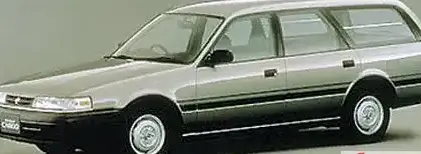
The Mazda 626 IV Station Wagon 2.0i (90 hp) was a practical and relatively affordable family vehicle produced between 1994 and 1998. Part of the fourth generation (GE platform) of the Mazda 626, the station wagon body style offered increased cargo capacity compared to the sedan, appealing to families and those needing versatile transportation. This particular variant, equipped with the 2.0-liter inline-four engine and a five-speed manual transmission, represented a mid-range offering within the 626 lineup, positioned between the base 1.8-liter models and the more powerful V6 options available in some markets. It was primarily sold in European and Asian markets, with limited availability in North America where the 626 was offered primarily as a sedan.
Technical Specifications
| Brand | Mazda |
| Model | 626 |
| Generation | 626 IV Station Wagon |
| Type (Engine) | 2.0 i (90 Hp) |
| Start of production | 1994 |
| End of production | 1998 |
| Powertrain Architecture | Internal Combustion engine |
| Body type | Station wagon (estate) |
| Seats | 5 |
| Doors | 5 |
| Fuel consumption (combined) | 8.3 l/100 km (28.3 US mpg, 34 UK mpg, 12 km/l) |
| Fuel Type | Petrol (Gasoline) |
| Acceleration 0 – 100 km/h | 11.9 sec |
| Acceleration 0 – 62 mph | 11.9 sec |
| Acceleration 0 – 60 mph | 11.3 sec |
| Maximum speed | 171 km/h (106.25 mph) |
| Weight-to-power ratio | 13.4 kg/Hp, 74.7 Hp/tonne |
| Weight-to-torque ratio | 7.9 kg/Nm, 127 Nm/tonne |
| Power | 90 Hp @ 5000 rpm |
| Power per litre | 45 Hp/l |
| Torque | 153 Nm @ 2500 rpm (112.85 lb.-ft. @ 2500 rpm) |
| Engine layout | Front, Transverse |
| Engine displacement | 1998 cm3 (121.93 cu. in.) |
| Number of cylinders | 4 |
| Engine configuration | Inline |
| Cylinder Bore | 86 mm (3.39 in.) |
| Piston Stroke | 86 mm (3.39 in.) |
| Compression ratio | 8.6:1 |
| Number of valves per cylinder | 2 |
| Fuel injection system | Multi-port manifold injection |
| Engine aspiration | Naturally aspirated engine |
| Valvetrain | OHC |
| Kerb Weight | 1205 kg (2656.57 lbs.) |
| Max. weight | 1760 kg (3880.14 lbs.) |
| Max load | 555 kg (1223.57 lbs.) |
| Trunk (boot) space – minimum | 430 l (15.19 cu. ft.) |
| Trunk (boot) space – maximum | 1315 l (46.44 cu. ft.) |
| Fuel tank capacity | 60 l (15.85 US gal | 13.2 UK gal) |
| Length | 4600 mm (181.1 in.) |
| Width | 1690 mm (66.54 in.) |
| Height | 1465 mm (57.68 in.) |
| Wheelbase | 2575 mm (101.38 in.) |
| Front track | 1455 mm (57.28 in.) |
| Rear (Back) track | 1465 mm (57.68 in.) |
| Drivetrain Architecture | The Internal combustion engine (ICE) drives the front wheels of the vehicle. |
| Drive wheel | Front wheel drive |
| Number of gears and type of gearbox | 5 gears, manual transmission |
| Front suspension | Wishbone |
| Rear suspension | Trailing arm |
| Front brakes | Ventilated discs |
| Rear brakes | Disc |
| Assisting systems | ABS (Anti-lock braking system) |
| Steering type | Steering rack and pinion |
| Power steering | Hydraulic Steering |
| Tires size | 185/70 R14 88 S |
| Wheel rims size | 5.5J x 14 ET 45 |
Powertrain & Engine Architecture
The heart of the 626 IV 2.0i was the Mazda F-series engine, specifically the FE-DOHC variant. This 1998cc inline-four cylinder engine featured a single overhead camshaft (SOHC) design, although later iterations of the F-series would adopt dual overhead camshafts. The engine utilized multi-port fuel injection, contributing to improved fuel efficiency and smoother power delivery compared to earlier carbureted designs. The 8.6:1 compression ratio was a compromise between performance and the fuel quality available in various markets. The five-speed manual transmission offered a relatively direct driving experience, with gear ratios tuned for a balance of acceleration and fuel economy. While not a particularly powerful engine, the FE-DOHC was known for its reliability and relatively low maintenance costs.
Driving Characteristics
The 2.0i variant of the 626 IV Station Wagon offered a comfortable, if not particularly sporty, driving experience. With 90 horsepower, acceleration was adequate for everyday driving, but overtaking maneuvers required planning. The five-speed manual transmission allowed drivers to keep the engine in its optimal power band, but the engine lacked the low-end torque of larger displacement engines. Compared to the V6 models available in some markets, the 2.0i felt noticeably less powerful. However, it offered a more engaging driving experience than the automatic transmission options, which were often criticized for their sluggishness. The station wagon’s suspension provided a comfortable ride, absorbing bumps and imperfections in the road well, making it a suitable vehicle for long journeys.
Equipment & Trim Levels
The 626 IV 2.0i typically came equipped with a reasonable level of standard features. These included power steering, central locking, electric windows, and an AM/FM radio. Higher trim levels, often denoted by additional badging, could add features such as air conditioning, alloy wheels, a sunroof, and upgraded interior upholstery. Interior materials were generally durable and functional, though not particularly luxurious. The dashboard layout was straightforward and easy to use, with clearly labeled controls. Safety features were relatively basic for the time, typically including a driver’s airbag and ABS anti-lock brakes.
Chassis & Braking
The 626 IV Station Wagon utilized a front-engine, front-wheel-drive layout. The front suspension employed a wishbone design, while the rear suspension featured a trailing arm setup. This configuration provided a good balance of ride comfort and handling. The braking system consisted of ventilated discs on the front wheels and solid discs on the rear, providing adequate stopping power for the vehicle’s weight and performance. ABS was often included as standard equipment, enhancing braking performance in slippery conditions. The steering was rack and pinion, offering precise and responsive control.
Market Reception & Comparison
The Mazda 626 IV Station Wagon 2.0i was generally well-received by automotive critics as a practical and reliable family vehicle. It offered a good amount of space for passengers and cargo, and its fuel economy was competitive for its class. However, some critics noted that the engine lacked power, particularly when fully loaded. Compared to other station wagons in its segment, such as the Ford Mondeo Estate and the Opel/Vauxhall Vectra Estate, the 626 offered a slightly more refined driving experience and a reputation for reliability. The 2.0i variant was often seen as a sensible choice for buyers who prioritized fuel efficiency and practicality over outright performance.
Legacy
The Mazda 626 IV, including the 2.0i station wagon variant, has developed a reputation as a durable and dependable vehicle. The FE-DOHC engine, while not known for its high performance, is generally considered to be reliable and relatively easy to maintain. Today, well-maintained examples of the 626 IV are becoming increasingly sought after by enthusiasts and collectors. While not a particularly rare or valuable classic car, the 626 IV represents a significant chapter in Mazda’s history and a testament to the company’s commitment to building practical and reliable vehicles. Parts availability can be a challenge, but many components are still available through aftermarket suppliers and online marketplaces.