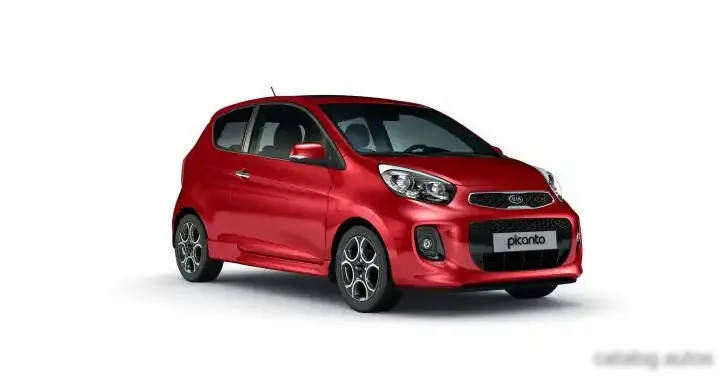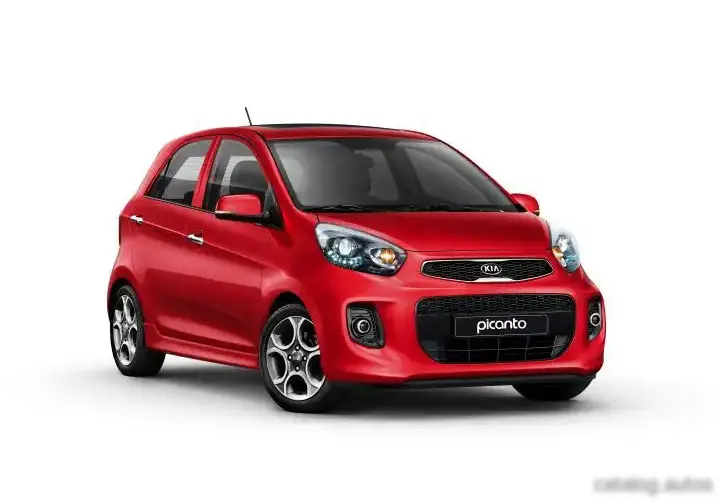
The Kia Picanto II 5D (facelift 2015) 1.2 (85 Hp) represents a significant iteration of Kia’s city car, produced from 2015 to 2017. This variant occupied the entry to mid-level position within the Picanto II range, offering a balance of affordability, practicality, and reasonable fuel efficiency. It was primarily aimed at the European and Asian markets, where demand for compact, economical vehicles is high. The facelift brought styling updates and minor mechanical refinements to the existing TA platform, enhancing its appeal in a competitive segment. This particular model is notable for its combination of a small-displacement engine and a five-speed manual transmission, a configuration designed to maximize fuel economy and minimize running costs.
Technical Specifications
| Brand | Kia |
| Model | Picanto |
| Generation | Picanto II 5D (facelift 2015) |
| Type (Engine) | 1.2 (85 Hp) |
| Start of production | 2015 |
| End of production | 2017 |
| Powertrain Architecture | Internal Combustion engine |
| Body type | Hatchback |
| Seats | 5 |
| Doors | 5 |
| Fuel consumption (urban) | 5.9-6.3 l/100 km (39.9 – 37.3 US mpg, 47.9 – 44.8 UK mpg, 16.9 – 15.9 km/l) |
| Fuel consumption (extra urban) | 3.8 l/100 km (61.9 US mpg, 74.3 UK mpg, 26.3 km/l) |
| Fuel consumption (combined) | 4.6-4.7 l/100 km (51.1 – 50 US mpg, 61.4 – 60.1 UK mpg, 21.7 – 21.3 km/l) |
| CO2 emissions | 106-109 g/km |
| Fuel Type | Petrol (Gasoline) |
| Acceleration 0 – 100 km/h | 11.9 sec |
| Acceleration 0 – 62 mph | 11.9 sec |
| Acceleration 0 – 60 mph | 11.3 sec |
| Maximum speed | 175 km/h (108.74 mph) |
| Emission standard | Euro 6 |
| Weight-to-power ratio | 10.2 kg/Hp, 98.3 Hp/tonne |
| Weight-to-torque ratio | 7.2 kg/Nm, 138.7 Nm/tonne |
| Power | 85 Hp @ 6000 rpm |
| Power per litre | 68.1 Hp/l |
| Torque | 120 Nm @ 4000 rpm (88.51 lb.-ft. @ 4000 rpm) |
| Engine layout | Front, Transverse |
| Engine Model/Code | G4LA |
| Engine displacement | 1248 cm3 (76.16 cu. in.) |
| Number of cylinders | 4 |
| Engine configuration | Inline |
| Cylinder Bore | 71 mm (2.8 in.) |
| Piston Stroke | 78.8 mm (3.1 in.) |
| Compression ratio | 10.5:1 |
| Number of valves per cylinder | 4 |
| Fuel injection system | Multi-port manifold injection |
| Engine aspiration | Naturally aspirated engine |
| Engine oil capacity | 3.5 l (3.7 US qt | 3.08 UK qt) |
| Coolant | 5.1 l (5.39 US qt | 4.49 UK qt) |
| Kerb Weight | 865-1001 kg (1907 – 2206.83 lbs.) |
| Max. weight | 1430 kg (3152.61 lbs.) |
| Max load | 429-565 kg (945.78 – 1245.61 lbs.) |
| Trunk (boot) space – minimum | 200 l (7.06 cu. ft.) |
| Trunk (boot) space – maximum | 870 l (30.72 cu. ft.) |
| Fuel tank capacity | 35 l (9.25 US gal | 7.7 UK gal) |
| Length | 3595 mm (141.54 in.) |
| Width | 1595 mm (62.8 in.) |
| Width including mirrors | 1880 mm (74.02 in.) |
| Height | 1480 mm (58.27 in.) |
| Wheelbase | 2385 mm (93.9 in.) |
| Front track | 1409-1421 mm (55.47 – 55.94 in.) |
| Rear (Back) track | 1412-1424 mm (55.59 – 56.06 in.) |
| Minimum turning circle | 9.6 m (31.5 ft.) |
| Drivetrain Architecture | Front wheel drive |
| Drive wheel | Front wheel drive |
| Number of gears and type of gearbox | 5 gears, manual transmission |
| Front suspension | Independent, type McPherson with coil spring and anti-roll bar |
| Rear suspension | Semi-independent, coil spring |
| Front brakes | Ventilated discs |
| Rear brakes | Disc |
| Assisting systems | ABS (Anti-lock braking system) |
| Steering type | Steering rack and pinion |
| Power steering | Electric Steering |
| Tires size | 155/70 R13 75T; 165/60 R14 75H; 175/50 R15 75H |
| Wheel rims size | 4.5J x 13 ET 46; 5.0J x 14 ET 49; 5.5J x 15 |
INTRODUCTION
The Kia Picanto II, launched in 2011 and facelifted in 2015, was Kia’s offering in the highly competitive European city car segment. The 1.2-liter 85 horsepower variant with a five-speed manual transmission was a core model, designed to appeal to buyers prioritizing fuel efficiency and low running costs. Positioned below the more powerful 1.0-liter turbocharged engine (when available in certain markets) and above any base-level trims, it offered a reasonable balance of performance and economy. The facelift brought subtle cosmetic changes, including a revised front grille and updated interior trim, along with minor improvements to the vehicle’s refinement.
Powertrain & Engine Architecture
The heart of this Picanto variant is the Kia G4LA 1.2-liter inline-four cylinder gasoline engine. This engine utilizes a naturally aspirated configuration with multi-point fuel injection. The G4LA engine is known for its simplicity and reliability, featuring a single overhead camshaft (SOHC) design with four valves per cylinder. The engine’s relatively low compression ratio of 10.5:1 contributes to its ability to run on readily available fuel grades. The five-speed manual transmission is a standard unit, offering a conventional gear layout. The gear ratios are tuned for maximizing fuel economy, with a relatively tall final drive. This transmission is known for its light shift action, but isn’t particularly sporty in feel.
Driving Characteristics
The 1.2-liter engine, producing 85 hp and 120 Nm of torque, provides adequate, though not exhilarating, performance. Acceleration from 0-60 mph takes around 11.3 seconds, and top speed is approximately 108.74 mph. In real-world driving, the engine feels best suited to urban environments and slower-speed roads. The five-speed manual transmission allows for reasonable control, but the engine lacks significant low-end torque, requiring frequent downshifts when overtaking or climbing hills. Compared to the more powerful engine options (if available), this variant feels noticeably slower, but offers superior fuel economy. The steering is light and easy, making it ideal for maneuvering in tight city streets.
Equipment & Trim Levels
The 1.2-liter Picanto typically came equipped with a reasonable level of standard features. These generally included air conditioning, power steering, central locking, electric front windows, and a basic audio system with USB connectivity. Higher trim levels, often denoted by ‘SE’ or ‘Sport’ designations, added features such as alloy wheels, fog lights, a more comprehensive audio system, and upgraded interior trim. Optional extras included a sunroof, parking sensors, and a navigation system. Interior upholstery was typically cloth, with a simple and functional dashboard layout.
Chassis & Braking
The Picanto II utilizes a front-wheel-drive layout with a McPherson strut front suspension and a semi-independent torsion beam rear suspension. This setup provides a comfortable ride quality, particularly on smoother roads. The front brakes are ventilated discs, while the rear brakes are discs, providing adequate stopping power for the vehicle’s weight and performance. ABS (Anti-lock Braking System) is standard, enhancing safety. The relatively lightweight construction of the Picanto contributes to its nimble handling characteristics.
Market Reception & Comparison
The Kia Picanto II 1.2 (85 Hp) was generally well-received by automotive critics as a practical and affordable city car. Its fuel economy was a major selling point, and its compact size made it easy to park and maneuver in urban environments. Compared to rivals like the Hyundai i10, Volkswagen Up!, and Fiat 500, the Picanto offered a competitive price point and a generous warranty. However, some critics noted that the engine lacked refinement and that the interior materials were somewhat basic. The 1.2-liter engine offered a better balance of performance and economy compared to the smaller 1.0-liter engine, but at the expense of slightly higher fuel consumption.
Legacy
The Kia Picanto II 1.2 (85 Hp) has proven to be a reliable and durable vehicle, with many examples still on the road today. The G4LA engine is known for its longevity, provided it receives regular maintenance. In the used car market, this variant represents a good value proposition for buyers seeking an affordable and economical city car. Common issues are relatively minor, often relating to wear and tear on suspension components or electrical accessories. The Picanto II helped to establish Kia as a credible player in the European city car segment, paving the way for subsequent generations of the model.