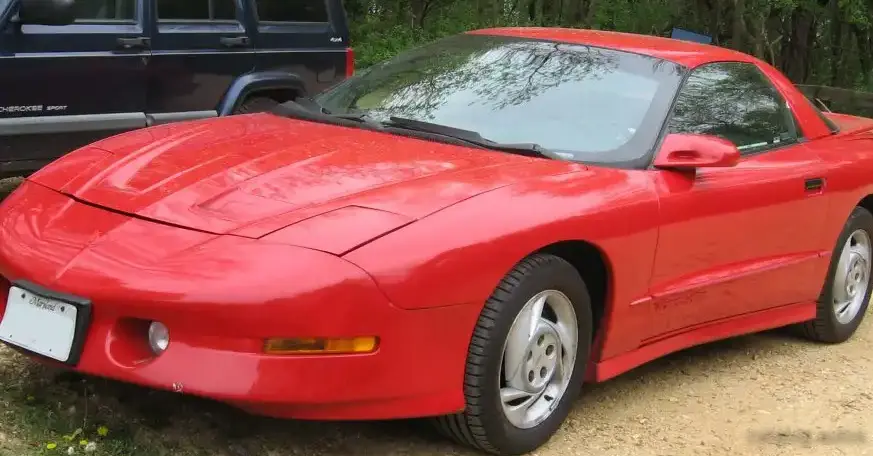
The Pontiac Firebird IV 3.8i V6 Automatic, produced from 1995 to 2002, represented a significant iteration of the iconic Firebird sports car. Falling within the fourth generation (1993-2002) of the Firebird, this variant occupied a middle-ground position in the lineup, offering a balance between performance and affordability. It served as a step up from the base V6 models, while remaining more accessible than the flagship Firebird Formula or Trans Am equipped with the more potent V8 engines. The 3.8i V6 Automatic aimed to provide a comfortable and capable driving experience for a broader range of buyers, appealing to those seeking a stylish and sporty coupe without the higher price tag or aggressive nature of its V8 siblings.
Technical Specifications
| Brand | Pontiac |
| Model | Firebird |
| Generation | Firebird IV |
| Type (Engine) | 3.8i V6 (208 Hp) Automatic |
| Start of production | 1995 |
| End of production | 2002 |
| Powertrain Architecture | Internal Combustion engine |
| Body type | Coupe |
| Seats | 5 |
| Doors | 3 |
| Fuel consumption (combined) | 10.3 l/100 km (22.8 US mpg, 27.4 UK mpg, 9.7 km/l) |
| Fuel Type | Petrol (Gasoline) |
| Weight-to-power ratio | 7.1 kg/Hp, 141.7 Hp/tonne |
| Weight-to-torque ratio | 4.7 kg/Nm, 212.5 Nm/tonne |
| Power | 208 Hp @ 5200 rpm |
| Power per litre | 54.9 Hp/l |
| Torque | 312 Nm @ 4000 rpm (230.12 lb.-ft. @ 4000 rpm) |
| Engine layout | Front, Longitudinal |
| Engine Model/Code | L36 |
| Engine displacement | 3791 cm3 (231.34 cu. in.) |
| Number of cylinders | 6 |
| Engine configuration | V-engine |
| Cylinder Bore | 96.5 mm (3.8 in.) |
| Piston Stroke | 86.4 mm (3.4 in.) |
| Compression ratio | 9.4:1 |
| Number of valves per cylinder | 2 |
| Fuel injection system | Multi-port manifold injection |
| Engine aspiration | Naturally aspirated engine |
| Engine oil capacity | 4.3 l (4.54 US qt | 3.78 UK qt) |
| Coolant | 11.6 l (12.26 US qt | 10.21 UK qt) |
| Kerb Weight | 1468 kg (3236.39 lbs.) |
| Trunk (boot) space – minimum | 366 l (12.93 cu. ft.) |
| Fuel tank capacity | 59 l (15.59 US gal | 12.98 UK gal) |
| Length | 4968 mm (195.59 in.) |
| Width | 1893 mm (74.53 in.) |
| Height | 1321 mm (52.01 in.) |
| Wheelbase | 2566 mm (101.02 in.) |
| Front track | 1542 mm (60.71 in.) |
| Rear (Back) track | 1540 mm (60.63 in.) |
| Drivetrain Architecture | Rear wheel drive |
| Number of gears and type of gearbox | 4 gears, automatic transmission |
| Front suspension | Double wishbone |
| Rear suspension | Coil spring |
| Front brakes | Ventilated discs |
| Rear brakes | Disc |
| Assisting systems | ABS (Anti-lock braking system) |
| Steering type | Steering rack and pinion |
| Power steering | Hydraulic Steering |
| Tires size | 215/60 R16 S |
| Wheel rims size | 16 |
Powertrain & Engine Architecture
The heart of the Firebird IV 3.8i V6 Automatic is the 3.8-liter (3791 cc) L36 V6 engine. This engine, a member of the GM 3800 series, is a 60-degree V-engine known for its durability and relatively smooth operation. The L36 featured a cast iron block with aluminum cylinder heads, and utilized a multi-port fuel injection system for precise fuel delivery. The engine produced 208 horsepower at 5200 rpm and 230 lb-ft of torque at 4000 rpm. The 9.4:1 compression ratio contributed to a good balance of power and efficiency. The engine was longitudinally mounted in the front of the vehicle, driving the rear wheels. Paired with the L36 was a 4-speed automatic transmission, a 4T60E, which was chosen for its smooth shifting and ease of use. This transmission was a common choice for GM vehicles of the era and was known for its reliability when properly maintained.
Driving Characteristics
The 3.8i V6 Automatic Firebird offered a comfortable and refined driving experience. While not as overtly sporty as the V8-powered models, the V6 provided adequate power for everyday driving and even some spirited acceleration. The automatic transmission, while not offering the driver engagement of a manual, provided smooth and predictable shifts. The 4T60E transmission’s gear ratios were tuned for a balance of acceleration and fuel economy. The car felt relatively planted on the road, thanks to its well-tuned suspension. Compared to the manual transmission versions of the 3.8L, the automatic sacrificed some responsiveness, but gained in ease of use, particularly in city traffic. Against the higher-output V8 models, the 3.8i V6 Automatic was noticeably slower in acceleration and lacked the aggressive exhaust note, but it offered a more fuel-efficient and affordable alternative.
Equipment & Trim Levels
The Firebird IV 3.8i V6 Automatic typically came standard with features such as air conditioning, power windows and locks, a CD player, and cloth upholstery. Optional extras included leather seats, a sunroof, upgraded sound systems, and various cosmetic enhancements. The interior design was driver-focused, with a wraparound dashboard and comfortable bucket seats. The trim level often dictated the level of standard equipment, with higher trims offering more luxurious features. The base model offered a functional and comfortable interior, while optional packages could elevate the experience with premium materials and additional convenience features.
Chassis & Braking
The Firebird IV utilized a double wishbone suspension in the front and a coil spring suspension in the rear. This setup provided a good balance of ride comfort and handling. The car featured ventilated disc brakes in the front and solid disc brakes in the rear. An Anti-lock Braking System (ABS) was standard, enhancing safety by preventing wheel lockup during hard braking. The steering was rack and pinion, providing precise and responsive steering feel. The standard tire size was 215/60 R16, mounted on 16-inch wheels. The chassis was designed to be relatively lightweight, contributing to the car’s agility.
Market Reception & Comparison
The Firebird IV 3.8i V6 Automatic was generally well-received by critics as a capable and affordable sports coupe. It was praised for its comfortable ride, smooth engine, and user-friendly automatic transmission. However, some reviewers noted that it lacked the raw performance of the V8 models. Fuel economy was considered reasonable for a sports car of its era, averaging around 22.8 US mpg in combined driving. Compared to other V6-powered coupes of the time, such as the Ford Mustang and Chevrolet Camaro, the Firebird offered a more refined interior and a slightly more sophisticated driving experience. Reliability was generally good, with the L36 engine proving to be a durable and long-lasting powerplant.
Legacy
The Pontiac Firebird IV 3.8i V6 Automatic remains a popular choice among enthusiasts today. The L36 V6 engine is known for its reliability and relatively low maintenance costs. Parts availability is generally good, and the car is relatively easy to work on. While not as highly sought after as the V8 models, the 3.8i V6 Automatic offers a compelling combination of style, comfort, and affordability. It represents a significant chapter in the Firebird’s history, offering a more accessible entry point into the world of Pontiac’s iconic sports car. Well-maintained examples continue to be enjoyed by enthusiasts and collectors alike, serving as a reminder of a bygone era of American automotive design and engineering.