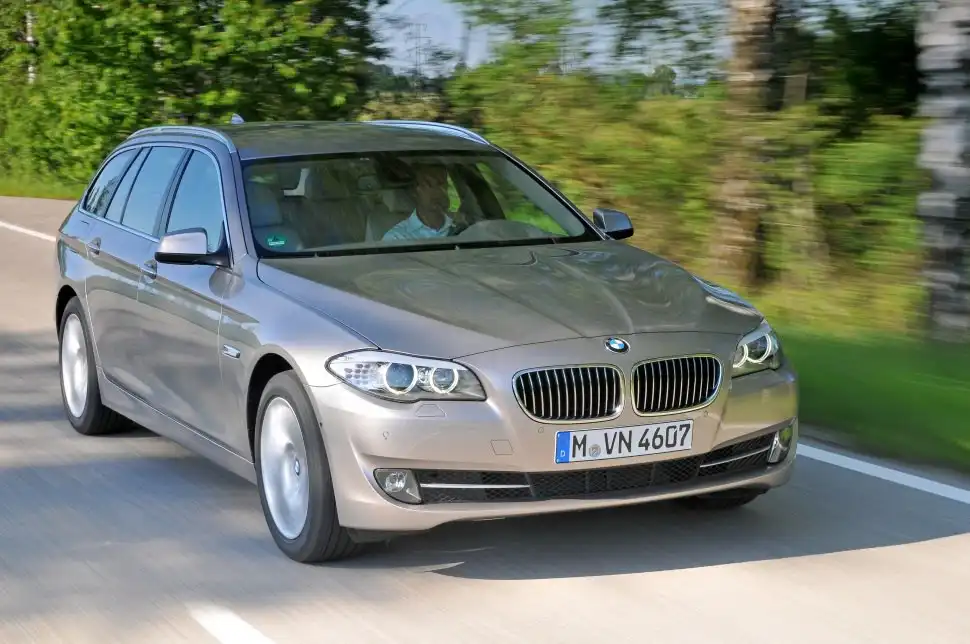
The BMW 5 Series Touring (F11) 520i, produced from 2011 to 2013, represents BMW’s entry point into the premium, mid-size wagon segment. Positioned as the base engine option within the F11 5 Series Touring range, it offered a balance of practicality, efficiency, and the BMW driving experience. This variant was primarily aimed at buyers seeking a spacious, comfortable, and relatively economical vehicle for family use, without sacrificing the prestige associated with the BMW brand. It sat below the more powerful 528i, 535i, and diesel-powered 525d/530d models in the lineup.
Technical Specifications
| Brand | BMW |
| Model | 5 Series |
| Generation | 5 Series Touring (F11) |
| Type (Engine) | 520i (184 Hp) |
| Start of production | 2011 |
| End of production | 2013 |
| Powertrain Architecture | Internal Combustion engine |
| Body type | Station wagon (estate) |
| Seats | 5 |
| Doors | 5 |
| Fuel consumption (urban) | 9.2-9.6 l/100 km (25.6 – 24.5 US mpg) |
| Fuel consumption (extra urban) | 5.7-6.0 l/100 km (41.3 – 39.2 US mpg) |
| Fuel consumption (combined) | 7.0-7.3 l/100 km (33.6 – 32.2 US mpg) |
| CO2 emissions | 163-170 g/km |
| Fuel Type | Petrol (Gasoline) |
| Acceleration 0 – 100 km/h | 8.3 sec |
| Acceleration 0 – 62 mph | 8.3 sec |
| Acceleration 0 – 60 mph | 7.9 sec |
| Maximum speed | 220 km/h (136.7 mph) |
| Emission standard | Euro 5 |
| Weight-to-power ratio | 9.3 kg/Hp, 107.9 Hp/tonne |
| Weight-to-torque ratio | 6.3 kg/Nm, 158.4 Nm/tonne |
| Power | 184 Hp @ 5000-6250 rpm |
| Power per litre | 92.1 Hp/l |
| Torque | 270 Nm @ 1250-4500 rpm (199.14 lb.-ft. @ 1250-4500 rpm) |
| Engine layout | Front, Longitudinal |
| Engine Model/Code | N20B20B |
| Engine displacement | 1997 cm3 (121.86 cu. in.) |
| Number of cylinders | 4 |
| Engine configuration | Inline |
| Cylinder Bore | 84 mm (3.31 in.) |
| Piston Stroke | 90.1 mm (3.55 in.) |
| Compression ratio | 11:1 |
| Number of valves per cylinder | 4 |
| Fuel injection system | Direct injection |
| Engine aspiration | Twin-power turbo, Intercooler |
| Engine oil capacity | 5 l (5.28 US qt | 4.4 UK qt) |
| Coolant | 9.1 l (9.62 US qt | 8.01 UK qt) |
| Kerb Weight | 1705 kg (3758.88 lbs.) |
| Max. weight | 2345 kg (5169.84 lbs.) |
| Max load | 640 kg (1410.96 lbs.) |
| Trunk (boot) space – minimum | 560 l (19.78 cu. ft.) |
| Trunk (boot) space – maximum | 1670 l (58.98 cu. ft.) |
| Fuel tank capacity | 70 l (18.49 US gal | 15.4 UK gal) |
| Max. roof load | 100 kg (220.46 lbs.) |
| Permitted trailer load with brakes (12%) | 1900 kg (4188.78 lbs.) |
| Permitted trailer load without brakes | 750 kg (1653.47 lbs.) |
| Permitted towbar download | 90 kg (198.42 lbs.) |
| Length | 4907 mm (193.19 in.) |
| Width | 1860 mm (73.23 in.) |
| Height | 1462 mm (57.56 in.) |
| Wheelbase | 2968 mm (116.85 in.) |
| Front track | 1600 mm (62.99 in.) |
| Rear (Back) track | 1626 mm (64.02 in.) |
| Ride height (ground clearance) | 141 mm (5.55 in.) |
| Drag coefficient (Cd) | 0.32 |
| Minimum turning circle (turning diameter) | 11.95 m (39.21 ft.) |
| Drivetrain Architecture | The Internal combustion engine (ICE) drives the rear wheels of the vehicle. |
| Drive wheel | Rear wheel drive |
| Number of gears and type of gearbox | 6 gears, manual transmission |
| Front suspension | Double wishbone |
| Rear suspension | Independent multi-link suspension |
| Front brakes | Ventilated discs |
| Rear brakes | Ventilated discs |
| Assisting systems | ABS (Anti-lock braking system) |
| Steering type | Steering rack and pinion |
| Power steering | Electric Steering |
| Tires size | 225/55 R17; 245/45 R18; 245/40 R19 |
| Wheel rims size | 8J x 17; 8J x 18; 8.5J x 19 |
Powertrain & Engine Architecture
The 520i Touring was powered by the BMW N20B20B 2.0-liter inline-four cylinder engine. This engine was a key component of BMW’s new generation of modular engines, characterized by its direct fuel injection, a single twin-scroll turbocharger, and variable valve timing (VANOS) and valve lift (Valvetronic) technologies. These features combined to deliver a good balance of power and efficiency. The N20 engine produced 184 horsepower at 5,000-6,250 rpm and 270 Nm (199 lb-ft) of torque between 1,250 and 4,500 rpm. The engine’s turbocharger provided boost from low engine speeds, minimizing turbo lag and providing responsive acceleration. The 520i was typically equipped with a six-speed manual transmission, although an optional eight-speed automatic transmission was also available. The automatic transmission offered smoother shifts and improved fuel economy, but at the expense of some driver engagement.
Driving Characteristics
The 520i Touring, with its 184 hp and relatively modest torque output, offered a comfortable and refined driving experience. Acceleration from 0 to 60 mph took around 7.9 seconds, which was adequate for everyday driving but not particularly sporty. The engine felt responsive in most situations, thanks to the turbocharger, but lacked the outright punch of the larger six-cylinder engines offered in the 5 Series range. The manual transmission provided a more engaging driving experience, allowing drivers to fully control the engine’s power delivery. The automatic transmission, while smooth, could sometimes feel hesitant during quick maneuvers. The F11’s suspension provided a comfortable ride, absorbing bumps and imperfections in the road with ease. However, the car’s weight and relatively soft suspension setup meant that it wasn’t as agile or engaging to drive as some of its competitors.
Equipment & Trim Levels
The 520i Touring typically came standard with a comprehensive list of features, including leather upholstery, automatic climate control, a multi-function steering wheel, and a BMW Professional radio system. Optional extras included navigation, a premium sound system, heated seats, and a sunroof. The interior was well-appointed and offered a high level of comfort and refinement. The dashboard layout was clean and intuitive, with all controls within easy reach of the driver. The rear seats were spacious and comfortable, providing ample legroom and headroom for passengers. The wagon body style offered a generous amount of cargo space, making the 520i Touring a practical choice for families.
Chassis & Braking
The F11 5 Series Touring featured a double wishbone front suspension and an independent multi-link rear suspension. This suspension setup provided a comfortable ride and good handling characteristics. The 520i Touring was equipped with ventilated disc brakes on all four wheels, providing ample stopping power. Anti-lock braking system (ABS) and electronic stability control (ESC) were standard features, enhancing safety and stability. The steering was precise and well-weighted, providing good feedback to the driver. The car’s weight distribution was well-balanced, contributing to its neutral handling characteristics.
Market Reception & Comparison
The 520i Touring was generally well-received by critics, who praised its comfortable ride, spacious interior, and fuel efficiency. However, some critics noted that the engine lacked the power and refinement of the larger engines offered in the 5 Series range. Compared to the 528i and 535i models, the 520i offered a more affordable entry point into the 5 Series lineup, but at the expense of performance. The 520d diesel model offered similar fuel economy but with more torque and a slightly higher price tag. The 520i’s main competitors included the Audi A6 Avant and the Mercedes-Benz E-Class Estate.
Legacy
The N20 engine, used in the 520i Touring, proved to be a reliable and durable powerplant, although some early models experienced issues with the timing chain tensioner. Regular maintenance and timely oil changes are crucial for ensuring the long-term reliability of this engine. Today, the F11 520i Touring represents a good value proposition in the used car market, offering a spacious, comfortable, and relatively economical wagon with the prestige of the BMW brand. Its blend of practicality and driving enjoyment continues to appeal to buyers seeking a versatile and refined vehicle.