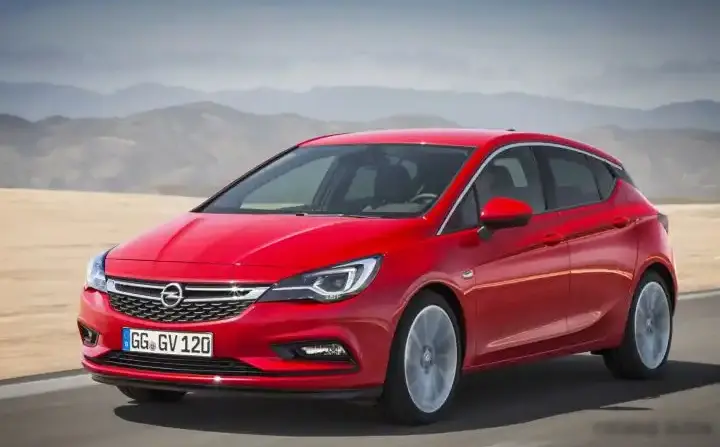
The Opel Astra K 1.6 Turbo, producing 200 horsepower, was a performance-oriented variant of the Astra K generation, manufactured from 2018 through July 2019. Positioned as a mid-to-upper trim level within the Astra K lineup, it offered a significant power upgrade over the base engine options, appealing to drivers seeking a more engaging driving experience. This model played a key role in modernizing the Astra’s image, showcasing Opel’s advancements in turbocharged engine technology and offering a competitive alternative to rivals like the Volkswagen Golf and Ford Focus in the European market.
Technical Specifications
| Brand | Opel |
| Model | Astra |
| Generation | Astra K |
| Type (Engine) | 1.6 Turbo (200 Hp) |
| Start of production | 2018 |
| End of production | July, 2019 |
| Powertrain Architecture | Internal Combustion engine |
| Body type | Hatchback |
| Seats | 5 |
| Doors | 5 |
| Fuel consumption (urban) | 8.5 l/100 km (27.7 US mpg, 33.2 UK mpg, 11.8 km/l) |
| Fuel consumption (extra urban) | 5.1-5.5 l/100 km (46.1 – 42.8 US mpg, 55.4 – 51.4 UK mpg, 19.6 – 18.2 km/l) |
| Fuel consumption (combined) | 6.3-6.6 l/100 km (37.3 – 35.6 US mpg, 44.8 – 42.8 UK mpg, 15.9 – 15.2 km/l) |
| CO2 emissions | 144-151 g/km |
| Fuel Type | Petrol (Gasoline) |
| Acceleration 0 – 100 km/h | 7.8 sec |
| Acceleration 0 – 62 mph | 7.8 sec |
| Acceleration 0 – 60 mph | 7.4 sec |
| Maximum speed | 235 km/h (146.02 mph) |
| Emission standard | Euro 6d-Temp |
| Weight-to-power ratio | 6.4 kg/Hp, 156.9 Hp/tonne |
| Weight-to-torque ratio | 4.3 kg/Nm, 235.3 Nm/tonne |
| Power | 200 Hp @ 5500 rpm |
| Power per litre | 125.2 Hp/l |
| Torque | 300 Nm @ 1650-4500 rpm (221.27 lb.-ft. @ 1650-4500 rpm) |
| Engine layout | Front, Transverse |
| Engine Model/Code | D16SHT |
| Engine displacement | 1598 cm3 (97.52 cu. in.) |
| Number of cylinders | 4 |
| Engine configuration | Inline |
| Cylinder Bore | 79 mm (3.11 in.) |
| Piston Stroke | 81.5 mm (3.21 in.) |
| Compression ratio | 9.5:1 |
| Number of valves per cylinder | 4 |
| Fuel injection system | Direct injection |
| Engine aspiration | Turbocharger, Intercooler |
| Engine oil capacity | 5.5 l (5.81 US qt | 4.84 UK qt) |
| Coolant | 5.9 l (6.23 US qt | 5.19 UK qt) |
| Kerb Weight | 1275 kg (2810.89 lbs.) |
| Max. weight | 1880 kg (4144.69 lbs.) |
| Max load | 605 kg (1333.8 lbs.) |
| Trunk (boot) space – minimum | 370 l (13.07 cu. ft.) |
| Trunk (boot) space – maximum | 1210 l (42.73 cu. ft.) |
| Fuel tank capacity | 48 l (12.68 US gal | 10.56 UK gal) |
| Max. roof load | 75 kg (165.35 lbs.) |
| Permitted trailer load with brakes (12%) | 1700 kg (3747.86 lbs.) |
| Permitted trailer load without brakes | 650 kg (1433 lbs.) |
| Length | 4370 mm (172.05 in.) |
| Width | 1809 mm (71.22 in.) |
| Width with mirrors folded | 1871 mm (73.66 in.) |
| Width including mirrors | 2042 mm (80.39 in.) |
| Height | 1485 mm (58.46 in.) |
| Wheelbase | 2662 mm (104.8 in.) |
| Front track | 1544 mm (60.79 in.) |
| Rear (Back) track | 1558 mm (61.34 in.) |
| Minimum turning circle | 11.05 m (36.25 ft.) |
| Drivetrain Architecture | The Internal combustion engine (ICE) drives the front wheels of the vehicle. |
| Drive wheel | Front wheel drive |
| Number of gears and type of gearbox | 6 gears, manual transmission |
| Front brakes | Disc |
| Rear brakes | Disc |
| Assisting systems | ABS (Anti-lock braking system) |
| Steering type | Steering rack and pinion |
| Power steering | Electric Steering |
| Tires size | 205/55 R16; 225/40 R18 |
| Wheel rims size | 7J x 16; 7.5J x 18 |
INTRODUCTION
The Opel Astra K 1.6 Turbo (200 hp) represented a significant step up in performance for the Astra K range, launched in 2015. Built on the General Motors’ 1HX0/A3 platform, this variant was introduced in 2018 and continued through July 2019. It aimed to attract buyers who desired a more spirited driving experience without sacrificing the practicality and fuel efficiency expected of a compact hatchback. The 1.6 Turbo engine was a key component of Opel’s strategy to offer a wider range of powertrain options, catering to diverse customer preferences. It was primarily sold in European markets, where compact hatchbacks are exceptionally popular.
Powertrain & Engine Architecture
At the heart of the Astra K 1.6 Turbo lies the D16SHT engine, a 1.6-liter inline-four cylinder gasoline engine equipped with direct fuel injection and a turbocharger. This engine utilizes a sophisticated direct injection system, delivering fuel directly into the combustion chamber for improved efficiency and power output. The engine’s valvetrain features four valves per cylinder, optimizing airflow for enhanced performance. The turbocharger, coupled with an intercooler, forces more air into the engine, boosting horsepower and torque. The engine produces 200 hp at 5500 rpm and 300 Nm (221 lb-ft) of torque between 1650 and 4500 rpm. The engine was typically paired with a six-speed manual transmission, although an optional six-speed automatic transmission was also available. The automatic transmission was designed to provide smooth and efficient gear changes, complementing the engine’s power delivery.
Driving Characteristics
The Astra K 1.6 Turbo offered a noticeable improvement in driving dynamics compared to lower-powered Astra K models. The 200 hp output and 300 Nm of torque provided brisk acceleration, with a 0-60 mph time of around 7.4 seconds. The turbocharger’s boost was readily available from relatively low engine speeds, resulting in strong mid-range acceleration. The six-speed manual transmission allowed for precise gear selection, while the optional automatic transmission offered convenience in urban driving. Compared to the base 1.0-liter three-cylinder engine, the 1.6 Turbo provided a more refined and responsive driving experience. While not as sporty as the Opel Astra OPC (Vauxhall VXR), it offered a compelling balance of performance and practicality. The suspension was tuned to provide a comfortable ride while maintaining good handling characteristics.
Equipment & Trim Levels
The 1.6 Turbo trim typically included a generous level of standard equipment. This often included features such as air conditioning, a touchscreen infotainment system with Apple CarPlay and Android Auto compatibility, Bluetooth connectivity, and a suite of safety features like automatic emergency braking and lane departure warning. Higher trim levels offered additional features such as leather upholstery, heated front seats, a panoramic sunroof, and advanced driver-assistance systems like adaptive cruise control. Interior upholstery was typically cloth on the base trims, with leather options available on higher-spec models. The dashboard layout was modern and ergonomically designed, with a focus on ease of use.
Chassis & Braking
The Astra K 1.6 Turbo utilized a MacPherson strut front suspension and a torsion beam rear suspension. This setup provided a good balance of ride comfort and handling. The braking system consisted of disc brakes on all four wheels, providing ample stopping power. Anti-lock Braking System (ABS) and Electronic Stability Control (ESC) were standard features, enhancing safety and control. The steering was electrically assisted, offering a light and precise feel. The chassis was designed to be relatively lightweight, contributing to the car’s agility and fuel efficiency.
Market Reception & Comparison
The Astra K 1.6 Turbo was generally well-received by automotive critics. It was praised for its responsive engine, comfortable ride, and generous equipment levels. Compared to rivals like the Volkswagen Golf 1.4 TSI and the Ford Focus 1.5 EcoBoost, the Astra K 1.6 Turbo offered a competitive combination of performance, fuel economy, and value. Fuel economy figures were typically around 37.3-35.6 US mpg combined, making it a relatively efficient performer in its class. Reliability reports were generally positive, with few major issues reported. However, some owners noted occasional issues with the turbocharger and direct injection system, which are common concerns with modern turbocharged engines.
Legacy
The Opel Astra K 1.6 Turbo remains a popular choice in the used car market. Its combination of performance, practicality, and affordability makes it an attractive option for buyers seeking a well-rounded compact hatchback. The D16SHT engine, while requiring regular maintenance, is generally considered to be a reliable unit when properly cared for. The Astra K generation as a whole helped to revitalize the Astra’s image, establishing it as a strong contender in the competitive European compact car segment. The 1.6 Turbo variant, in particular, demonstrated Opel’s ability to deliver engaging driving experiences without compromising on efficiency or practicality.