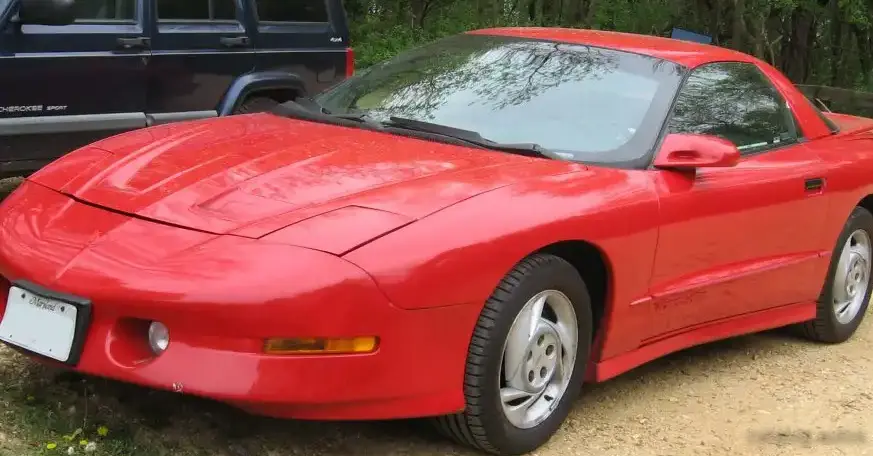
The Pontiac Firebird IV 5.7i V8, produced from 2000 to 2002, represented the final iteration of the fourth-generation Firebird (1993-2002). Positioned as the performance flagship of the Firebird lineup, it offered the most powerful engine option available. The Firebird IV, built on the F-body platform shared with the Chevrolet Camaro, aimed to deliver a blend of American muscle car heritage and modern technology. This particular 5.7i variant, equipped with the LS1 V8 engine, was a direct competitor to the Ford Mustang GT and Chevrolet Camaro SS, targeting enthusiasts seeking high horsepower and rear-wheel drive performance.
Technical Specifications
| Brand | Pontiac |
| Model | Firebird |
| Generation | Firebird IV |
| Type (Engine) | 5.7i V8 (329 Hp) |
| Start of production | 2000 year |
| End of production | 2002 year |
| Powertrain Architecture | Internal Combustion engine |
| Body type | Coupe |
| Seats | 4 |
| Doors | 3 |
| Fuel consumption (economy) – urban | 12.4 l/100 km (19 US mpg) |
| Fuel consumption (economy) – extra urban | 8.4 l/100 km (28 US mpg) |
| Fuel consumption (economy) – combined | 10.7 l/100 km (22 US mpg) |
| Fuel Type | Petrol (Gasoline) |
| Acceleration 0 – 100 km/h | 6 sec |
| Acceleration 0 – 62 mph | 6 sec |
| Acceleration 0 – 60 mph | 5.7 sec |
| Maximum speed | 250 km/h (155.34 mph) |
| Weight-to-power ratio | 4.8 kg/Hp |
| Weight-to-torque ratio | 3.3 kg/Nm |
| Power | 329 Hp @ 5200 rpm |
| Power per litre | 58.1 Hp/l |
| Torque | 475 Nm @ 4400 rpm (350.34 lb.-ft. @ 4400 rpm) |
| Engine layout | Front, Longitudinal |
| Engine Model/Code | LS1 |
| Engine displacement | 5665 cm3 (345.7 cu. in.) |
| Number of cylinders | 8 |
| Engine configuration | V-engine |
| Cylinder Bore | 99 mm (3.9 in.) |
| Piston Stroke | 92 mm (3.62 in.) |
| Compression ratio | 10.1:1 |
| Number of valves per cylinder | 2 |
| Fuel injection system | Multi-port manifold injection |
| Engine aspiration | Naturally aspirated engine |
| Engine oil capacity | 5.2 l (5.49 US qt | 4.58 UK qt) |
| Coolant | 11.3 l (11.94 US qt | 9.94 UK qt) |
| Kerb Weight | 1585 kg (3494.33 lbs.) |
| Trunk (boot) space – minimum | 365 l (12.89 cu. ft.) |
| Trunk (boot) space – maximum | 955 l (33.73 cu. ft.) |
| Fuel tank capacity | 59 l (15.59 US gal | 12.98 UK gal) |
| Length | 4910 mm (193.31 in.) |
| Width | 1890 mm (74.41 in.) |
| Height | 1320 mm (51.97 in.) |
| Wheelbase | 2570 mm (101.18 in.) |
| Front track | 1540 mm (60.63 in.) |
| Rear (Back) track | 1540 mm (60.63 in.) |
| Drivetrain Architecture | Rear wheel drive |
| Number of gears and type of gearbox | 6 gears, manual transmission |
| Front suspension | Double wishbone |
| Rear suspension | Coil spring |
| Front brakes | Ventilated discs |
| Rear brakes | Ventilated discs |
| Assisting systems | ABS (Anti-lock braking system) |
| Steering type | Steering rack and pinion |
| Power steering | Hydraulic Steering |
| Tires size | 235/55 R16 |
Powertrain & Engine Architecture
The heart of the Firebird IV 5.7i was the LS1 small-block V8 engine. This 5.7-liter (346 cubic inch) engine was a significant upgrade over previous Firebird engines, utilizing aluminum cylinder heads and a cast iron block. The LS1 featured a Gen III small-block architecture, known for its robust design and potential for performance modifications. It employed multi-port fuel injection and a two-valve per cylinder configuration. The engine produced 329 horsepower at 5200 rpm and 350 lb-ft of torque at 4400 rpm. The standard transmission for this model was a six-speed manual, contributing to its sporty character. The engine’s longitudinal mounting and rear-wheel drive configuration were hallmarks of traditional American muscle cars.
Driving Characteristics
The 5.7i Firebird offered a distinctly different driving experience compared to lower-trim models. The LS1 engine delivered strong acceleration, achieving 0-60 mph in approximately 5.7 seconds. The six-speed manual transmission allowed for precise control and maximized power delivery. While not as refined as some contemporary sports cars, the Firebird IV provided a raw, visceral driving experience. The rear-wheel drive setup offered good balance, but required driver awareness, especially in inclement weather. The suspension, while tuned for performance, still provided a reasonably comfortable ride for daily driving.
Equipment & Trim Levels
The 5.7i trim was the top-of-the-line Firebird, and included a number of standard features. These typically included leather upholstery, air conditioning, power windows and locks, a premium sound system, and alloy wheels. Optional extras included a T-top roof, upgraded audio systems, and various cosmetic enhancements. The interior design featured a driver-focused cockpit with analog gauges and a sporty steering wheel. The Firebird IV’s interior, while functional, was not as luxurious as some competitors.
Chassis & Braking
The Firebird IV utilized a unibody construction for rigidity. The front suspension consisted of a double wishbone setup, while the rear featured a coil-spring arrangement. Both the front and rear brakes were ventilated discs, providing adequate stopping power for the car’s performance capabilities. Anti-lock brakes (ABS) were standard. The chassis was designed to handle the increased power of the LS1 engine, offering a relatively stable and predictable ride. The standard tire size was 235/55 R16, providing a good balance of grip and ride comfort.
Market Reception & Comparison
The Firebird IV 5.7i was generally well-received by automotive critics, who praised its powerful engine and engaging driving dynamics. However, it faced stiff competition from the Ford Mustang GT and Chevrolet Camaro SS. Compared to the Mustang, the Firebird offered a slightly more refined ride and handling, but the Mustang often had a stronger brand image. Against the Camaro SS, the Firebird was often seen as the more stylish option. Fuel economy, at 19 mpg city and 28 mpg highway, was typical for a V8-powered sports car of that era. Reliability was generally good, although the LS1 engine could be susceptible to oil leaks over time.
Legacy
The Pontiac Firebird IV 5.7i represents the final chapter in the Firebird’s long history. The LS1 engine proved to be a durable and highly regarded powerplant, and continues to be popular among enthusiasts for performance upgrades and swaps. Today, the Firebird IV 5.7i is a sought-after collectible, particularly among those who appreciate classic American muscle cars. Well-maintained examples command a premium in the used car market. The combination of its powerful engine, sporty handling, and iconic styling ensures that the Firebird IV 5.7i will remain a memorable and desirable vehicle for years to come.