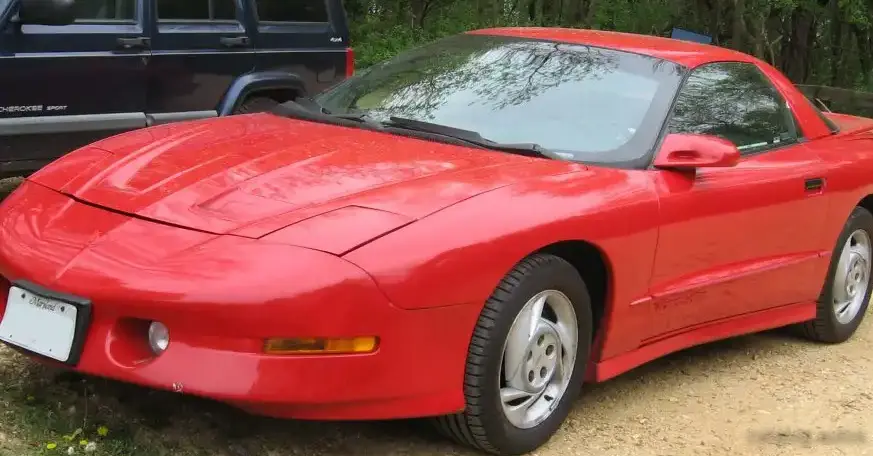
The Pontiac Firebird IV 5.7i V8 Automatic, produced between 2000 and 2002, represented the final iteration of Pontiac’s iconic pony car. Positioned as the performance flagship of the fourth-generation Firebird (1993-2002), this variant offered a substantial power upgrade over the base V6 models and the intermediate 3.8L V6. It was a direct competitor to the Ford Mustang GT and Chevrolet Camaro SS, aiming for enthusiasts seeking a powerful, rear-wheel-drive American coupe. The Firebird IV, built on the F-body platform shared with the Chevrolet Camaro, marked the end of an era for Pontiac, as the Firebird line was discontinued alongside its Camaro sibling in 2002.
Technical Specifications
| Brand | Pontiac |
| Model | Firebird |
| Generation | Firebird IV |
| Type (Engine) | 5.7i V8 (329 Hp) Automatic |
| Start of production | 2000 |
| End of production | 2002 |
| Powertrain Architecture | Internal Combustion engine |
| Body type | Coupe |
| Seats | 4 |
| Doors | 3 |
| Fuel consumption (urban) | 13.1 l/100 km (18 US mpg, 21.6 UK mpg, 7.6 km/l) |
| Fuel consumption (extra urban) | 9.1 l/100 km (25.8 US mpg, 31 UK mpg, 11 km/l) |
| Fuel consumption (combined) | 11.2 l/100 km (21 US mpg, 25.2 UK mpg, 8.9 km/l) |
| Fuel Type | Petrol (Gasoline) |
| Acceleration 0 – 100 km/h | 6 sec |
| Acceleration 0 – 62 mph | 6 sec |
| Acceleration 0 – 60 mph | 5.7 sec |
| Maximum speed | 250 km/h (155.34 mph) |
| Weight-to-power ratio | 4.8 kg/Hp, 207.6 Hp/tonne |
| Weight-to-torque ratio | 3.3 kg/Nm, 299.7 Nm/tonne |
| Power | 329 Hp @ 5200 rpm |
| Power per litre | 58.1 Hp/l |
| Torque | 475 Nm @ 4400 rpm (350.34 lb.-ft. @ 4400 rpm) |
| Engine layout | Front, Longitudinal |
| Engine Model/Code | LS1 |
| Engine displacement | 5665 cm3 (345.7 cu. in.) |
| Number of cylinders | 8 |
| Engine configuration | V-engine |
| Cylinder Bore | 99 mm (3.9 in.) |
| Piston Stroke | 92 mm (3.62 in.) |
| Compression ratio | 10.1:1 |
| Number of valves per cylinder | 2 |
| Fuel injection system | Multi-port manifold injection |
| Engine aspiration | Naturally aspirated engine |
| Engine oil capacity | 5.2 l (5.49 US qt | 4.58 UK qt) |
| Coolant capacity | 11.2 l (11.83 US qt | 9.85 UK qt) |
| Kerb Weight | 1585 kg (3494.33 lbs.) |
| Trunk (boot) space – minimum | 365 l (12.89 cu. ft.) |
| Trunk (boot) space – maximum | 955 l (33.73 cu. ft.) |
| Fuel tank capacity | 59 l (15.59 US gal | 12.98 UK gal) |
| Length | 4910 mm (193.31 in.) |
| Width | 1890 mm (74.41 in.) |
| Height | 1320 mm (51.97 in.) |
| Wheelbase | 2570 mm (101.18 in.) |
| Front track | 1540 mm (60.63 in.) |
| Rear (Back) track | 1540 mm (60.63 in.) |
| Drivetrain Architecture | Rear wheel drive |
| Number of gears and type of gearbox | 4 gears, automatic transmission |
| Front suspension | Double wishbone |
| Rear suspension | Coil spring |
| Front brakes | Ventilated discs |
| Rear brakes | Ventilated discs |
| Assisting systems | ABS (Anti-lock braking system) |
| Steering type | Steering rack and pinion |
| Power steering | Hydraulic Steering |
| Tires size | 235/55 R16 |
| Wheel rims size | 16 |
INTRODUCTION
The 2000-2002 Pontiac Firebird IV 5.7i V8 Automatic was the pinnacle of performance for the fourth-generation Firebird. Built on the versatile F-body platform, it shared its underpinnings with the Chevrolet Camaro. The “5.7i” designation referred to the engine displacement and fuel injection system. This variant was positioned as the top-tier Firebird, offering a significant performance boost over the V6 models and appealing to drivers who prioritized power and a classic American muscle car experience. It represented a final attempt by Pontiac to maintain a presence in the performance coupe segment before the brand’s eventual demise.
Powertrain & Engine Architecture
The heart of the Firebird IV 5.7i was the LS1 5.7-liter (345.7 cubic inch) V8 engine. This engine, part of General Motors’ Small-Block family, was a significant upgrade from previous Firebird engines. It featured an aluminum block and cylinder heads, contributing to a relatively lightweight design. The LS1 utilized a multi-port fuel injection system, delivering precise fuel metering for optimal performance and efficiency. The engine boasted a 10.1:1 compression ratio and two valves per cylinder. The 4L60E four-speed automatic transmission was the sole transmission option for this model. This transmission was known for its durability and smooth shifting, although it wasn’t as performance-oriented as a manual transmission. The automatic transmission was calibrated to provide a balance between acceleration and drivability, with gear ratios optimized for both city and highway driving.
Driving Characteristics
The Firebird IV 5.7i Automatic delivered a potent driving experience. The 329 horsepower and 350 lb-ft of torque provided brisk acceleration, with 0-60 mph times consistently in the 5.7-second range. While a manual transmission would have likely shaved some time off those figures, the automatic offered a more accessible and comfortable driving experience for a wider range of drivers. The 4L60E transmission, while smooth, did exhibit some inherent torque converter slip, which slightly diminished the feeling of direct connection to the engine. The rear-wheel-drive configuration provided a classic muscle car feel, with ample traction and a tendency towards oversteer when pushed to its limits. The suspension, while tuned for comfort, offered reasonable handling characteristics, allowing for confident cornering.
Equipment & Trim Levels
The Firebird IV 5.7i came standard with a relatively well-equipped interior. Features included leather bucket seats, air conditioning, power windows and locks, and a premium sound system. Optional extras included a T-top roof, upgraded audio systems, and various cosmetic enhancements. The interior design was typical of early 2000s GM vehicles, with a focus on functionality and durability rather than luxury. The dashboard featured analog gauges, providing clear and concise information to the driver. The Firebird IV also included standard safety features such as anti-lock brakes (ABS).
Chassis & Braking
The Firebird IV utilized a traditional front-engine, rear-wheel-drive layout. The chassis featured a double wishbone suspension in the front and a coil spring suspension in the rear. Ventilated disc brakes were standard on all four wheels, providing adequate stopping power for the car’s weight and performance. ABS was included as a standard safety feature. The suspension was tuned to provide a balance between ride comfort and handling performance. While not a dedicated track car, the Firebird IV offered a reasonably composed ride, even on less-than-perfect road surfaces.
Market Reception & Comparison
The Firebird IV 5.7i was generally well-received by automotive critics, who praised its powerful engine and aggressive styling. However, some reviewers noted that the interior felt dated compared to some of its competitors. Compared to the V6-powered Firebirds, the 5.7i offered a substantial performance upgrade, but at a higher price point. Against rivals like the Ford Mustang GT and Chevrolet Camaro SS, the Firebird IV offered a comparable level of performance and features. Fuel economy, at 18 mpg city and 25 mpg highway, was typical for a V8-powered sports coupe of that era. Reliability was generally good, although the 4L60E transmission could be prone to issues if not properly maintained.
Legacy
The Pontiac Firebird IV 5.7i V8 Automatic represents the final chapter in the Firebird’s storied history. While the F-body platform itself was discontinued in 2002, the LS1 engine has become a popular choice for engine swaps and performance modifications. Today, the Firebird IV 5.7i is a sought-after collectible, particularly among enthusiasts who appreciate its classic American muscle car styling and potent V8 engine. Well-maintained examples command a premium in the used car market. The powertrain, while not without its quirks, has proven to be relatively durable and reliable, making it a viable option for those seeking a classic American performance car.