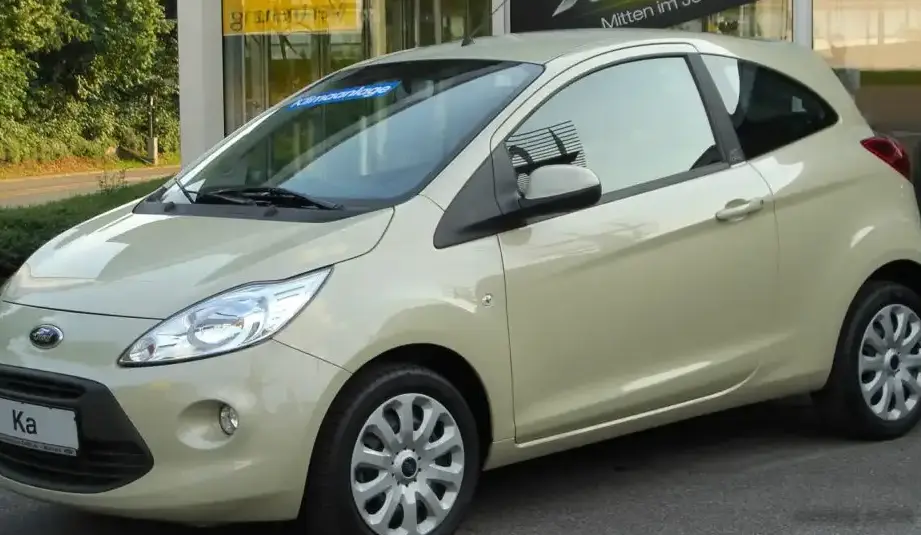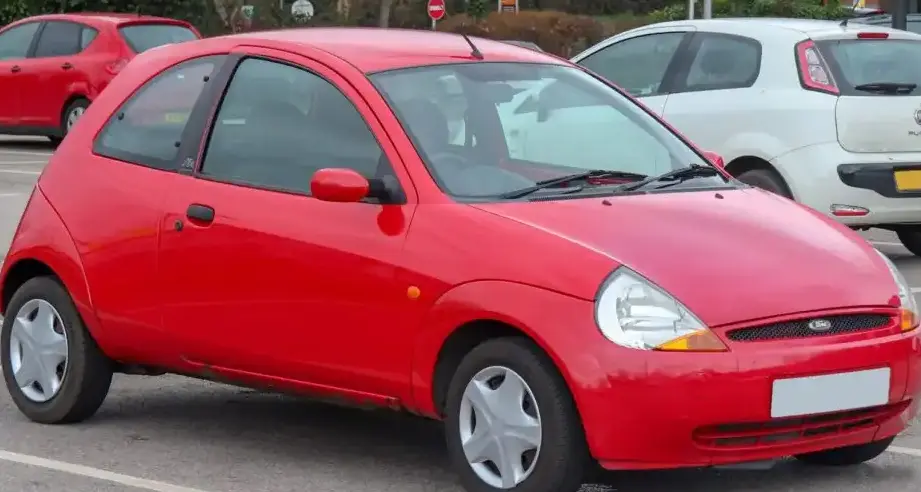
The Ford KA (RBT) 1.3i, producing 70 horsepower, was a key component of Ford’s entry-level offerings in the European market from 2002 to 2008. Positioned as an affordable and practical city car, the 1.3i variant served as the base model within the KA range, appealing to budget-conscious buyers and those seeking low running costs. It was built on Ford’s B platform, shared with the Fiesta, and represented Ford’s attempt to capture a larger share of the small car segment. This generation KA, internally designated RBT, was a significant departure from its predecessor, offering a more modern design and improved interior space.
Technical Specifications
| Brand | Ford |
| Model | KA |
| Generation | KA (RBT) |
| Type (Engine) | 1.3 i (70 Hp) |
| Start of production | 2002 |
| End of production | 2008 |
| Powertrain Architecture | Internal Combustion engine |
| Body type | Hatchback |
| Seats | 4 |
| Doors | 3 |
| Fuel consumption (urban) | 8.2 l/100 km (28.7 US mpg) |
| Fuel consumption (extra urban) | 4.7 l/100 km (50 US mpg) |
| Fuel Type | Petrol (Gasoline) |
| Acceleration 0 – 100 km/h | 14.1 sec |
| Acceleration 0 – 62 mph | 14.1 sec |
| Acceleration 0 – 60 mph | 13.4 sec |
| Maximum speed | 167 km/h (103.77 mph) |
| Weight-to-power ratio | 12.7 kg/Hp |
| Weight-to-torque ratio | 8.4 kg/Nm |
| Power | 70 Hp @ 5500 rpm |
| Power per litre | 53.9 Hp/l |
| Torque | 106 Nm @ 3000 rpm (78.18 lb.-ft. @ 3000 rpm) |
| Engine layout | Front, Transverse |
| Engine Model/Code | A9A, A9B |
| Engine displacement | 1299 cm3 (79.27 cu. in.) |
| Number of cylinders | 4 |
| Engine configuration | Inline |
| Cylinder Bore | 74 mm (2.91 in.) |
| Piston Stroke | 75.5 mm (2.97 in.) |
| Compression ratio | 10.2:1 |
| Number of valves per cylinder | 2 |
| Fuel injection system | Multi-port manifold injection |
| Engine aspiration | Naturally aspirated |
| Engine oil capacity | 4.1 l (4.33 US qt | 3.61 UK qt) |
| Coolant | 5.25 l (5.55 US qt | 4.62 UK qt) |
| Kerb Weight | 890 kg (1962.11 lbs.) |
| Max. weight | 1265 kg (2788.85 lbs.) |
| Max load | 375 kg (826.73 lbs.) |
| Trunk (boot) space – minimum | 186 l (6.57 cu. ft.) |
| Trunk (boot) space – maximum | 724 l (25.57 cu. ft.) |
| Fuel tank capacity | 42 l (11.1 US gal | 9.24 UK gal) |
| Length | 3620 mm (142.52 in.) |
| Width | 1639 mm (64.53 in.) |
| Height | 1383 mm (54.45 in.) |
| Wheelbase | 2448 mm (96.38 in.) |
| Front track | 1395 mm (54.92 in.) |
| Rear track | 1411 mm (55.55 in.) |
| Drivetrain Architecture | Front wheel drive |
| Number of gears | 5 |
| Gearbox type | Manual transmission |
| Front suspension | Spring Strut |
| Rear suspension | Coil spring |
| Front brakes | Disc |
| Rear brakes | Drum |
| Assisting systems | ABS (Anti-lock braking system) |
| Steering type | Steering rack and pinion |
| Tires size | 165/60 R14 |
Introduction
The Ford KA (RBT) 1.3i, produced between 2002 and 2008, was a significant model for Ford in Europe. Designed as a direct competitor to cars like the Fiat Panda and Renault Twingo, the KA aimed to provide affordable and practical transportation for urban drivers. The 1.3i engine, paired with a five-speed manual transmission, represented the entry point into the KA range. It was a deliberate choice to offer a low-cost option, focusing on fuel efficiency and ease of driving rather than outright performance. The RBT generation marked a substantial improvement over the first-generation KA, offering a more refined driving experience and a more spacious interior.
Powertrain & Engine Architecture
The heart of the KA 1.3i was the Ford A9A or A9B engine, an inline four-cylinder petrol engine displacing 1299cc. This engine, a member of Ford’s Duratec family, featured a single overhead camshaft (SOHC) valvetrain with two valves per cylinder. Fuel delivery was managed by a multi-port fuel injection system, providing adequate, though not exceptional, performance. The engine produced 70 horsepower at 5500 rpm and 106 Nm (78.18 lb-ft) of torque at 3000 rpm. The five-speed manual transmission was the standard offering, chosen for its simplicity and contribution to fuel economy. The transmission featured a relatively long final drive ratio, prioritizing fuel efficiency over rapid acceleration. The engine’s design emphasized reliability and low maintenance costs, making it a popular choice for first-time car buyers and those seeking a dependable city vehicle.
Driving Characteristics
The KA 1.3i offered a predictable and easy-to-drive experience. With 70 horsepower, acceleration was modest, taking approximately 14.1 seconds to reach 62 mph (100 km/h). However, the car’s light weight (around 890 kg or 1962 lbs) helped to mitigate the lack of power, making it feel reasonably nimble in urban environments. The long gearing of the five-speed manual transmission meant that the engine rarely felt strained at highway speeds, but overtaking required careful planning. Compared to higher-spec KA models with larger engines, the 1.3i lacked the punch for quick acceleration or spirited driving. The steering was light and responsive, making maneuvering in tight spaces effortless. The suspension, while basic, provided a comfortable ride on smooth roads, although it could become unsettled on rough surfaces.
Equipment & Trim Levels
The KA 1.3i was typically offered with a fairly basic level of equipment, reflecting its position as the entry-level model. Standard features generally included power steering, central locking, and a basic audio system. Interior upholstery was typically cloth, and the dashboard featured a simple, functional design. Optional extras included air conditioning, electric front windows, and alloy wheels. Higher trim levels, such as the Style or Zetec, added more features, but the 1.3i remained the most affordable and sparsely equipped variant. The focus was on providing essential features at a low price point.
Chassis & Braking
The KA 1.3i utilized a MacPherson strut front suspension and a coil spring rear suspension. This setup provided a reasonable balance between ride comfort and handling. The front brakes were disc brakes, while the rear brakes were drum brakes – a cost-saving measure common in this segment. Anti-lock Braking System (ABS) was standard, enhancing safety. The chassis was relatively lightweight, contributing to the car’s nimble handling. Stabilizer bars were fitted to both the front and rear axles, helping to reduce body roll during cornering. The suspension was tuned for comfort rather than outright performance, prioritizing a smooth ride over sharp handling.
Market Reception & Comparison
The Ford KA 1.3i was generally well-received by critics as an affordable and practical city car. Its low purchase price and excellent fuel economy were major selling points. However, some reviewers criticized its lack of power and basic interior. Compared to other trims in the KA lineup, such as the 1.6i, the 1.3i offered significantly less performance but at a lower cost. The 1.3i was often compared to rivals like the Fiat Panda and Renault Twingo, offering a similar level of practicality and affordability. In terms of reliability, the KA 1.3i proved to be a dependable vehicle, with relatively few reported issues. Its simple engine design and robust construction contributed to its longevity.
Legacy
The Ford KA 1.3i remains a popular choice in the used car market, particularly among first-time buyers and those seeking an affordable and reliable city car. The A9A/A9B engine is known for its durability and relatively low maintenance costs. While not a performance car, the KA 1.3i offers a practical and economical solution for urban transportation. Its simple design and readily available parts make it relatively easy to maintain and repair. Today, the KA 1.3i is often seen as a classic example of a no-frills, affordable car that prioritized practicality and reliability over luxury and performance.