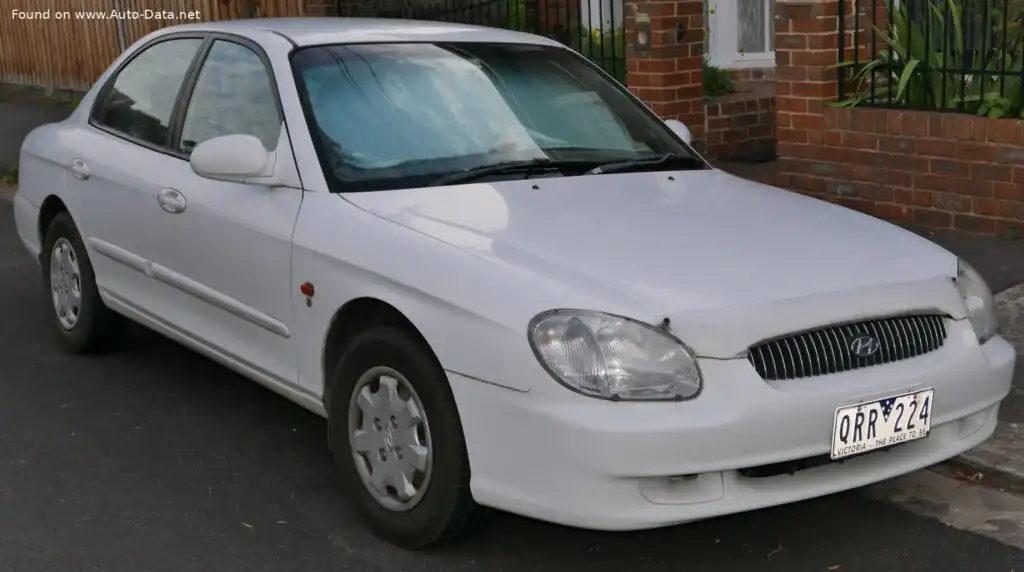
The Hyundai Sonata IV (EF) 2.0, equipped with a 147 horsepower engine and automatic transmission, was a significant model for Hyundai, representing a substantial step forward in the company’s ambition to compete in the mid-size sedan segment. Produced between 1998 and 2001, this variant played a crucial role in establishing the EF Sonata as a viable alternative to established Japanese and American competitors. It sat in the mid-range of the EF Sonata lineup, offering a balance between affordability and features, appealing to a broad customer base seeking a comfortable and reliable family vehicle. The EF generation, internally designated as the 1HX0 platform, marked a turning point for Hyundai, showcasing improved design, build quality, and technology.
Technical Specifications
| Brand | Hyundai |
| Model | Sonata |
| Generation | Sonata IV (EF) |
| Type (Engine) | 2.0 (147 Hp) Automatic |
| Start of production | 1998 |
| End of production | 2001 |
| Powertrain Architecture | Internal Combustion engine |
| Body type | Sedan |
| Seats | 5 |
| Doors | 4 |
| Fuel Type | Petrol (Gasoline) |
| Weight-to-power ratio | 9 kg/Hp, 110.5 Hp/tonne |
| Weight-to-torque ratio | 7 kg/Nm, 142.9 Nm/tonne |
| Power | 147 Hp @ 6000 rpm |
| Power per litre | 73.6 Hp/l |
| Torque | 190 Nm @ 4500 rpm (140.14 lb.-ft. @ 4500 rpm) |
| Engine layout | Front, Transverse |
| Engine displacement | 1997 cm3 (121.86 cu. in.) |
| Number of cylinders | 4 |
| Engine configuration | Inline |
| Cylinder Bore | 85 mm (3.35 in.) |
| Piston Stroke | 88 mm (3.46 in.) |
| Compression ratio | 10:1 |
| Number of valves per cylinder | 4 |
| Fuel injection system | Multi-port manifold injection |
| Engine aspiration | Naturally aspirated engine |
| Valvetrain | DOHC |
| Kerb Weight | 1330 kg (2932.15 lbs.) |
| Trunk (boot) space – minimum | 396 l (13.98 cu. ft.) |
| Fuel tank capacity | 65 l (17.17 US gal | 14.3 UK gal) |
| Length | 4710 mm (185.43 in.) |
| Width | 1818 mm (71.57 in.) |
| Height | 1410 mm (55.51 in.) |
| Wheelbase | 2700 mm (106.3 in.) |
| Front track | 1540 mm (60.63 in.) |
| Rear (Back) track | 1520 mm (59.84 in.) |
| Drag coefficient (Cd) | 0.32 |
| Minimum turning circle (turning diameter) | 10.5 m (34.45 ft.) |
| Drivetrain Architecture | The Internal combustion engine (ICE) drives the front wheels of the vehicle. |
| Drive wheel | Front wheel drive |
| Number of gears and type of gearbox | 4 gears, automatic transmission |
| Front suspension | Independent, type McPherson with coil spring and anti-roll bar |
| Rear suspension | Independent multi-link suspension |
| Front brakes | Ventilated discs |
| Rear brakes | Disc |
| Assisting systems | ABS (Anti-lock braking system) |
| Steering type | Steering rack and pinion |
| Power steering | Hydraulic Steering |
| Tires size | 195/70 R14 |
| Wheel rims size | 14 |
Powertrain & Engine Architecture
The heart of the Sonata IV 2.0 Automatic is the Hyundai G4GF engine, a 1.997-liter inline-four cylinder powerplant. This engine utilizes a multi-port fuel injection (MPI) system, delivering fuel directly into the intake ports just before the intake valves. The engine features a double overhead camshaft (DOHC) valvetrain, operating 16 valves (four per cylinder) to optimize airflow and enhance volumetric efficiency. The 10:1 compression ratio was a standard for the time, balancing performance and fuel economy. The engine’s 147 horsepower output at 6000 rpm and 190 Nm (140.14 lb-ft) of torque at 4500 rpm provided adequate power for everyday driving. Paired with a four-speed automatic transmission, the powertrain prioritized smooth operation and ease of use over outright performance. This transmission was a conventional hydraulic automatic, offering a relatively simple and reliable design.
Driving Characteristics
The 2.0-liter automatic Sonata offered a comfortable and predictable driving experience. While not particularly sporty, the engine provided sufficient power for merging onto highways and passing slower traffic. The four-speed automatic transmission, while lacking the responsiveness of a manual or more modern automatic, offered smooth shifts and contributed to the car’s overall refinement. Compared to the base 1.8L engine option, the 2.0L provided a noticeable increase in power and torque, resulting in quicker acceleration and improved highway cruising ability. However, it didn’t match the performance of the later V6 models. The automatic transmission’s gear ratios were tuned for fuel efficiency and comfort, rather than aggressive acceleration. The steering was light and easy, making it suitable for city driving, but lacked the feedback desired by more enthusiastic drivers.
Equipment & Trim Levels
The 2.0-liter automatic Sonata typically came equipped with a reasonable level of standard features. These included air conditioning, power windows and locks, a basic audio system, and cloth upholstery. Higher trim levels offered upgrades such as alloy wheels, a sunroof, upgraded audio systems, and leather upholstery. Safety features included ABS (Anti-lock Braking System) as standard equipment, a significant improvement for the time. Optional extras often included a CD player, cruise control, and power mirrors. The interior design was functional and straightforward, prioritizing practicality over luxury.
Chassis & Braking
The EF Sonata utilized an independent suspension system at all four wheels. The front suspension employed a McPherson strut design with coil springs and an anti-roll bar, while the rear suspension featured a multi-link setup. This configuration provided a comfortable ride and reasonable handling characteristics. The braking system consisted of ventilated discs at the front and solid discs at the rear, providing adequate stopping power for the vehicle’s weight and performance. The hydraulic power steering system offered light and easy steering, enhancing maneuverability.
Market Reception & Comparison
The Hyundai Sonata IV 2.0 Automatic was generally well-received by critics as a solid and reliable mid-size sedan. It offered a compelling value proposition, providing a good level of features and comfort at a competitive price point. Compared to its rivals, such as the Honda Accord and Toyota Camry, the Sonata offered a similar level of practicality and reliability, but often at a lower price. Fuel economy was respectable for the time, averaging around 22-26 mpg in combined driving. Reliability was generally good, although some owners reported minor issues with the automatic transmission over the long term. The 2.0L engine proved to be durable and relatively maintenance-free.
Legacy
The Hyundai Sonata IV (EF) 2.0 Automatic holds a significant place in Hyundai’s history as a model that helped establish the brand as a serious competitor in the global automotive market. The powertrain, while not groundbreaking, proved to be reliable and durable, and many examples are still on the road today. In the used car market, these Sonatas are often sought after for their affordability, practicality, and relatively low maintenance costs. While not a collector’s item, the EF Sonata represents a pivotal moment in Hyundai’s evolution, demonstrating the company’s commitment to improving quality and offering value to consumers.