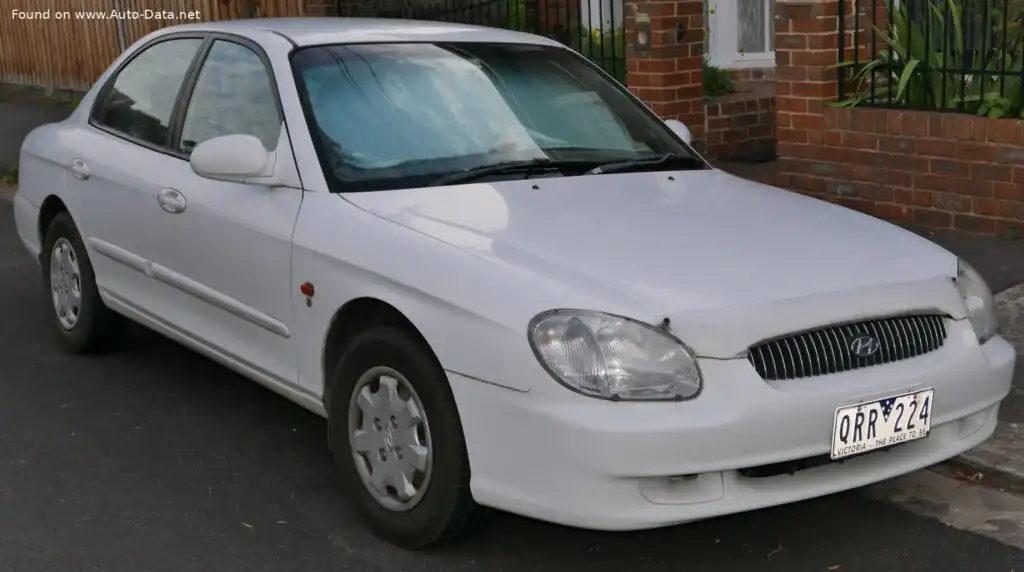
The Hyundai Sonata IV (EF) 2.4, produced between 1998 and 2000, represented a significant step forward for the South Korean automaker in the mid-size sedan segment. Positioned as a comfortable and relatively affordable option, the 2.4-liter variant with the automatic transmission aimed to broaden the Sonata’s appeal beyond the base models. This generation, known internally as the EF, was a crucial model for Hyundai as it sought to establish a stronger foothold in the North American market and shed its reputation for producing low-cost, basic vehicles. The EF Sonata was built on the platform shared with the Kia Optima, marking a period of increased collaboration within the Hyundai-Kia Automotive Group.
Technical Specifications
| Brand | Hyundai |
| Model | Sonata |
| Generation | Sonata IV (EF) |
| Type (Engine) | 2.4 (150 Hp) Automatic |
| Start of production | 1998 |
| End of production | 2000 |
| Powertrain Architecture | Internal Combustion engine |
| Body type | Sedan |
| Seats | 5 |
| Doors | 4 |
| Fuel Type | Petrol (Gasoline) |
| Weight-to-power ratio | 9.5 kg/Hp, 105.6 Hp/tonne |
| Weight-to-torque ratio | 6.7 kg/Nm, 149.3 Nm/tonne |
| Power | 150 Hp @ 5500 rpm |
| Power per litre | 63.8 Hp/l |
| Torque | 212 Nm @ 3000 rpm, 156.36 lb.-ft. @ 3000 rpm |
| Engine layout | Front, Transverse |
| Engine displacement | 2351 cm3, 143.47 cu. in. |
| Number of cylinders | 4 |
| Engine configuration | Inline |
| Cylinder Bore | 86.5 mm, 3.41 in. |
| Piston Stroke | 100 mm, 3.94 in. |
| Compression ratio | 10:1 |
| Number of valves per cylinder | 4 |
| Fuel injection system | Multi-port manifold injection |
| Engine aspiration | Naturally aspirated engine |
| Valvetrain | DOHC |
| Engine oil capacity | 4.5 l, 4.76 US qt | 3.96 UK qt |
| Coolant | 7.7 l, 8.14 US qt | 6.78 UK qt |
| Kerb Weight | 1420 kg, 3130.56 lbs |
| Trunk (boot) space – minimum | 396 l, 13.98 cu. ft |
| Fuel tank capacity | 65 l, 17.17 US gal | 14.3 UK gal |
| Length | 4710 mm, 185.43 in |
| Width | 1818 mm, 71.57 in |
| Height | 1410 mm, 55.51 in |
| Wheelbase | 2700 mm, 106.3 in |
| Front track | 1540 mm, 60.63 in |
| Rear (Back) track | 1520 mm, 59.84 in |
| Drag coefficient (Cd) | 0.32 |
| Minimum turning circle (turning diameter) | 10.5 m, 34.45 ft |
| Drivetrain Architecture | The Internal combustion engine (ICE) drives the front wheels of the vehicle. |
| Drive wheel | Front wheel drive |
| Number of gears and type of gearbox | 4 gears, automatic transmission |
| Front suspension | Independent, type McPherson with coil spring and anti-roll bar |
| Rear suspension | Independent multi-link suspension |
| Front brakes | Ventilated discs |
| Rear brakes | Disc |
| Assisting systems | ABS (Anti-lock braking system) |
| Steering type | Steering rack and pinion |
| Power steering | Hydraulic Steering |
| Tires size | 195/70 R14 |
| Wheel rims size | 14 |
Powertrain & Engine Architecture
The heart of the Sonata 2.4 was the 2.4-liter inline-four cylinder engine, designated as the G6EA. This engine featured a double overhead camshaft (DOHC) valvetrain with four valves per cylinder, contributing to its respectable power output for its displacement. The engine utilized a multi-port fuel injection system, delivering fuel directly to each intake port for improved combustion efficiency. The 10:1 compression ratio was a standard figure for naturally aspirated engines of the era. Paired with this engine was a four-speed automatic transmission, designed for smooth and convenient operation. While not a performance-oriented transmission, it was well-suited to the engine’s torque curve and the intended use case of the vehicle. The transmission was electronically controlled, offering adaptive shifting based on driving conditions.
Driving Characteristics
The 150 horsepower and 212 Nm (156 lb-ft) of torque provided by the 2.4-liter engine and automatic transmission combination resulted in adequate, but not exhilarating, performance. Acceleration from 0 to 60 mph was typically in the 9-10 second range. The automatic transmission, while smooth, did contribute to some power loss compared to the available five-speed manual transmission. Gear ratios were optimized for fuel economy and comfortable cruising rather than aggressive acceleration. In real-world driving, the Sonata 2.4 Automatic felt competent for everyday commuting and highway driving, but lacked the responsiveness of the higher-output engines offered in the lineup. The automatic transmission’s shift points were generally well-placed, but could sometimes feel hesitant during quick overtaking maneuvers.
Equipment & Trim Levels
The 2.4-liter automatic Sonata typically came with a reasonable level of standard equipment. This included air conditioning, power windows and locks, a basic audio system, and cloth upholstery. Higher trim levels, such as the GLS, added features like alloy wheels, a sunroof, upgraded audio systems, and cruise control. Optional extras included leather upholstery, a CD player, and power-adjustable seats. The interior design was functional and straightforward, prioritizing practicality over luxury. The dashboard layout was clean and easy to navigate, with clearly labeled controls.
Chassis & Braking
The Sonata EF featured an independent suspension system at all four wheels. The front suspension utilized a McPherson strut design with coil springs and an anti-roll bar, while the rear suspension employed a multi-link setup. This configuration provided a comfortable ride quality, absorbing bumps and irregularities in the road surface effectively. Braking duties were handled by ventilated discs at the front and solid discs at the rear. An anti-lock braking system (ABS) was standard, enhancing safety by preventing wheel lockup during hard braking. The steering system was a rack-and-pinion setup with hydraulic power assistance, providing responsive and precise steering feel.
Market Reception & Comparison
The Sonata 2.4 Automatic was generally well-received by critics as a solid and dependable mid-size sedan. It offered a good balance of features, comfort, and affordability. However, it wasn’t considered a standout performer in its class. Compared to the V6-powered Sonata, the 2.4-liter version offered significantly less power and acceleration. The 2.0-liter base model was more fuel-efficient but lacked the refinement and power of the 2.4. Fuel economy for the 2.4-liter automatic was rated around 22 mpg city and 30 mpg highway, which was competitive for the time. Reliability was generally good, although some owners reported minor issues with the automatic transmission over the long term.
Legacy
The Hyundai Sonata EF 2.4 Automatic played a vital role in establishing Hyundai as a credible competitor in the mid-size sedan market. While not a particularly groundbreaking vehicle, it offered a compelling package of value and reliability. Today, these Sonatas are relatively affordable on the used car market, making them attractive options for budget-conscious buyers. The G6EA engine is known for its durability, and with proper maintenance, can provide many years of reliable service. However, potential buyers should be aware of the possibility of age-related issues, such as worn suspension components and potential transmission problems. The EF Sonata remains a testament to Hyundai’s progress and its commitment to building increasingly competitive vehicles.