
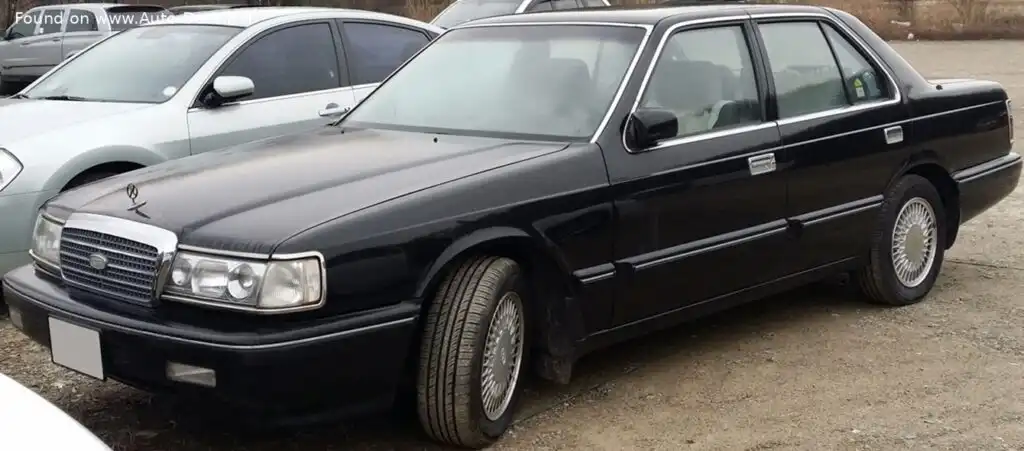
The Kia Potentia 2.5 i V6 24V, produced between 1997 and 2001, represented Kia’s foray into the mid-size executive sedan market. Positioned as a more upscale offering within Kia’s lineup, the Potentia aimed to compete with established European and Japanese rivals. This particular variant, equipped with the 2.5-liter V6 engine and a four-speed automatic transmission, was intended to provide a balance of performance and convenience for buyers seeking a comfortable and refined driving experience. The Potentia was primarily marketed in select international markets, serving as a stepping stone for Kia to build brand recognition and expand its global presence.
Technical Specifications
| Brand | Kia |
| Model | Potentia |
| Generation | Potentia |
| Type (Engine) | 2.5 i V6 24V (175 Hp) |
| Start of production | 1997 |
| End of production | 2001 |
| Powertrain Architecture | Internal Combustion engine |
| Body type | Sedan |
| Seats | 5 |
| Doors | 4 |
| Fuel consumption (urban) | 15 l/100 km (15.7 US mpg, 18.8 UK mpg, 6.7 km/l) |
| Fuel consumption (extra urban) | 8 l/100 km (29.4 US mpg, 35.3 UK mpg, 12.5 km/l) |
| Fuel Type | Petrol (Gasoline) |
| Maximum speed | 198 km/h (123.03 mph) |
| Weight-to-power ratio | 9.1 kg/Hp, 110.1 Hp/tonne |
| Weight-to-torque ratio | 8.5 kg/Nm, 117 Nm/tonne |
| Power | 175 Hp @ 6000 rpm |
| Power per litre | 70.1 Hp/l |
| Torque | 186 Nm @ 4000 rpm (137.19 lb.-ft. @ 4000 rpm) |
| Engine layout | Front, Longitudinal |
| Engine displacement | 2497 cm3 (152.38 cu. in.) |
| Number of cylinders | 6 |
| Engine configuration | V-engine |
| Cylinder Bore | 80 mm (3.15 in.) |
| Piston Stroke | 82.8 mm (3.26 in.) |
| Compression ratio | 10.5:1 |
| Number of valves per cylinder | 4 |
| Fuel injection system | Multi-port manifold injection |
| Engine aspiration | Naturally aspirated engine |
| Valvetrain | DOHC |
| Kerb Weight | 1590 kg (3505.35 lbs.) |
| Fuel tank capacity | 70 l (18.49 US gal | 15.4 UK gal) |
| Length | 4955 mm (195.08 in.) |
| Width | 1725 mm (67.91 in.) |
| Height | 1430 mm (56.3 in.) |
| Wheelbase | 2710 mm (106.69 in.) |
| Front track | 1445 mm (56.89 in.) |
| Rear track | 1460 mm (57.48 in.) |
| Drivetrain Architecture | The Internal combustion engine (ICE) drives the rear wheels of the vehicle. |
| Drive wheel | Rear wheel drive |
| Number of gears | 4 |
| Type of gearbox | automatic transmission |
| Front suspension | Spring Strut |
| Rear suspension | Spring Strut |
| Front brakes | Ventilated discs |
| Rear brakes | Disc |
| Assisting systems | ABS (Anti-lock braking system) |
| Steering type | Steering rack and pinion |
| Power steering | Hydraulic Steering |
| Tires size | 195/65 R15 |
Powertrain & Engine Architecture
The heart of the Potentia 2.5 i was the 6-cylinder, 2.5-liter (2497 cc) gasoline engine. This engine, utilizing a naturally aspirated configuration, featured a double overhead camshaft (DOHC) valvetrain with four valves per cylinder (24V). The engine employed multi-port fuel injection, a common technology in the late 1990s, to deliver fuel directly into the intake ports. The engine produced 175 horsepower at 6000 rpm and 186 Nm (137.19 lb-ft) of torque at 4000 rpm. The engine was mounted longitudinally in the front of the vehicle, driving the rear wheels. The four-speed automatic transmission was chosen for its ease of use and suitability for the intended market, prioritizing comfort over outright performance. While not a particularly advanced transmission by modern standards, it provided smooth shifts and adequate responsiveness for everyday driving.
Driving Characteristics
The 175 hp and 186 Nm of torque delivered by the 2.5L V6, coupled with the four-speed automatic, resulted in a driving experience geared towards comfort and refinement rather than sporty performance. Acceleration was adequate for merging and highway cruising, but not particularly brisk. The automatic transmission, while smooth, lacked the responsiveness of a manual gearbox, and the limited number of gears meant the engine often operated at higher rpm during acceleration. Compared to potential manual transmission versions (which were not widely available), the automatic offered less driver engagement and slightly reduced fuel efficiency. The rear-wheel-drive configuration provided a balanced feel, but the relatively soft suspension tuning prioritized ride comfort over sharp handling.
Equipment & Trim Levels
The Potentia 2.5 i V6 typically came equipped with a reasonable level of standard features, reflecting its positioning as a mid-range executive sedan. Standard amenities often included power windows, power door locks, air conditioning, and a basic audio system. Interior upholstery was typically cloth, although leather options were often available as an upgrade. Dashboard design was functional and straightforward, with a focus on ease of use. Optional extras could include a sunroof, upgraded audio systems, and alloy wheels. The specific trim levels and available options varied depending on the target market.
Chassis & Braking
The Potentia utilized a conventional chassis design with a spring strut suspension system at both the front and rear. This setup prioritized ride comfort over sporty handling. Braking duties were handled by ventilated discs at the front and solid discs at the rear. An Anti-lock Braking System (ABS) was standard, enhancing safety by preventing wheel lockup during hard braking. The steering system employed a rack and pinion setup with hydraulic power assistance, providing relatively light and easy steering feel. The vehicle rode on 195/65 R15 tires, a common size for the era, offering a balance of comfort and grip.
Market Reception & Comparison
The Kia Potentia 2.5 i V6 received mixed reviews from automotive critics. While praised for its comfortable ride and spacious interior, it was often criticized for its lack of dynamic performance and somewhat bland styling. Compared to other trims in the Potentia lineup, the 2.5L V6 automatic offered a more refined and convenient driving experience than the base engine options, but lacked the sporty appeal of any potential higher-performance variants. Fuel economy was average for its class, and reliability was generally considered acceptable, although not exceptional. The Potentia faced stiff competition from established rivals such as the Toyota Camry, Honda Accord, and Nissan Maxima.
Legacy
The Kia Potentia, while not a resounding commercial success, played an important role in Kia’s evolution as a global automaker. It demonstrated Kia’s ambition to compete in the mid-size sedan segment and helped to build brand awareness in international markets. The 2.5L V6 engine and four-speed automatic transmission proved to be reasonably reliable, and many examples remain on the road today. In the used car market, the Potentia 2.5 i V6 is often appreciated for its affordability, spaciousness, and comfortable ride, making it a viable option for buyers seeking a classic, well-rounded sedan.
