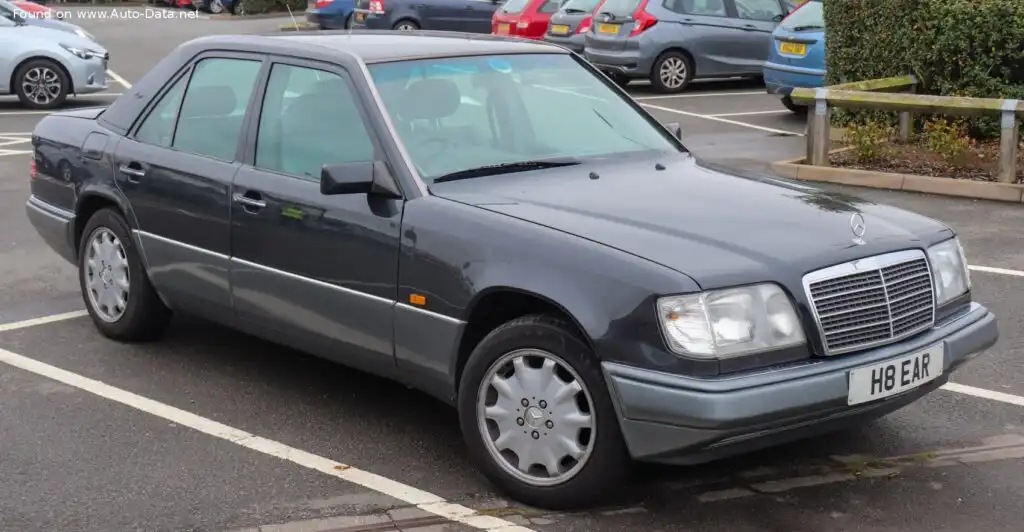
The Mercedes-Benz E 200 Automatic, produced between July 1993 and August 1995, represents a key variant within the W124 E-Class range. Positioned as a mid-range offering, it aimed to provide a balance of performance, comfort, and fuel efficiency for the discerning buyer. The W124 generation, renowned for its robust engineering and build quality, served as the successor to the W123 and laid the groundwork for the modern E-Class. This particular 2.0-liter, 136 horsepower configuration, paired with a four-speed automatic transmission, was a popular choice in European markets, offering a refined driving experience suitable for both city commuting and long-distance travel.
Technical Specifications
| Brand | Mercedes-Benz |
| Model | E-class |
| Generation | E-class (W124) |
| Type (Engine) | E 200 (136 Hp) Automatic |
| Start of production | July, 1993 |
| End of production | August, 1995 |
| Powertrain Architecture | Internal Combustion engine |
| Body type | Sedan |
| Seats | 5 |
| Doors | 4 |
| Fuel consumption (urban) | 11.4 l/100 km (20.6 US mpg) |
| Fuel consumption (extra urban) | 7 l/100 km (33.6 US mpg) |
| Fuel Type | Petrol (Gasoline) |
| Acceleration 0 – 100 km/h | 12 sec |
| Acceleration 0 – 62 mph | 12 sec |
| Acceleration 0 – 60 mph | 11.4 sec |
| Maximum speed | 195 km/h (121.17 mph) |
| Weight-to-power ratio | 10 kg/Hp |
| Weight-to-torque ratio | 7.2 kg/Nm |
| Power | 136 Hp @ 5500 rpm |
| Torque | 190 Nm @ 4000 rpm (140.14 lb.-ft. @ 4000 rpm) |
| Engine layout | Front, Longitudinal |
| Engine Model/Code | M 111 E 20 / 111.940 |
| Engine displacement | 1998 cm3 (121.93 cu. in.) |
| Number of cylinders | 4 |
| Engine configuration | Inline |
| Cylinder Bore | 89.9 mm (3.54 in.) |
| Piston Stroke | 78.7 mm (3.1 in.) |
| Compression ratio | 9.6:1 |
| Number of valves per cylinder | 4 |
| Fuel injection system | Multi-port manifold injection |
| Engine aspiration | Naturally aspirated engine |
| Valvetrain | DOHC |
| Engine oil capacity | 5.5 l (5.81 US qt | 4.84 UK qt) |
| Coolant | 8.5 l (8.98 US qt | 7.48 UK qt) |
| Kerb Weight | 1360 kg (2998.29 lbs.) |
| Max. weight | 1950 kg (4299.01 lbs.) |
| Max load | 590 kg (1300.73 lbs.) |
| Trunk (boot) space – minimum | 520 l (18.36 cu. ft.) |
| Fuel tank capacity | 70 l (18.49 US gal | 15.4 UK gal) |
| Length | 4740 mm (186.61 in.) |
| Width | 1740 mm (68.5 in.) |
| Height | 1430 mm (56.3 in.) |
| Wheelbase | 2800 mm (110.24 in.) |
| Front track | 1501 mm (59.09 in.) |
| Rear (Back) track | 1491 mm (58.7 in.) |
| Drivetrain Architecture | Rear wheel drive |
| Number of gears and type of gearbox | 4 gears, automatic transmission |
| Front suspension | Wishbone |
| Rear suspension | Independent multi-link suspension |
| Front brakes | Ventilated discs |
| Rear brakes | Disc |
| Assisting systems | ABS (Anti-lock braking system) |
| Steering type | Cone worm with recirculation balls |
| Power steering | Hydraulic Steering |
| Tires size | Front wheel tires: 195/65 R15Rear wheel tires: 195/65 R15 |
| Wheel rims size | Front wheel rims: 6.5J x 15Rear wheel rims: 6.5J x 15 |
Powertrain & Engine Architecture
The E 200 Automatic was powered by the M111 E 20 engine, a 1998cc inline-four cylinder unit. This engine was a significant departure from the earlier iron-block Mercedes engines, utilizing an aluminum block and head to reduce weight. The M111 featured multi-port fuel injection and a double overhead camshaft (DOHC) valvetrain, contributing to its relatively smooth operation and respectable power output. The engine code 111.940 specifically denotes this configuration. The four-speed automatic transmission, a common unit in Mercedes-Benz vehicles of the era, was designed for smooth shifts and ease of use. While not particularly sporty, it provided a comfortable and refined driving experience. The transmission’s gear ratios were optimized for fuel efficiency and relaxed cruising, rather than outright acceleration.
Driving Characteristics
The E 200 Automatic offered a comfortable and predictable driving experience. With 136 horsepower, acceleration was adequate but not exhilarating, taking approximately 12 seconds to reach 60 mph. The automatic transmission, while smooth, did contribute to a slight loss of responsiveness compared to the five-speed manual version. The focus was on providing a relaxed and refined ride, making it well-suited for long journeys. The rear-wheel drive configuration provided balanced handling, although it lacked the agility of some front-wheel drive competitors. Compared to the higher-performance E 280 or E 320 models, the E 200 Automatic prioritized fuel economy and affordability over outright speed.
Equipment & Trim Levels
The E 200 Automatic typically came equipped with a respectable level of standard features, including power windows, central locking, and a basic audio system. Interior upholstery was usually cloth, although leather was available as an option. The dashboard layout was typical of W124 models, characterized by a functional and understated design. Optional extras included a sunroof, upgraded audio systems, automatic climate control, and heated seats. The level of equipment varied depending on the specific market and individual customer preferences.
Chassis & Braking
The W124 E-Class featured a robust chassis with independent suspension all around. The front suspension utilized wishbones, while the rear employed a multi-link setup, providing a comfortable ride and good handling characteristics. The E 200 Automatic was equipped with ventilated disc brakes at the front and solid discs at the rear. Anti-lock braking system (ABS) was standard, enhancing safety and stability during braking. The steering was a recirculating ball system with hydraulic power assistance, offering a good balance of feel and ease of use.
Market Reception & Comparison
The E 200 Automatic was generally well-received by critics as a practical and reliable family sedan. It offered a good balance of comfort, fuel efficiency, and affordability. However, some reviewers noted that its performance was somewhat underwhelming compared to its more powerful siblings. In terms of fuel economy, the E 200 Automatic offered a noticeable improvement over the larger-engined models, making it an attractive option for those prioritizing running costs. Reliability was a strong point, with the M111 engine proving to be durable and long-lasting.
Legacy
The W124 E-Class, and the E 200 Automatic variant in particular, has earned a reputation for exceptional durability and build quality. Many examples are still on the road today, a testament to their robust engineering. The M111 engine is known for its longevity and relatively simple maintenance requirements. In the used car market, the E 200 Automatic remains a popular choice for those seeking a classic Mercedes-Benz that is both reliable and affordable. While not a performance icon, it represents a well-engineered and thoughtfully designed vehicle that continues to provide comfortable and dependable transportation.