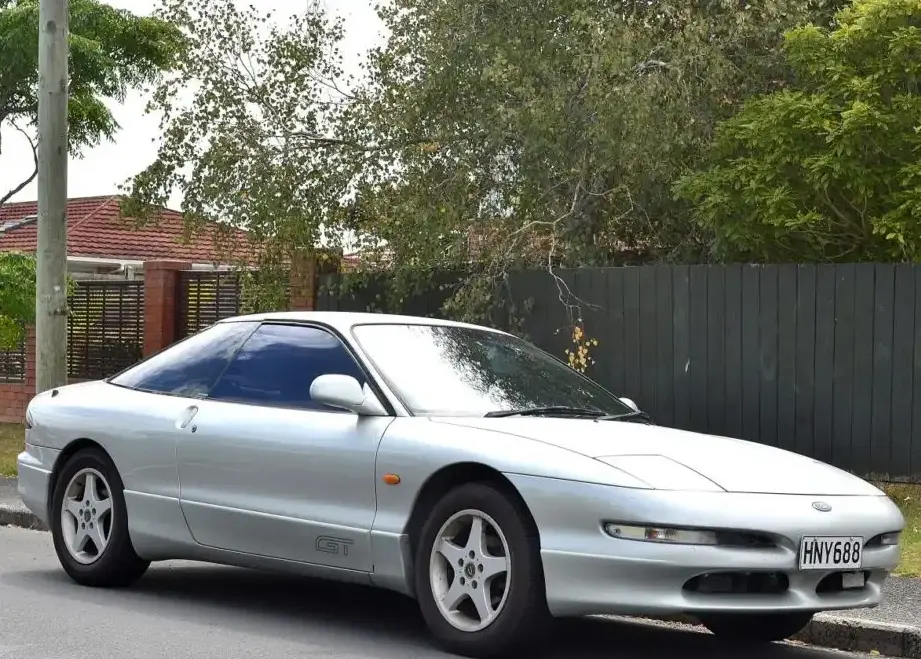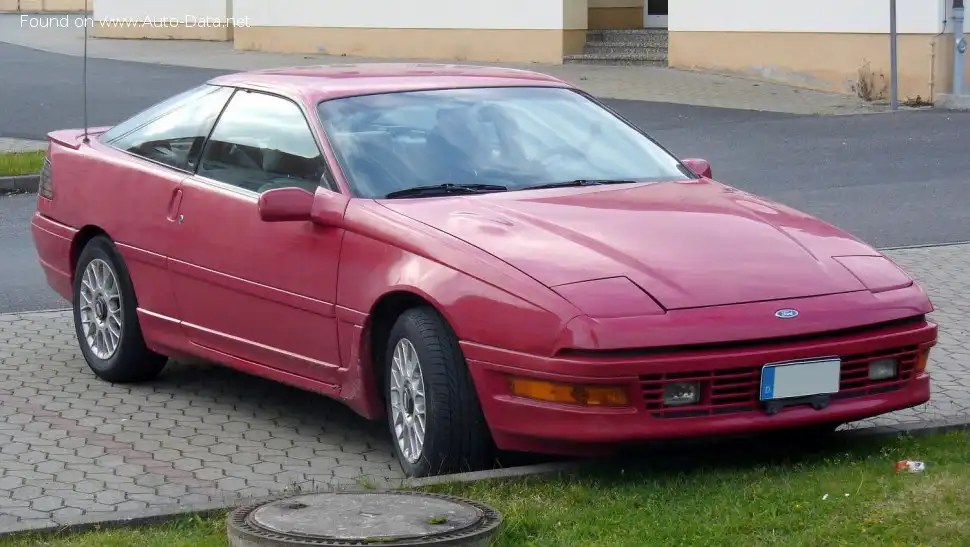
The Ford Probe I 2.2, equipped with a 110 horsepower engine and automatic transmission, was produced between 1988 and 1992. It represented Ford’s attempt to create a sporty, technologically advanced coupe aimed at capturing a segment of the market traditionally dominated by Japanese imports. Positioned as a mid-range offering within the Probe I lineup, it slotted between the base 2.0L model and the higher-performance 2.2L Turbo variant. The Probe I was built on Ford’s MN12 platform, a front-wheel-drive architecture also underpinning the Mazda MX-6, a result of the joint venture between Ford and Mazda. This generation of Probe was a significant departure from the rear-wheel-drive Ford Probe II that followed, and it aimed to offer a more modern driving experience with a focus on aerodynamics and fuel efficiency.
Technical Specifications
| Brand | Ford |
| Model | Probe |
| Generation | Probe I |
| Type (Engine) | 2.2 (110 Hp) Automatic |
| Start of production | 1988 |
| End of production | 1992 |
| Powertrain Architecture | Internal Combustion engine |
| Body type | Coupe |
| Seats | 4 |
| Doors | 3 |
| Fuel consumption (urban) | 10.7-11.2 l/100 km (22-21 US mpg) |
| Fuel consumption (extra urban) | 8.1-8.4 l/100 km (29-28 US mpg) |
| Fuel consumption (combined) | 9.8 l/100 km (24 US mpg) |
| Fuel Type | Petrol (Gasoline) |
| Power | 110 Hp @ 4700 rpm |
| Power per litre | 50.4 Hp/l |
| Torque | 176 Nm @ 3000 rpm (129.81 lb.-ft. @ 3000 rpm) |
| Engine layout | Front, Transverse |
| Engine Model/Code | F2 |
| Engine displacement | 2184 cm3 (133.28 cu. in.) |
| Number of cylinders | 4 |
| Engine configuration | Inline |
| Cylinder Bore | 86 mm (3.39 in.) |
| Piston Stroke | 94 mm (3.7 in.) |
| Compression ratio | 8.6:1 |
| Number of valves per cylinder | 3 |
| Fuel injection system | Multi-port manifold injection |
| Engine aspiration | Naturally aspirated |
| Engine oil capacity | 4.6 l (4.86 US qt | 4.05 UK qt) |
| Coolant capacity | 7.5 l (7.93 US qt | 6.6 UK qt) |
| Trunk (boot) space (min) | 337 l (11.9 cu. ft.) |
| Trunk (boot) space (max) | 1186 l (41.88 cu. ft.) |
| Fuel tank capacity | 57 l (15.06 US gal | 12.54 UK gal) |
| Length | 4496 mm (177.01 in.) |
| Width | 1725 mm (67.91 in.) |
| Height | 1316 mm (51.81 in.) |
| Wheelbase | 2515 mm (99.02 in.) |
| Front track | 1455 mm (57.28 in.) |
| Rear track | 1466 mm (57.72 in.) |
| Drag coefficient (Cd) | 0.308 |
| Minimum turning circle | 11.4 m (37.4 ft.) |
| Drivetrain | Front wheel drive |
| Number of gears | 4 |
| Gearbox type | Automatic transmission |
| Front suspension | Independent, McPherson with coil spring and anti-roll bar |
| Rear suspension | McPherson, Transverse stabilizer, Trailing arm |
| Front brakes | Ventilated discs, 264 mm |
| Rear brakes | Drum, 228.6 mm |
| Steering type | Steering rack and pinion |
| Power steering | Hydraulic |
| Tires size | 185/70 R14; 195/70 R14 |
| Wheel rims size | 5.5J x 14; 6J x 14 |
Powertrain & Engine Architecture
The heart of the Probe I 2.2 Automatic is the Ford F2 engine, a 2.2-liter inline-four cylinder powerplant. This engine utilized a single overhead camshaft (SOHC) valvetrain with three valves per cylinder (two intake, one exhaust). Fuel delivery was managed by a multi-port fuel injection system, contributing to improved efficiency and throttle response compared to earlier carbureted designs. The 8.6:1 compression ratio was a compromise between performance and the fuel quality available at the time. The engine’s 110 horsepower and 176 Nm (129.81 lb-ft) of torque were delivered to the front wheels through a four-speed automatic transmission. This transmission, while providing convenience, was not known for its sporty character and was geared more towards smooth, comfortable cruising.
Driving Characteristics
The 2.2L automatic Probe I offered a comfortable, but not particularly exhilarating, driving experience. The automatic transmission, while smooth, resulted in noticeable acceleration lag compared to the five-speed manual versions. The gear ratios were optimized for fuel economy rather than outright performance. The 0-60 mph time was estimated to be around 10-11 seconds, placing it behind the quicker 2.2L Turbo and comparable to many contemporary four-cylinder Japanese coupes. Steering was light and precise, contributing to easy maneuverability, but lacked the feedback desired by driving enthusiasts. The suspension provided a reasonably comfortable ride, absorbing most road imperfections, but could feel somewhat soft during aggressive cornering.
Equipment & Trim Levels
The 2.2L Automatic Probe I typically came standard with features such as air conditioning, power steering, a basic AM/FM stereo, and cloth upholstery. Optional extras included a premium sound system, power windows and locks, cruise control, and a sunroof. Interior trim was generally functional and straightforward, with a focus on ergonomics. The dashboard layout was clean and easy to read, although the materials used were not particularly luxurious. The automatic transmission models often received slightly more comfortable seating as a standard feature, catering to buyers prioritizing convenience over sporty aesthetics.
Chassis & Braking
The Probe I utilized an independent McPherson strut suspension in the front, providing decent handling characteristics. The rear suspension employed a trailing arm setup with a transverse stabilizer bar, aimed at reducing body roll. Braking duties were handled by ventilated discs in the front and drum brakes in the rear. While adequate for everyday driving, the rear drum brakes were a point of criticism, as they lacked the stopping power and fade resistance of disc brakes. The hydraulic power steering provided light and easy steering, making it suitable for urban driving conditions.
Market Reception & Comparison
The Ford Probe I 2.2 Automatic received mixed reviews. Critics praised its aerodynamic styling and relatively fuel-efficient engine, but often criticized its lack of outright performance and the somewhat unrefined automatic transmission. Compared to the 2.2L Turbo model, the automatic version felt significantly slower and less engaging to drive. The 2.0L base model offered better fuel economy but lacked the power of the 2.2L. Japanese competitors like the Honda Prelude and Toyota Celica were often seen as offering a more refined driving experience and better build quality. However, the Probe I offered a unique American styling and a more affordable price point.
Legacy
The Ford Probe I, particularly the 2.2L Automatic variant, has become a relatively affordable classic car. While not known for exceptional reliability, the F2 engine is generally considered durable and relatively easy to maintain. Common issues include oil leaks, sensor failures, and wear and tear on the automatic transmission. Parts availability is generally good, although some specific trim pieces can be difficult to find. Today, the Probe I is appreciated by enthusiasts for its distinctive styling and its role as a transitional vehicle in Ford’s lineup, bridging the gap between traditional American coupes and the more modern, import-inspired designs of the 1990s. Well-maintained examples are increasingly sought after by collectors and those looking for a unique and affordable classic car.