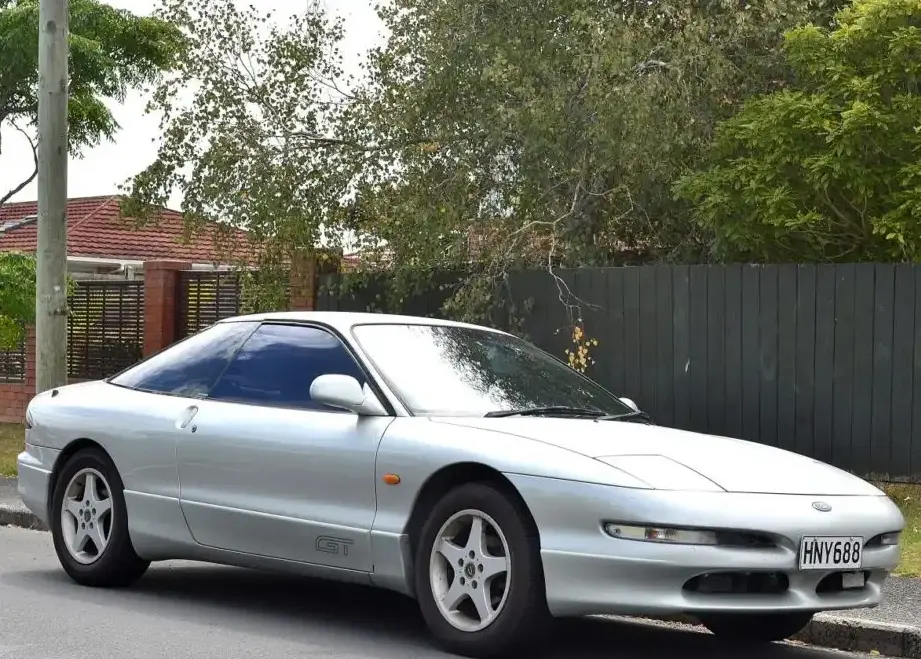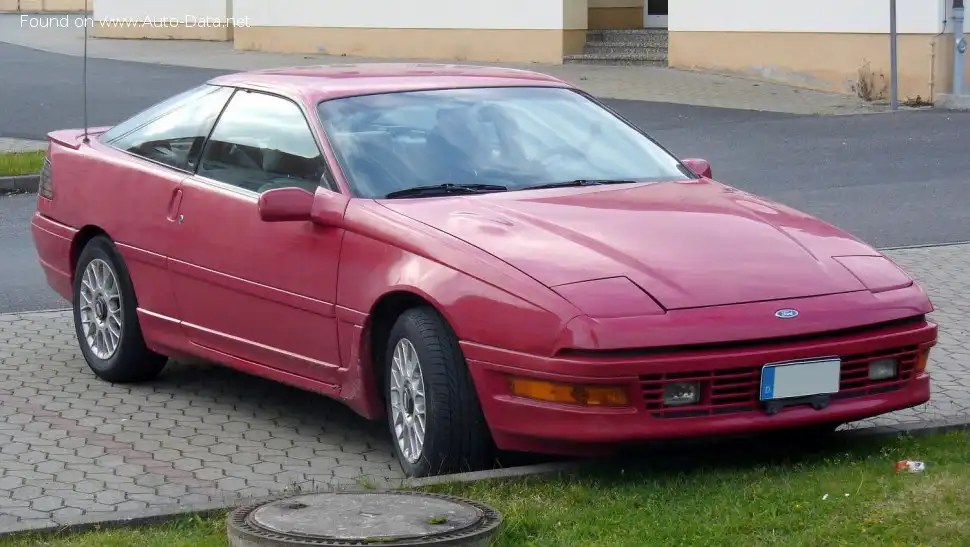
The Ford Probe I 2.2 GT Automatic, produced between 1989 and 1992, represented a significant departure for Ford, moving away from the traditional Mustang formula and embracing a more modern, aerodynamic coupe design. Positioned as the performance-oriented trim of the first-generation Probe (designated 1HX0), the 2.2 GT aimed to attract buyers seeking a sporty and technologically advanced vehicle. It served as a bridge between the more economical base models and foreshadowed Ford’s future design language. The Probe was intended to be a direct competitor to Japanese sports coupes like the Toyota Celica and Mazda MX-6, offering a blend of style, performance, and features.
Technical Specifications
| Brand | Ford |
| Model | Probe |
| Generation | Probe I |
| Type (Engine) | 2.2 GT (145 Hp) Automatic |
| Start of production | 1989 |
| End of production | 1992 |
| Powertrain Architecture | Internal Combustion engine |
| Body type | Coupe |
| Seats | 4 |
| Doors | 3 |
| Fuel consumption (urban) | 12.4 l/100 km (19 US mpg, 22.8 UK mpg) |
| Fuel consumption (extra urban) | 9.4 l/100 km (25 US mpg, 30.1 UK mpg) |
| Fuel consumption (combined) | 11.2 l/100 km (21 US mpg, 25.2 UK mpg) |
| Fuel Type | Petrol (Gasoline) |
| Power | 145 Hp @ 4300 rpm |
| Power per litre | 66.4 Hp/l |
| Torque | 258 Nm @ 3500 rpm (190.29 lb.-ft. @ 3500 rpm) |
| Engine layout | Front, Transverse |
| Engine Model/Code | F2T |
| Engine displacement | 2184 cm3 (133.28 cu. in.) |
| Number of cylinders | 4 |
| Engine configuration | Inline |
| Cylinder Bore | 86 mm (3.39 in.) |
| Piston Stroke | 94 mm (3.7 in.) |
| Compression ratio | 7.8:1 |
| Number of valves per cylinder | 3 |
| Fuel injection system | Multi-port manifold injection |
| Engine aspiration | Turbocharger, Intercooler |
| Valvetrain | SOHC |
| Engine oil capacity | 4.6 l (4.86 US qt | 4.05 UK qt) |
| Coolant capacity | 7.5 l (7.93 US qt | 6.6 UK qt) |
| Trunk (boot) space (minimum) | 337 l (11.9 cu. ft.) |
| Trunk (boot) space (maximum) | 1158 l (40.89 cu. ft.) |
| Fuel tank capacity | 57 l (15.06 US gal | 12.54 UK gal) |
| Length | 4496 mm (177.01 in.) |
| Width | 1725 mm (67.91 in.) |
| Height | 1316 mm (51.81 in.) |
| Wheelbase | 2515 mm (99.02 in.) |
| Front track | 1455 mm (57.28 in.) |
| Rear track | 1466 mm (57.72 in.) |
| Drag coefficient (Cd) | 0.312 |
| Minimum turning circle | 11.8 m (38.71 ft.) |
| Drivetrain | Front wheel drive |
| Number of gears | 4 |
| Gearbox type | Automatic transmission |
| Front suspension | Independent, McPherson with coil spring and anti-roll bar |
| Rear suspension | McPherson, Transverse stabilizer |
| Front brakes | Ventilated discs, 264 mm |
| Rear brakes | Disc, 259 mm |
| Steering type | Steering rack and pinion |
| Power steering | Hydraulic |
| Tires size | 205/60 VR15 |
| Wheel rims size | 6J x 15 |
Powertrain & Engine Architecture
The heart of the 2.2 GT was the F2T engine, a 2.2-liter inline-four cylinder powerplant. This engine was notable for its use of a turbocharger and intercooler, a relatively uncommon feature in mainstream American cars of the late 1980s and early 1990s. The engine utilized multi-port fuel injection, contributing to improved fuel efficiency and responsiveness. The single overhead camshaft (SOHC) valvetrain, while not as sophisticated as dual overhead cam designs, provided a good balance of performance and cost-effectiveness. The 4-speed automatic transmission was a Ford-sourced unit, designed to handle the increased torque output of the turbocharged engine. While not known for lightning-fast shifts, it provided smooth and comfortable operation for everyday driving.
Driving Characteristics
The 2.2 GT Automatic offered a noticeable step up in performance compared to the base Probe models. The turbocharger provided a surge of power in the mid-range, making it capable of brisk acceleration. However, the automatic transmission did detract somewhat from the overall driving experience. The gear ratios were tuned for comfort and fuel economy rather than outright performance, resulting in a less engaging feel than the available 5-speed manual transmission. The automatic also contributed to slightly slower 0-60 mph times compared to its manual counterpart. Despite this, the 2.2 GT was considered a fun and capable sports coupe for its time.
Equipment & Trim Levels
The 2.2 GT Automatic came standard with a number of features designed to enhance comfort and convenience. These included power windows, power door locks, and a premium sound system. The interior typically featured cloth upholstery, although leather was available as an option. The dashboard layout was modern for its time, with a driver-focused design and easy-to-read gauges. Optional extras included a sunroof, upgraded audio systems, and alloy wheels. The GT trim also featured unique exterior styling cues, such as a rear spoiler and body-colored side skirts.
Chassis & Braking
The Probe I utilized a front-wheel-drive chassis with independent suspension at all four corners. The front suspension employed a McPherson strut design with coil springs and an anti-roll bar, while the rear suspension also used a McPherson strut setup with a transverse stabilizer. This suspension configuration provided a comfortable ride while maintaining good handling characteristics. The 2.2 GT was equipped with ventilated disc brakes at the front and solid disc brakes at the rear, providing adequate stopping power for its weight and performance. Power-assisted steering was standard, making the car easy to maneuver at low speeds.
Market Reception & Comparison
The Ford Probe I 2.2 GT Automatic received mixed reviews from automotive critics. While praised for its styling and technology, some reviewers found the automatic transmission to be a detriment to the driving experience. Fuel economy was considered average for the class, with combined figures around 21 mpg. Compared to other trims in the Probe lineup, the 2.2 GT offered significantly more performance but came at a higher price. The 1.6L and 2.0L models were more fuel-efficient and affordable, while appealing to a broader audience. The 2.2 GT targeted buyers who prioritized performance and were willing to sacrifice some fuel economy.
Legacy
The Ford Probe I, and particularly the 2.2 GT variant, holds a unique place in automotive history. It represented Ford’s attempt to move beyond the traditional muscle car image and embrace a more modern, technologically advanced approach to vehicle design. While the Probe was ultimately discontinued after a relatively short production run, it paved the way for future Ford models. Today, the 2.2 GT Automatic is a sought-after classic among enthusiasts, particularly those who appreciate its turbocharged engine and distinctive styling. The F2T engine, while not without its quirks, is generally considered to be a reliable powertrain when properly maintained. Finding well-preserved examples can be challenging, but the Probe I 2.2 GT remains a compelling and affordable entry point into the world of classic sports coupes.