
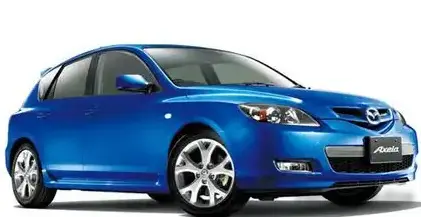
The Mazda Axela 1.5 16V Sport, known as the Mazda3 in many markets outside of Japan, represents a key entry point into Mazda’s compact hatchback lineup during its first generation, produced from 2003 to 2009 (with continued production of this specific variant in some markets until 2019). This model, powered by a 1.5-liter gasoline engine paired with a four-speed automatic transmission, was designed to offer a balance of affordability, fuel efficiency, and practicality for a broad range of consumers. It served as the base trim level in many regions, offering a more accessible price point compared to higher-performance or more luxuriously equipped versions of the Axela.
Technical Specifications
| Brand | Mazda |
| Model | Axela |
| Generation | Axela |
| Type (Engine) | 1.5 16V Sport (114 Hp) |
| Start of production | 2003 year |
| End of production | 2019 year |
| Powertrain Architecture | Internal Combustion engine |
| Body type | Hatchback |
| Seats | 5 |
| Doors | 5 |
| Fuel Type | Petrol (Gasoline) |
| Maximum speed | 180 km/h (111.85 mph) |
| Weight-to-power ratio | 10.9 kg/Hp, 91.9 Hp/tonne |
| Weight-to-torque ratio | 8.9 kg/Nm, 112.9 Nm/tonne |
| Power | 114 Hp @ 6000 rpm |
| Power per litre | 76.1 Hp/l |
| Torque | 140 Nm (103.26 lb.-ft.) |
| Engine layout | Front, Transverse |
| Engine displacement | 1498 cm3 (91.41 cu. in.) |
| Number of cylinders | 4 |
| Engine configuration | Inline |
| Cylinder Bore | 78 mm (3.07 in.) |
| Piston Stroke | 78.4 mm (3.09 in.) |
| Compression ratio | 10:1 |
| Number of valves per cylinder | 4 |
| Fuel injection system | Multi-port manifold injection |
| Engine aspiration | Naturally aspirated engine |
| Kerb Weight | 1240 kg (2733.73 lbs.) |
| Max. weight | 1515 kg (3340 lbs.) |
| Max load | 275 kg (606.27 lbs.) |
| Trunk (boot) space – minimum | 300 l (10.59 cu. ft.) |
| Trunk (boot) space – maximum | 635 l (22.42 cu. ft.) |
| Fuel tank capacity | 55 l (14.53 US gal | 12.1 UK gal) |
| Length | 4405 mm (173.43 in.) |
| Width | 1745 mm (68.7 in.) |
| Height | 1465 mm (57.68 in.) |
| Wheelbase | 2640 mm (103.94 in.) |
| Front track | 1530 mm (60.24 in.) |
| Rear (Back) track | 1515 mm (59.65 in.) |
| Drivetrain Architecture | The Internal combustion engine (ICE) drives the front wheels of the vehicle. |
| Drive wheel | Front wheel drive |
| Number of gears and type of gearbox | 4 gears, automatic transmission |
| Front suspension | Independent coil spring |
| Rear suspension | Independent coil spring |
| Front brakes | Disc |
| Rear brakes | Drum |
| Assisting systems | ABS (Anti-lock braking system) |
| Tires size | 195/65R15 |
Powertrain & Engine Architecture
The heart of the Axela 1.5 Sport is the Mazda ZJ-VE engine, a 1.5-liter inline-four cylinder gasoline engine. This engine utilizes a single overhead camshaft (SOHC) design with four valves per cylinder, contributing to reasonable performance for its displacement. The ZJ-VE engine employs multi-point fuel injection, delivering fuel directly into the intake ports. This system, while not as advanced as direct injection, provides efficient fuel atomization and consistent combustion. The engine’s 10:1 compression ratio is a typical value for naturally aspirated gasoline engines of this era, balancing power output and fuel economy. The four-speed automatic transmission, while providing convenience, is a relatively simple unit. It features traditional hydraulic control and lacks the efficiency and responsiveness of more modern automatic transmissions with more gears.
Driving Characteristics
The 114 horsepower and 103 lb-ft of torque produced by the 1.5-liter engine translate to adequate, but not exhilarating, performance. Acceleration is best described as leisurely, with a 0-60 mph time estimated around 11-12 seconds. The four-speed automatic transmission contributes to this, with relatively wide gear ratios. Compared to the more powerful 2.0-liter variants of the Axela, or even the diesel options available in some markets, the 1.5L automatic feels noticeably slower. However, the engine is reasonably smooth and refined for its class, and the automatic transmission provides seamless shifts in normal driving conditions. The focus is on providing a comfortable and economical driving experience rather than sporty performance.
Equipment & Trim Levels
The 1.5 16V Sport trim typically included standard features such as air conditioning, power windows, power door locks, and a basic audio system. Interior upholstery was generally cloth, with a simple and functional dashboard layout. Optional extras could include alloy wheels, a sunroof, and upgraded audio systems. The trim level was positioned as the entry-level offering, making it attractive to budget-conscious buyers. It lacked some of the more premium features found in higher trims, such as automatic climate control, leather upholstery, and advanced safety systems.
Chassis & Braking
The Axela 1.5 Sport utilizes an independent coil spring suspension system for both the front and rear wheels, providing a comfortable ride quality. Front brakes are disc brakes, offering adequate stopping power, while the rear brakes are drum brakes, a cost-saving measure common in entry-level vehicles. Anti-lock Braking System (ABS) was standard, enhancing safety by preventing wheel lockup during hard braking. The chassis is relatively lightweight, contributing to the car’s fuel efficiency and handling. Stabilizer bars were typically included, helping to reduce body roll during cornering.
Market Reception & Comparison
The Mazda Axela 1.5 16V Sport was generally well-received as an affordable and practical compact hatchback. Critics praised its fuel efficiency and comfortable ride, but noted its lack of outright performance. Compared to the higher-trim Axela models, the 1.5L automatic offered significantly lower running costs but sacrificed performance and features. The 2.0-liter variants provided a more engaging driving experience, while diesel models offered superior fuel economy. However, the 1.5L Sport remained a popular choice for buyers prioritizing value and practicality.
Legacy
The Mazda Axela 1.5 16V Sport, while not the most powerful or feature-rich version of the Axela, has proven to be a reliable and durable vehicle. The ZJ-VE engine is known for its longevity, and the four-speed automatic transmission, while simple, is generally robust. In the used car market, these models are often sought after for their affordability and low running costs. They represent a sensible choice for first-time car buyers or those seeking a dependable and economical daily driver. Parts availability remains good, and maintenance costs are relatively low, making it a practical option even today.
