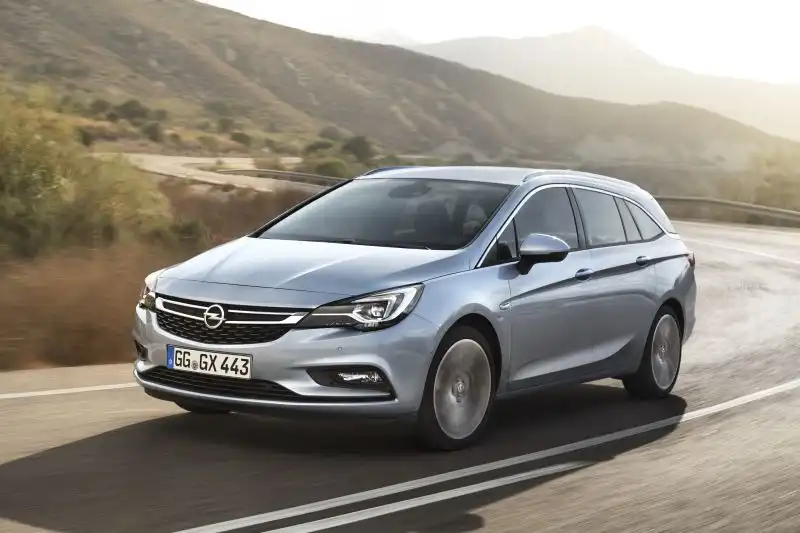
The Opel Astra K Sports Tourer 1.6 Turbo (200 hp) Automatic, produced from 2018 to July 2019, represents a compelling blend of practicality and performance within the Astra K generation. Positioned as a mid-to-upper trim level within the Sports Tourer (estate) body style, this variant aimed to provide a more engaging driving experience than the lower-powered engine options while maintaining the versatility expected of a family wagon. It was primarily marketed in Europe, where the Astra K competed with rivals like the Volkswagen Golf Estate, Ford Focus Estate, and Peugeot 308 SW. This model utilized the General Motors’ 1HX0/A3 platform, shared with other Vauxhall/Opel and Peugeot/Citroen vehicles.
Technical Specifications
| Brand | Opel |
| Model | Astra |
| Generation | Astra K Sports Tourer |
| Type (Engine) | 1.6 Turbo (200 Hp) Automatic |
| Start of production | 2018 |
| End of production | July, 2019 |
| Powertrain Architecture | Internal Combustion engine |
| Body type | Station wagon (estate) |
| Seats | 5 |
| Doors | 5 |
| Fuel consumption (urban) | 8.5-8.7 l/100 km (27.7 – 27 US mpg, 33.2 – 32.5 UK mpg, 11.8 – 11.5 km/l) |
| Fuel consumption (extra urban) | 5.4-5.6 l/100 km (43.6 – 42 US mpg, 52.3 – 50.4 UK mpg, 18.5 – 17.9 km/l) |
| Fuel consumption (combined) | 6.5-6.7 l/100 km (36.2 – 35.1 US mpg, 43.5 – 42.2 UK mpg, 15.4 – 14.9 km/l) |
| CO2 emissions | 149-154 g/km |
| Fuel Type | Petrol (Gasoline) |
| Acceleration 0 – 100 km/h | 7.9 sec |
| Acceleration 0 – 62 mph | 7.9 sec |
| Acceleration 0 – 60 mph | 7.5 sec |
| Maximum speed | 235 km/h (146.02 mph) |
| Emission standard | Euro 6d-Temp |
| Weight-to-power ratio | 6.8 kg/Hp, 148.1 Hp/tonne |
| Weight-to-torque ratio | 4.5 kg/Nm, 222.2 Nm/tonne |
| Power | 200 Hp @ 5500 rpm |
| Power per litre | 125.2 Hp/l |
| Torque | 300 Nm @ 1650-4500 rpm (221.27 lb.-ft. @ 1650-4500 rpm) |
| Engine layout | Front, Transverse |
| Engine Model/Code | D16SHT |
| Engine displacement | 1598 cm3 (97.52 cu. in.) |
| Number of cylinders | 4 |
| Engine configuration | Inline |
| Cylinder Bore | 79 mm (3.11 in.) |
| Piston Stroke | 81.5 mm (3.21 in.) |
| Compression ratio | 9.5:1 |
| Number of valves per cylinder | 4 |
| Fuel injection system | Direct injection |
| Engine aspiration | Turbocharger, Intercooler |
| Engine oil capacity | 5.5 l (5.81 US qt | 4.84 UK qt) |
| Coolant | 5.9 l (6.23 US qt | 5.19 UK qt) |
| Kerb Weight | 1350 kg (2976.24 lbs.) |
| Max. weight | 1980 kg (4365.15 lbs.) |
| Max load | 630 kg (1388.91 lbs.) |
| Trunk (boot) space – minimum | 540 l (19.07 cu. ft.) |
| Trunk (boot) space – maximum | 1630 l (57.56 cu. ft.) |
| Fuel tank capacity | 48 l (12.68 US gal | 10.56 UK gal) |
| Max. roof load | 75 kg (165.35 lbs.) |
| Permitted trailer load with brakes (12%) | 1700 kg (3747.86 lbs.) |
| Permitted trailer load without brakes | 680 kg (1499.14 lbs.) |
| Length | 4702 mm (185.12 in.) |
| Width | 1809 mm (71.22 in.) |
| Width with mirrors folded | 1871 mm (73.66 in.) |
| Width including mirrors | 2042 mm (80.39 in.) |
| Height | 1510 mm (59.45 in.) |
| Wheelbase | 2662 mm (104.8 in.) |
| Front track | 1544 mm (60.79 in.) |
| Rear (Back) track | 1558 mm (61.34 in.) |
| Minimum turning circle | 11.05 m (36.25 ft.) |
| Drivetrain Architecture | The Internal combustion engine (ICE) drives the front wheels of the vehicle. |
| Drive wheel | Front wheel drive |
| Number of gears and type of gearbox | 6 gears, automatic transmission |
| Front brakes | Disc |
| Rear brakes | Disc |
| Assisting systems | ABS (Anti-lock braking system) |
| Steering type | Steering rack and pinion |
| Power steering | Electric Steering |
| Tires size | 205/55 R16; 225/40 R18 |
| Wheel rims size | 7J x 16; 7.5J x 18 |
Powertrain & Engine Architecture
The heart of the Astra K Sports Tourer 1.6 Turbo is the D16SHT engine, a 1.6-liter turbocharged inline-four cylinder gasoline engine. This engine is part of Opel/Vauxhall’s ‘Small Diesel/Gasoline’ (SDG) family, known for its modular design and efficiency. The D16SHT utilizes direct fuel injection, delivering fuel directly into the combustion chamber for improved combustion efficiency and power output. It also features an intercooled turbocharger, boosting power and torque. The engine’s valvetrain employs four valves per cylinder, contributing to its responsive nature. Paired with this engine is a six-speed automatic transmission, providing smooth gear changes and enhancing the overall driving experience. This transmission is a traditional torque-converter automatic, prioritizing comfort and ease of use over outright performance.
Driving Characteristics
The 200 hp output and 300 Nm (221 lb-ft) of torque provide the Astra K Sports Tourer 1.6 Turbo Automatic with respectable performance. Acceleration from 0 to 62 mph takes approximately 7.9 seconds, and it achieves a top speed of 146 mph. However, the automatic transmission, while smooth, does slightly diminish the sense of urgency compared to the six-speed manual version. The gear ratios are tuned for a balance between fuel economy and responsiveness, with a focus on providing adequate power for overtaking and highway cruising. The turbocharger provides a noticeable boost in power from around 1650 rpm, offering a broad torque curve that makes the car feel flexible in everyday driving situations. Compared to the lower-powered 1.4-liter turbo variants, the 1.6 Turbo offers a more confident and refined driving experience, particularly when fully loaded or tackling uphill stretches.
Equipment & Trim Levels
The 1.6 Turbo Automatic trim typically included a generous level of standard equipment. This often encompassed features such as air conditioning, a touchscreen infotainment system with Apple CarPlay and Android Auto compatibility, Bluetooth connectivity, cruise control, and alloy wheels. Interior upholstery was typically cloth, with options for leather upgrades. Higher trim levels within the 1.6 Turbo range could add features like heated front seats, a panoramic sunroof, advanced safety systems (such as lane departure warning and automatic emergency braking), and upgraded audio systems. Dashboard configuration was consistent across the Astra K range, featuring a clean and modern design with intuitive controls.
Chassis & Braking
The Astra K Sports Tourer utilizes a MacPherson strut front suspension and a torsion beam rear suspension. This setup provides a good balance between ride comfort and handling. The torsion beam rear suspension is a cost-effective solution that offers adequate performance for most driving conditions. Braking is handled by disc brakes on all four wheels, providing ample stopping power. Anti-lock Braking System (ABS) is standard, enhancing safety and control during emergency braking situations. Stabilizer bars are fitted to both the front and rear axles to reduce body roll during cornering.
Market Reception & Comparison
The Astra K Sports Tourer 1.6 Turbo Automatic was generally well-received by automotive critics. It was praised for its comfortable ride, spacious interior, and refined engine. However, some reviewers noted that the automatic transmission could feel slightly hesitant at times, and that the steering lacked a bit of feel. Compared to the 1.4-liter turbo variants, the 1.6 Turbo offered a noticeable performance upgrade, but at a slightly higher price point. Fuel economy was competitive within its class, averaging around 36-35 mpg in combined driving. Reliability reports suggest that the D16SHT engine is generally robust, although regular maintenance is crucial to prevent issues.
Legacy
The Opel Astra K Sports Tourer 1.6 Turbo Automatic has established itself as a practical and reliable used car option. The D16SHT engine has proven to be relatively durable, and parts availability is generally good. While not a particularly sporty vehicle, it offers a comfortable and refined driving experience, making it a suitable choice for families and commuters. The Astra K generation, as a whole, represents a significant step forward in terms of design, technology, and overall quality for Opel/Vauxhall, and the 1.6 Turbo Automatic variant remains a popular choice in the used car market today.