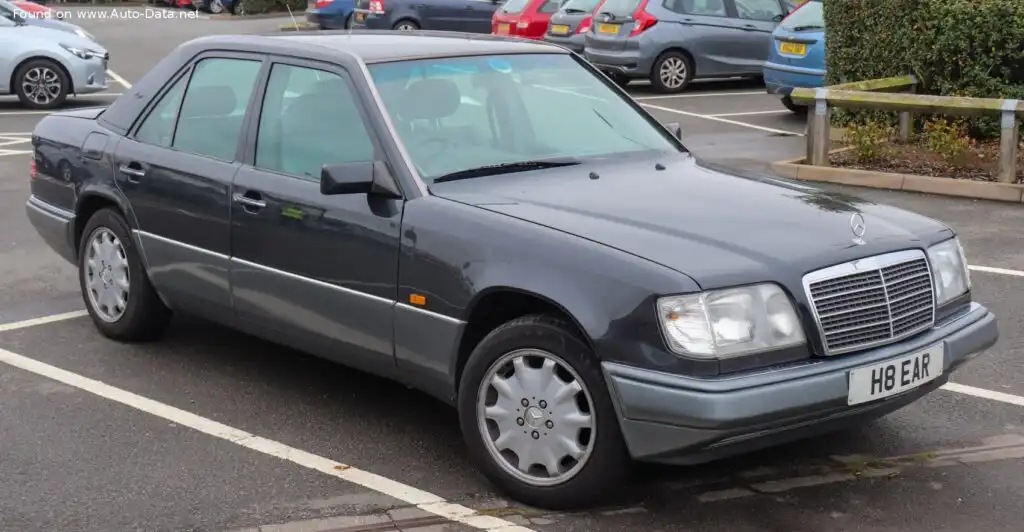
The Mercedes-Benz E 280 (W124), produced between July 1993 and August 1995, represented a significant step up in performance and refinement within the W124 E-Class range. Positioned as a mid-to-upper trim level, it offered a compelling blend of luxury, performance, and Mercedes-Benz engineering. The W124 series, launched in 1985, was intended as a successor to the W123, offering increased size, improved safety features, and a more modern design. The E 280 specifically aimed to provide a more spirited driving experience than the base E 220, while remaining more accessible than the flagship E 320 or the high-performance E 36 AMG models. It was primarily marketed towards buyers seeking a comfortable, well-equipped sedan with a capable engine for both highway cruising and everyday driving.
Technical Specifications
| Brand | Mercedes-Benz |
| Model | E-class |
| Generation | E-class (W124) |
| Type (Engine) | E 280 (193 Hp) |
| Start of production | July, 1993 |
| End of production | August, 1995 |
| Powertrain Architecture | Internal Combustion engine |
| Body type | Sedan |
| Seats | 5 |
| Doors | 4 |
| Fuel consumption (urban) | 14.6 l/100 km (16.1 US mpg, 19.3 UK mpg, 6.8 km/l) |
| Fuel consumption (extra urban) | 7.9 l/100 km (29.8 US mpg, 35.8 UK mpg, 12.7 km/l) |
| Fuel Type | Petrol (Gasoline) |
| Acceleration 0 – 100 km/h | 9.1 sec |
| Acceleration 0 – 62 mph | 9.1 sec |
| Acceleration 0 – 60 mph | 8.6 sec |
| Maximum speed | 230 km/h (142.92 mph) |
| Weight-to-power ratio | 7.7 kg/Hp, 129.5 Hp/tonne |
| Weight-to-torque ratio | 5.5 kg/Nm, 181.2 Nm/tonne |
| Power | 193 Hp @ 5500 rpm |
| Power per litre | 69 Hp/l |
| Torque | 270 Nm @ 3750 rpm (199.14 lb.-ft. @ 3750 rpm) |
| Engine layout | Front, Longitudinal |
| Engine Model/Code | M 104 E 28 / 104.942 |
| Engine displacement | 2799 cm3 (170.81 cu. in.) |
| Number of cylinders | 6 |
| Engine configuration | Inline |
| Cylinder Bore | 89.9 mm (3.54 in.) |
| Piston Stroke | 73.5 mm (2.89 in.) |
| Compression ratio | 10:1 |
| Number of valves per cylinder | 4 |
| Fuel injection system | Multi-port manifold injection |
| Engine aspiration | Naturally aspirated engine |
| Valvetrain | DOHC |
| Engine oil capacity | 7.5 l (7.93 US qt | 6.6 UK qt) |
| Coolant | 9 l (9.51 US qt | 7.92 UK qt) |
| Kerb Weight | 1490 kg (3284.89 lbs.) |
| Max. weight | 2050 kg (4519.48 lbs.) |
| Max load | 560 kg (1234.59 lbs.) |
| Trunk (boot) space – minimum | 520 l (18.36 cu. ft.) |
| Fuel tank capacity | 70 l (18.49 US gal | 15.4 UK gal) |
| Length | 4740 mm (186.61 in.) |
| Width | 1740 mm (68.5 in.) |
| Height | 1430 mm (56.3 in.) |
| Wheelbase | 2800 mm (110.24 in.) |
| Front track | 1501 mm (59.09 in.) |
| Rear (Back) track | 1491 mm (58.7 in.) |
| Drivetrain Architecture | The Internal combustion engine (ICE) drives the rear wheels of the vehicle. |
| Drive wheel | Rear wheel drive |
| Number of gears and type of gearbox | 5 gears, manual transmission |
| Front suspension | Wishbone |
| Rear suspension | Independent multi-link suspension |
| Front brakes | Ventilated discs |
| Rear brakes | Disc |
| Assisting systems | ABS (Anti-lock braking system) |
| Steering type | Cone worm with recirculation balls |
| Power steering | Hydraulic Steering |
| Tires size | Front wheel tires: 195/65 R15Rear wheel tires: 195/65 R15 |
| Wheel rims size | Front wheel rims: 6.5J x 15Rear wheel rims: 6.5J x 15 |
Powertrain & Engine Architecture
The heart of the E 280 was the M104.942, a 2.8-liter inline-six cylinder engine. This engine was a significant upgrade from the earlier M103 series, featuring a short-stroke design, a lighter alloy cylinder head, and improved fuel injection. The M104 utilized Bosch Motronic fuel injection, a sophisticated system that precisely controlled fuel delivery based on various engine parameters. The engine boasted dual overhead camshafts (DOHC) operating four valves per cylinder, contributing to its strong power output and smooth operation. The 193 horsepower was a substantial increase over the E 220’s output, and the 270 Nm (199 lb-ft) of torque provided ample pulling power. The five-speed manual transmission was standard, offering precise shifts and a direct connection to the engine. While an automatic transmission was available, it did impact acceleration slightly.
Driving Characteristics
The E 280 with the manual transmission offered a balanced driving experience. Acceleration to 60 mph took approximately 8.6 seconds, making it a reasonably quick car for its time. The inline-six engine delivered a smooth and linear power delivery, making it easy to modulate throttle and maintain control. The five-speed gearbox allowed drivers to keep the engine in its optimal power band. Compared to the E 220, the E 280 felt noticeably more responsive, particularly during overtaking maneuvers. The automatic transmission, while offering convenience, resulted in a slightly slower 0-60 mph time, typically around 9.5 seconds, due to the torque converter’s inherent efficiency losses. The rear-wheel drive configuration provided a traditional driving feel, favored by enthusiasts.
Equipment & Trim Levels
The E 280 typically came well-equipped, reflecting its position in the Mercedes-Benz lineup. Standard features included power windows, power locks, central locking, and a high-quality audio system. Interior upholstery was typically cloth, but leather was available as an option. Optional extras included a sunroof, automatic climate control, heated seats, and upgraded audio systems. The dashboard layout was typical of the W124, featuring a classic Mercedes-Benz design with clear instrumentation and logically placed controls. Wood trim was often included to enhance the luxurious feel of the interior.
Chassis & Braking
The W124 E-Class featured a robust chassis with independent suspension all around. The front suspension utilized wishbones, while the rear employed a multi-link setup, providing a comfortable ride and good handling characteristics. The E 280 was equipped with ventilated disc brakes at the front and solid discs at the rear, providing adequate stopping power. Anti-lock braking system (ABS) was standard, enhancing safety by preventing wheel lockup during hard braking. The steering was a recirculating ball system with hydraulic power assistance, offering a good balance of feel and ease of use.
Market Reception & Comparison
The E 280 was generally well-received by automotive critics. It was praised for its smooth engine, comfortable ride, and build quality. Compared to the E 220, the E 280 offered a significant performance upgrade without the higher price tag of the E 320. Fuel economy was reasonable for a car of its size and performance, averaging around 20 mpg in mixed driving. Reliability was generally good, although maintenance costs could be higher than those of some competitors due to the Mercedes-Benz brand and the complexity of the engine. The E 280 offered a compelling alternative to other luxury sedans of the time, such as the BMW 5 Series and the Audi 100.
Legacy
The W124 E 280 has developed a strong following among classic Mercedes-Benz enthusiasts. The M104 engine is known for its durability and relatively straightforward maintenance. Well-maintained examples are still relatively common on the used car market, although prices have been steadily increasing in recent years. The E 280 is often considered a sweet spot in the W124 range, offering a good balance of performance, comfort, and reliability. Its classic styling and robust engineering continue to appeal to drivers who appreciate a well-built and engaging driving experience. Finding one with a well-documented service history is crucial, as preventative maintenance is key to keeping these cars running smoothly for years to come.