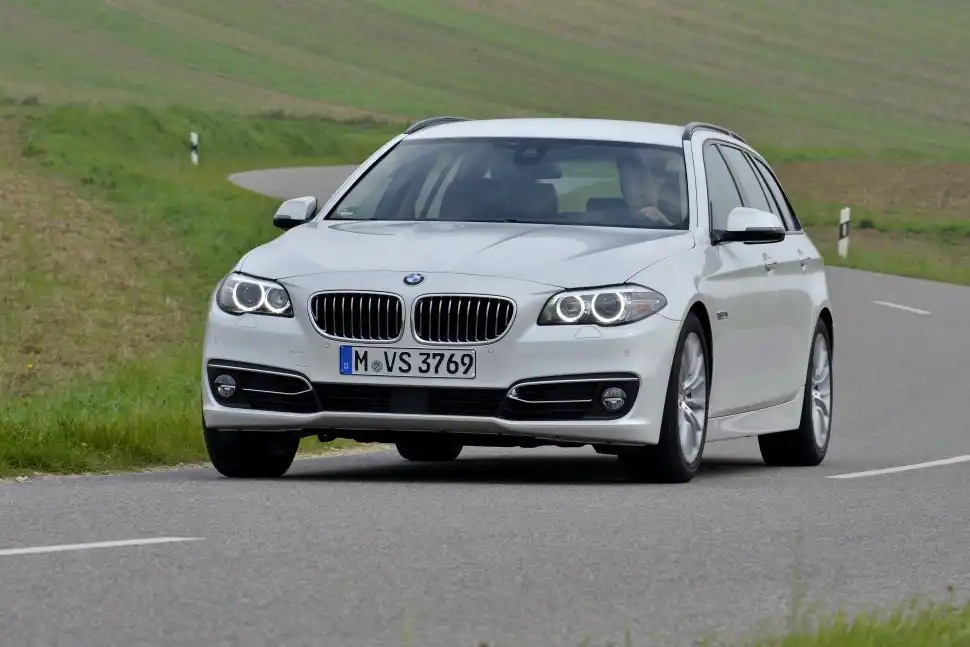
The BMW 5 Series Touring (F11 LCI), specifically the 525d variant produced from 2013 to 2017, represents a mid-cycle refresh of the F11 generation 5 Series wagon. Positioned as a premium executive estate, the 525d offered a blend of practicality, performance, and efficiency, appealing to buyers seeking a versatile vehicle with BMW’s renowned driving dynamics. The “LCI” (Life Cycle Impulse) facelift brought updated styling, improved technology, and refined engine options to the already successful F11 platform, which sat within the broader F10 5 Series sedan and wagon family. This particular 525d model served as a strong mid-range offering, bridging the gap between the more economical 520d and the higher-performance 530d.
Technical Specifications
| Brand | BMW |
| Model | 5 Series |
| Generation | 5 Series Touring (F11 LCI, Facelift 2013) |
| Type (Engine) | 525d (218 Hp) |
| Start of production | 2013 |
| End of production | 2017 |
| Powertrain Architecture | Internal Combustion engine |
| Body type | Station wagon (estate) |
| Seats | 5 |
| Doors | 5 |
| Fuel consumption (urban) | 6.2-6.6 l/100 km (37.9 – 35.6 US mpg, 45.6 – 42.8 UK mpg, 16.1 – 15.2 km/l) |
| Fuel consumption (extra urban) | 4.6-4.9 l/100 km (51.1 – 48 US mpg, 61.4 – 57.6 UK mpg, 21.7 – 20.4 km/l) |
| Fuel consumption (combined) | 5.2-5.6 l/100 km (45.2 – 42 US mpg, 54.3 – 50.4 UK mpg, 19.2 – 17.9 km/l) |
| CO2 emissions | 136-146 g/km |
| Fuel Type | Diesel |
| Acceleration 0 – 100 km/h | 7.2 sec |
| Acceleration 0 – 62 mph | 7.2 sec |
| Acceleration 0 – 60 mph | 6.8 sec |
| Maximum speed | 240 km/h (149.13 mph) |
| Emission standard | Euro 6 |
| Weight-to-power ratio | 8 kg/Hp, 124.6 Hp/tonne |
| Weight-to-torque ratio | 3.9 kg/Nm, 257.1 Nm/tonne |
| Power | 218 Hp @ 4400 rpm |
| Power per litre | 109.3 Hp/l |
| Torque | 450 Nm @ 1500-2500 rpm (331.9 lb.-ft. @ 1500-2500 rpm) |
| Engine layout | Front, Longitudinal |
| Engine Model/Code | N47D20D |
| Engine displacement | 1995 cm3 (121.74 cu. in.) |
| Number of cylinders | 4 |
| Engine configuration | Inline |
| Cylinder Bore | 84 mm (3.31 in.) |
| Piston Stroke | 90 mm (3.54 in.) |
| Compression ratio | 16.5:1 |
| Number of valves per cylinder | 4 |
| Fuel injection system | Diesel Commonrail |
| Engine aspiration | Twin-power turbo, Intercooler |
| Engine oil capacity | 7 l (7.4 US qt | 6.16 UK qt) |
| Coolant | 10 l (10.57 US qt | 8.8 UK qt) |
| Kerb Weight | 1750 kg (3858.09 lbs.) |
| Max. weight | 2400 kg (5291.09 lbs.) |
| Max load | 650 kg (1433 lbs.) |
| Trunk (boot) space – minimum | 560 l (19.78 cu. ft.) |
| Trunk (boot) space – maximum | 1670 l (58.98 cu. ft.) |
| Fuel tank capacity | 70 l (18.49 US gal | 15.4 UK gal) |
| Max. roof load | 100 kg (220.46 lbs.) |
| Permitted trailer load with brakes (12%) | 2000 kg (4409.25 lbs.) |
| Permitted trailer load without brakes | 750 kg (1653.47 lbs.) |
| Permitted towbar download | 90 kg (198.42 lbs.) |
| Length | 4907 mm (193.19 in.) |
| Width | 1860 mm (73.23 in.) |
| Height | 1462 mm (57.56 in.) |
| Wheelbase | 2968 mm (116.85 in.) |
| Front track | 1600 mm (62.99 in.) |
| Rear (Back) track | 1626 mm (64.02 in.) |
| Ride height (ground clearance) | 141 mm (5.55 in.) |
| Minimum turning circle (turning diameter) | 12.0 m (39.37 ft.) |
| Drivetrain Architecture | The Internal combustion engine (ICE) drives the rear wheels of the vehicle. |
| Drive wheel | Rear wheel drive |
| Number of gears and type of gearbox | 6 gears, manual transmission |
| Front suspension | Double wishbone |
| Rear suspension | Independent multi-link suspension |
| Front brakes | Ventilated discs |
| Rear brakes | Ventilated discs |
| Assisting systems | ABS (Anti-lock braking system) |
| Steering type | Steering rack and pinion |
| Power steering | Electric Steering |
| Tires size | 225/55 R17; 245/45 R18; 245/40 R19 |
| Wheel rims size | 8J x 17; 8J x 18; 8.5J x 19 |
INTRODUCTION
The F11 5 Series Touring, launched in 2010 and facelifted in 2013, offered BMW enthusiasts a practical alternative to the sedan without sacrificing the brand’s core driving experience. The 525d LCI, produced between 2013 and 2017, was powered by the N47D20D engine, a 2.0-liter turbocharged diesel inline-four. This engine was a mainstay in BMW’s lineup, known for its fuel efficiency and respectable performance. The 525d Touring aimed to provide a comfortable and capable vehicle for families and individuals needing ample cargo space, while still delivering the engaging driving dynamics expected from a BMW. It occupied a middle ground in the 5 Series Touring range, offering a balance between cost, performance, and fuel economy.
Powertrain & Engine Architecture
The heart of the 525d LCI is the N47D20D engine. This 2.0-liter inline-four diesel utilizes a single twin-scroll turbocharger and common-rail direct injection to deliver 218 horsepower and 450 Nm (331.9 lb-ft) of torque. The engine features 16 valves (four per cylinder) and a compression ratio of 16.5:1. The common-rail system, operating at very high pressures, ensures precise fuel delivery for optimal combustion and reduced emissions. The N47 engine family is known for its relatively complex valvetrain, incorporating variable valve timing (Double-VANOS) and variable valve lift (Valvetronic) on the intake side to optimize engine performance across the rev range. The 525d typically came equipped with a six-speed manual transmission, although an eight-speed automatic was also available as an option. The automatic transmission contributed to improved fuel efficiency and smoother gear changes.
Driving Characteristics
The 525d Touring, with its 218 hp and 450 Nm of torque, provided a respectable level of performance. Acceleration from 0 to 60 mph took around 6.8 seconds, making it adequately quick for everyday driving and overtaking maneuvers. The engine’s peak torque, available from 1500-2500 rpm, meant that strong pulling power was readily accessible, even at lower engine speeds. Compared to the more powerful 530d, the 525d felt less urgent in its acceleration, but it offered a more relaxed and fuel-efficient driving experience. The manual transmission provided a more engaging driving experience, while the optional eight-speed automatic offered seamless shifts and improved fuel economy. The rear-wheel-drive configuration contributed to the BMW’s characteristic balanced handling, although traction could be limited in slippery conditions.
Equipment & Trim Levels
The 525d Touring LCI came standard with a comprehensive list of features, including automatic climate control, power-adjustable front seats, a multi-function steering wheel, and a BMW Professional radio system. Upholstery typically consisted of cloth or leatherette, with full leather available as an option. Optional extras included a navigation system, a premium sound system, heated seats, a panoramic sunroof, and various driver assistance systems such as lane departure warning and adaptive cruise control. Trim levels varied depending on the market, but generally included options for enhanced interior trim materials and exterior styling elements. The LCI facelift brought updated interior trim options and improved infotainment systems.
Chassis & Braking
The F11 5 Series Touring featured a sophisticated chassis design, incorporating a double-wishbone front suspension and an independent multi-link rear suspension. This setup provided a comfortable ride quality while maintaining precise handling characteristics. The 525d typically came equipped with ventilated disc brakes on all four wheels, providing ample stopping power. Anti-lock braking system (ABS), electronic stability control (ESC), and traction control were standard safety features. The suspension was tuned to balance comfort and handling, offering a composed ride even when fully loaded. Stabilizer bars were fitted front and rear to reduce body roll during cornering.
Market Reception & Comparison
The 525d Touring LCI was generally well-received by automotive critics. It was praised for its fuel efficiency, comfortable ride, and spacious interior. Critics noted that the 2.0-liter diesel engine, while capable, lacked the refinement and outright performance of the larger 3.0-liter six-cylinder engines offered in the 5 Series range. However, the 525d offered a compelling value proposition for buyers prioritizing fuel economy and practicality. Compared to the 520d, the 525d offered a noticeable performance upgrade, while remaining more affordable than the 530d. Its main competitors included the Audi A6 Avant and the Mercedes-Benz E-Class Estate.
Legacy
The N47D20D engine, while generally reliable, has been known to exhibit issues with timing chain wear, particularly in earlier iterations. Regular oil changes and preventative maintenance are crucial for ensuring the longevity of this engine. The F11 5 Series Touring, including the 525d variant, has proven to be a durable and practical vehicle, and well-maintained examples continue to hold their value in the used car market. The combination of BMW’s driving dynamics, a spacious interior, and good fuel economy makes the 525d Touring a popular choice for buyers seeking a versatile and refined estate car.