
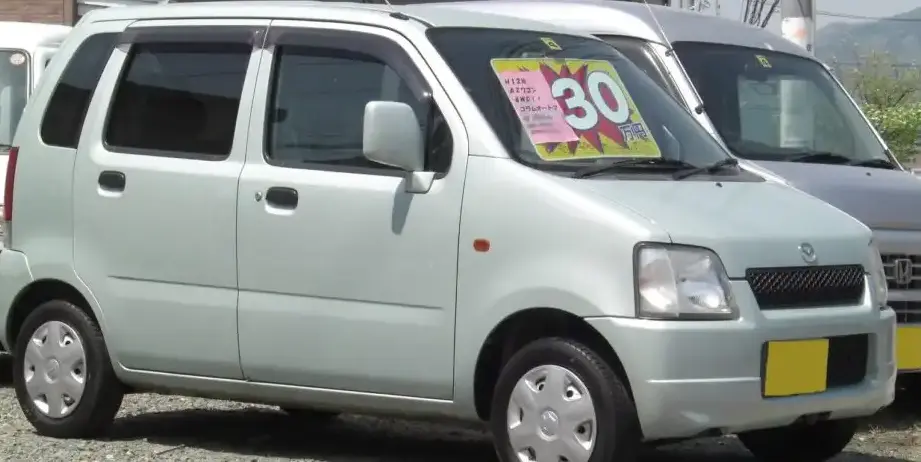
The Mazda Az-Wagon II 0.7 12V Turbo, produced between 1998 and 2000, represents a unique entry in the Japanese Kei car segment. This diminutive minivan, a successor to the original Az-Wagon, was designed to maximize interior space within the strict dimensional and engine size regulations governing Kei cars in Japan. The Az-Wagon II aimed to provide practical and affordable transportation for urban dwellers, and the 0.7-liter turbocharged variant offered a modest performance upgrade over naturally aspirated models. It was primarily sold within the Japanese domestic market (JDM), catering to a need for compact, fuel-efficient vehicles in densely populated areas. This particular configuration, with its small displacement engine and turbocharging, was positioned as a step up from the base models, offering a bit more pep for city driving and highway merging.
Technical Specifications
| Brand | Mazda |
| Model | Az-wagon |
| Generation | Az-wagon II |
| Type (Engine) | 0.7 12V Turbo (60 Hp) |
| Start of production | 1998 |
| End of production | 2000 |
| Powertrain Architecture | Internal Combustion engine |
| Body type | Minivan |
| Seats | 4 |
| Doors | 3/5 |
| Fuel consumption (urban) | 8 l/100 km (29.4 US mpg) |
| Fuel consumption (extra urban) | 4 l/100 km (58.8 US mpg) |
| Fuel Type | Petrol (Gasoline) |
| Maximum speed | 135 km/h (83.89 mph) |
| Weight-to-power ratio | 12.5 kg/Hp |
| Weight-to-torque ratio | 9 kg/Nm |
| Power | 60 Hp @ 6000 rpm |
| Power per litre | 91.3 Hp/l |
| Torque | 83 Nm @ 4000 rpm (61.22 lb.-ft. @ 4000 rpm) |
| Engine layout | Front, Transverse |
| Engine displacement | 657 cm3 (40.09 cu. in.) |
| Number of cylinders | 3 |
| Engine configuration | Inline |
| Cylinder Bore | 65 mm (2.56 in.) |
| Piston Stroke | 66 mm (2.6 in.) |
| Compression ratio | 8.1:1 |
| Number of valves per cylinder | 4 |
| Fuel injection system | Multi-port manifold injection |
| Engine aspiration | Turbocharger |
| Valvetrain | OHC |
| Kerb Weight | 750 kg (1653.47 lbs.) |
| Fuel tank capacity | 30 l (7.93 US gal) |
| Length | 3395 mm (133.66 in.) |
| Width | 1475 mm (58.07 in.) |
| Height | 1690 mm (66.54 in.) |
| Wheelbase | 2360 mm (92.91 in.) |
| Front track | 1290 mm (50.79 in.) |
| Rear track | 1290 mm (50.79 in.) |
| Minimum turning circle | 8.4 m (27.56 ft.) |
| Drivetrain Architecture | Front wheel drive |
| Number of gears | 5 |
| Gearbox type | Manual transmission |
| Front suspension | Spring Strut |
| Rear suspension | Coil spring |
| Front brakes | Disc |
| Rear brakes | Drum |
| Assisting systems | ABS (Anti-lock braking system) |
| Steering type | Steering rack and pinion |
| Tires size | 155/65 R13 |
Powertrain & Engine Architecture
The heart of the Az-Wagon II 0.7 Turbo is its 657cc inline-three cylinder engine, designated with various codes depending on specific sub-models. This engine, while small, benefited from a turbocharger and multi-point fuel injection to boost power output to 60 horsepower at 6000 rpm and 83 Nm (61.22 lb-ft) of torque at 4000 rpm. The turbocharger, a crucial component, allowed the engine to overcome the limitations of its small displacement, providing a noticeable increase in acceleration compared to naturally aspirated versions. The engine featured an overhead camshaft (OHC) valvetrain, operating with four valves per cylinder. The 8.1:1 compression ratio was a compromise between efficiency and the demands of turbocharging. The five-speed manual transmission was the standard offering, designed to keep the engine within its optimal power band. The engine’s transverse mounting and front-wheel-drive configuration were typical for Kei cars, maximizing interior space by eliminating the need for a driveshaft tunnel.
Driving Characteristics
The 0.7-liter turbocharged engine, paired with the five-speed manual transmission, provided a surprisingly lively driving experience for a vehicle of this size. While not a performance car by any means, the turbocharger provided a noticeable boost in acceleration, particularly in the mid-range. The gear ratios were tuned for city driving, with a relatively short first gear for quick starts and a fifth gear for highway cruising. Compared to the naturally aspirated versions, the turbo model offered significantly improved responsiveness, making overtaking and merging onto highways less stressful. However, the engine’s small displacement meant that it could feel strained when fully loaded or climbing steep hills. The lightweight nature of the vehicle (750 kg) helped to offset the modest power output, resulting in a reasonable power-to-weight ratio.
Equipment & Trim Levels
The Az-Wagon II 0.7 Turbo was generally equipped with basic but functional features. Standard equipment typically included power steering, air conditioning (often optional), and a basic audio system. Interior upholstery was typically cloth, with a simple dashboard layout. Higher trim levels might have included features like power windows, central locking, and upgraded audio systems. The focus was on practicality and affordability, rather than luxury. The 3/5 door configuration offered flexibility in terms of access to the rear seats and cargo area. The interior was designed to maximize space within the Kei car dimensions, offering comfortable seating for four adults.
Chassis & Braking
The Az-Wagon II utilized a simple but effective chassis design. Front suspension consisted of MacPherson strut springs, while the rear employed a coil spring setup. This configuration provided a comfortable ride, although handling was not particularly sporty. The front brakes were disc brakes, providing adequate stopping power, while the rear brakes were drums, a cost-saving measure common in this class of vehicle. An Anti-lock Braking System (ABS) was often included as standard equipment, enhancing safety. The steering system was a rack and pinion setup, providing precise and responsive steering.
Market Reception & Comparison
The Mazda Az-Wagon II 0.7 Turbo was well-received in the Japanese market as a practical and affordable Kei car. Critics praised its fuel efficiency, compact size, and surprisingly peppy engine. Compared to other Kei cars in its class, such as the Suzuki Wagon R and the Daihatsu Mira, the Az-Wagon offered a slightly more refined driving experience and a more spacious interior. The turbocharged engine provided a noticeable performance advantage over the base models, making it a popular choice for drivers who needed a bit more power. Fuel economy was a key selling point, with the Az-Wagon achieving around 58.8 US mpg on the highway.
Legacy
The Mazda Az-Wagon II, and particularly the 0.7 Turbo variant, has become a popular choice among enthusiasts of JDM cars. Its compact size, turbocharged engine, and unique styling have made it a sought-after vehicle in the used car market. While not known for any major reliability issues, regular maintenance is essential to keep the turbocharger and engine in good working order. Parts availability can be a challenge outside of Japan, but a growing aftermarket support network is emerging. The Az-Wagon II represents a fascinating example of Japanese automotive engineering, demonstrating how to maximize space and efficiency within a strict set of regulations.
