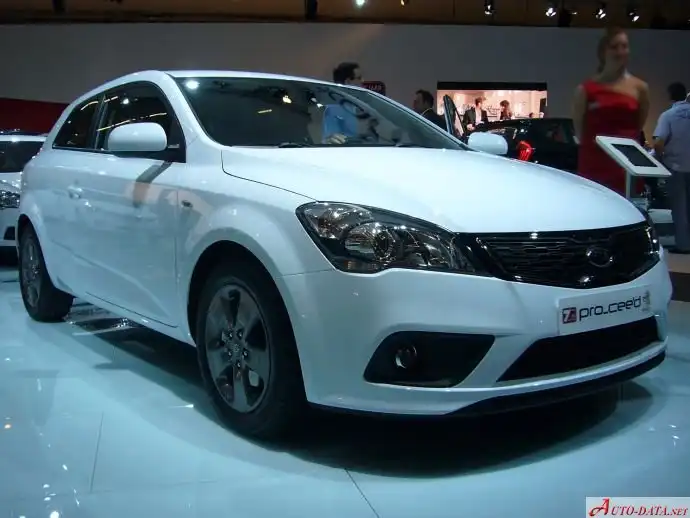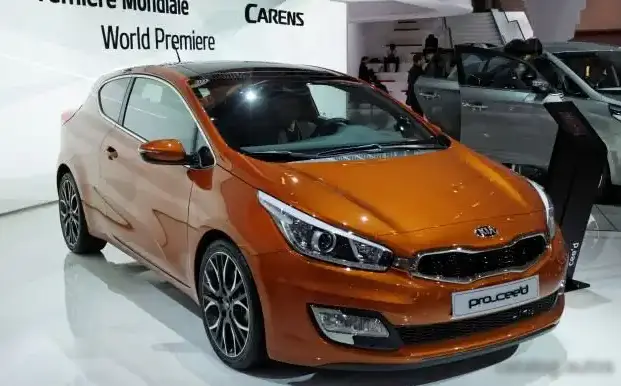
The Kia Pro Cee’d II 1.4D 16V CRDi, producing 90 horsepower, was a key variant in Kia’s European lineup from 2013 to 2015. Positioned as an entry-level diesel option within the second generation Pro Cee’d (JD) series, this three-door hatchback aimed to provide fuel efficiency and affordability to buyers. It was part of the 1HX0/JD platform generation, sharing its underpinnings with the Hyundai i30. This model represented Kia’s growing ambition to compete directly with established European manufacturers in the compact segment.
| Brand | Kia |
| Model | Pro Cee’d |
| Generation | Pro Cee’d II |
| Type (Engine) | 1.4D 16V CRDi (90 Hp) |
| Start of production | 2013 |
| End of production | 2015 |
| Powertrain Architecture | Internal Combustion engine |
| Body type | Hatchback |
| Seats | 5 |
| Doors | 3 |
| Fuel consumption (urban) | 5.4 l/100 km (43.6 US mpg) |
| Fuel consumption (extra urban) | 3.8 l/100 km (61.9 US mpg) |
| Fuel consumption (combined) | 4.3 l/100 km (54.7 US mpg) |
| CO2 emissions | 114 g/km |
| Fuel Type | Diesel |
| Acceleration 0 – 100 km/h | 13.5 sec |
| Acceleration 0 – 62 mph | 13.5 sec |
| Acceleration 0 – 60 mph | 12.8 sec |
| Maximum speed | 170 km/h (105.63 mph) |
| Emission standard | Euro 5 |
| Power | 90 Hp |
| Torque | 220 Nm @ 1500 rpm (162.26 lb.-ft. @ 1500 rpm) |
| Engine layout | Front, Transverse |
| Engine Model/Code | D4FC |
| Engine displacement | 1396 cm3 (85.19 cu. in.) |
| Number of cylinders | 4 |
| Engine configuration | Inline |
| Number of valves per cylinder | 4 |
| Fuel injection system | Diesel Commonrail |
| Engine aspiration | Turbocharger, Intercooler |
| Engine oil capacity | 5.3 l (5.6 US qt | 4.66 UK qt) |
| Coolant capacity | 6.9 l (7.29 US qt | 6.07 UK qt) |
| Trunk (boot) space (minimum) | 380 l (13.42 cu. ft.) |
| Fuel tank capacity | 53 l (14 US gal | 11.66 UK gal) |
| Length | 4310 mm (169.69 in.) |
| Width | 1780 mm (70.08 in.) |
| Height | 1430 mm (56.3 in.) |
| Wheelbase | 2650 mm (104.33 in.) |
| Minimum turning circle | 10.6 m (34.78 ft.) |
| Drivetrain | Front wheel drive |
| Number of gears | 6 |
| Gearbox type | Manual transmission |
| Front brakes | Ventilated discs |
| Rear brakes | Disc |
| Steering type | Steering rack and pinion |
| Power steering | Electric |
| Tires size | 195/65 R15; 205/55 R16; 225/45 R17 |
| Wheel rims size | 15; 16; 17 |
Powertrain & Engine Architecture
The heart of the Pro Cee’d II 1.4D 16V CRDi is the D4FC engine, a 1.4-liter inline-four cylinder diesel. This engine utilizes a second-generation common rail direct injection system, delivering fuel at extremely high pressures for optimized combustion. The engine is turbocharged with a variable geometry turbocharger (VGT) and intercooled, enhancing both power and efficiency. The 16-valve configuration (four valves per cylinder) contributes to improved breathing and overall performance. The engine’s architecture was designed to meet stringent Euro 5 emission standards, incorporating a diesel particulate filter (DPF) to reduce particulate matter emissions. The six-speed manual transmission was the only gearbox option available with this engine, prioritizing fuel economy over outright performance.
Driving Characteristics
The 90 horsepower output and 220 Nm (162 lb-ft) of torque delivered by the 1.4D engine resulted in a driving experience focused on fuel efficiency and usability rather than sporty performance. Acceleration from 0 to 60 mph took around 12.8 seconds, and top speed was limited to 105.63 mph. The engine’s torque peak at 1500 rpm provided adequate pulling power for everyday driving situations, making it suitable for urban commutes and highway cruising. Compared to the more powerful 1.6 GDI gasoline engine or the higher-output diesel variants, the 1.4D felt noticeably less responsive. The six-speed manual transmission offered precise shifts, but the gear ratios were tuned for economy, meaning frequent downshifts were often required when overtaking or climbing hills.
Equipment & Trim Levels
The 1.4D CRDi typically came equipped as a base or mid-range trim level. Standard features generally included air conditioning, electric front windows, a basic audio system with USB connectivity, and ABS brakes with Electronic Stability Control (ESC). Higher trim levels, such as the ‘2’ or ‘3’ trims, added features like alloy wheels, rear parking sensors, cruise control, and a more sophisticated infotainment system. Interior upholstery was typically cloth, with a functional and durable design. Optional extras included a panoramic sunroof, leather upholstery, and a navigation system. The overall interior design prioritized practicality and build quality over luxury.
Chassis & Braking
The Pro Cee’d II utilized a MacPherson strut front suspension and a coupled torsion beam rear suspension. This setup provided a good balance between ride comfort and handling. The front brakes were ventilated discs, offering adequate stopping power, while the rear brakes were solid discs. The electric power steering provided light and precise steering feel. Stabilizer bars were fitted to both the front and rear axles to reduce body roll during cornering. The suspension tuning was geared towards comfort, resulting in a relatively soft ride quality. Tire sizes varied depending on the trim level, ranging from 195/65 R15 to 225/45 R17.
Market Reception & Comparison
The Kia Pro Cee’d II 1.4D 16V CRDi was generally well-received by automotive critics for its fuel efficiency and value for money. It offered a compelling alternative to established European rivals like the Volkswagen Golf and Ford Focus, particularly for buyers prioritizing economy. However, some critics noted that the engine lacked refinement and felt underpowered compared to some competitors. Fuel economy figures of around 54.7 US mpg combined were a major selling point. Compared to the higher-output diesel variants (such as the 1.6 CRDi), the 1.4D offered lower running costs but sacrificed performance. The manual transmission was praised for its precise shifts, but some drivers preferred the convenience of an automatic gearbox.
Legacy
The D4FC engine, while not known for being exceptionally durable, proved to be reasonably reliable in the Pro Cee’d II. Common issues included DPF blockages (particularly with frequent short journeys) and occasional turbocharger failures. However, with regular maintenance and careful driving, the engine could provide many years of service. In the used car market, the 1.4D CRDi variant remains a popular choice for budget-conscious buyers seeking a fuel-efficient and practical hatchback. Its affordability and low running costs continue to make it an attractive option, despite its relatively modest performance.