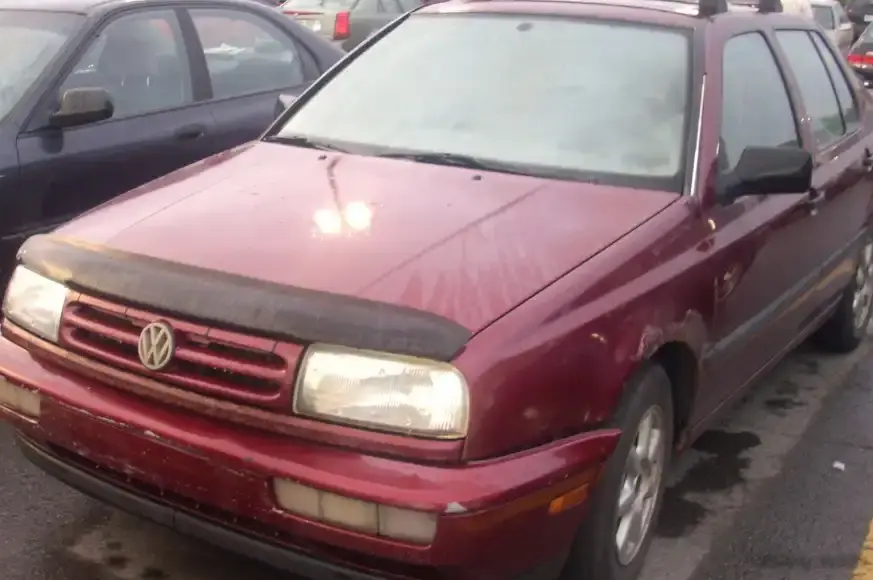
The Volkswagen Jetta III 1.6, producing 75 horsepower, was a mainstay of the Jetta lineup during its brief 1994-1995 production run. Positioned as the entry-level model, it offered affordable transportation within the broader Jetta III (1993-1999) generation, which itself was based on the Volkswagen Golf Mk3 platform (1HX0/A3). This variant aimed at budget-conscious buyers prioritizing fuel efficiency and practicality over outright performance. It represented a significant update over the previous Jetta II, offering improved refinement, safety features, and a more modern design.
Technical Specifications
| Brand | Volkswagen |
| Model | Jetta |
| Generation | Jetta III |
| Type (Engine) | 1.6 (75 Hp) |
| Start of production | 1994 |
| End of production | 1995 |
| Powertrain Architecture | Internal Combustion engine |
| Body type | Sedan |
| Seats | 5 |
| Doors | 4 |
| Fuel consumption (urban) | 9.1 l/100 km (25.8 US mpg, 31 UK mpg, 11 km/l) |
| Fuel consumption (extra urban) | 5.8 l/100 km (40.6 US mpg, 48.7 UK mpg, 17.2 km/l) |
| Fuel consumption (combined) | 7.6 l/100 km (30.9 US mpg, 37.2 UK mpg, 13.2 km/l) |
| Fuel Type | Petrol (Gasoline) |
| Acceleration 0 – 100 km/h | 14.4 sec |
| Acceleration 0 – 62 mph | 14.4 sec |
| Acceleration 0 – 60 mph | 13.7 sec |
| Maximum speed | 168 km/h (104.39 mph) |
| Weight-to-power ratio | 14.1 kg/Hp, 70.8 Hp/tonne |
| Weight-to-torque ratio | 8.3 kg/Nm, 120.8 Nm/tonne |
| Power | 75 Hp @ 5200 rpm |
| Power per litre | 46.9 Hp/l |
| Torque | 128 Nm @ 2800 rpm (94.41 lb.-ft. @ 2800 rpm) |
| Engine layout | Front, Transverse |
| Engine Model/Code | AEA |
| Engine displacement | 1598 cm3 (97.52 cu. in.) |
| Number of cylinders | 4 |
| Engine configuration | Inline |
| Cylinder Bore | 76.5 mm (3.01 in.) |
| Piston Stroke | 86.9 mm (3.42 in.) |
| Compression ratio | 9.3:1 |
| Number of valves per cylinder | 2 |
| Fuel injection system | Multi-port manifold injection |
| Engine aspiration | Naturally aspirated engine |
| Valvetrain | OHC |
| Engine oil capacity | 3.4 l (3.59 US qt | 2.99 UK qt) |
| Coolant | 5.6 l (5.92 US qt | 4.93 UK qt) |
| Kerb Weight | 1060 kg (2336.9 lbs.) |
| Max. weight | 1565 kg (3450.23 lbs.) |
| Max load | 505 kg (1113.33 lbs.) |
| Trunk (boot) space – minimum | 425 l (15.01 cu. ft.) |
| Trunk (boot) space – maximum | 885 l (31.25 cu. ft.) |
| Fuel tank capacity | 55 l (14.53 US gal | 12.1 UK gal) |
| Length | 4380 mm (172.44 in.) |
| Width | 1695 mm (66.73 in.) |
| Height | 1425 mm (56.1 in.) |
| Wheelbase | 2475 mm (97.44 in.) |
| Front track | 1465 mm (57.68 in.) |
| Rear (Back) track | 1448 mm (57.01 in.) |
| Drivetrain Architecture | The Internal combustion engine (ICE) drives the front wheels of the vehicle. |
| Drive wheel | Front wheel drive |
| Number of gears and type of gearbox | 5 gears, manual transmission |
| Front suspension | Wishbone |
| Rear suspension | Suspension with traction connecting levers |
| Front brakes | Disc |
| Rear brakes | Drum |
| Assisting systems | ABS (Anti-lock braking system) |
| Steering type | Steering rack and pinion |
| Power steering | Hydraulic Steering |
| Tires size | 185/60 R14 |
| Wheel rims size | 6J x 15 |
Powertrain & Engine Architecture
The Jetta III 1.6 was powered by the Volkswagen EA827 engine, specifically the AEA variant. This 1.6-liter inline-four engine featured a single overhead camshaft (OHC) design and two valves per cylinder. It utilized a multi-port fuel injection system, a common feature for the time, providing improved fuel atomization and efficiency compared to earlier carburetor-based systems. The AEA engine was known for its relative simplicity and durability, though it wasn’t a powerhouse. The engine’s 9.3:1 compression ratio was a compromise between performance and the ability to run on readily available fuel grades. The five-speed manual transmission was the standard offering, providing a reasonably efficient drivetrain for everyday driving.
Driving Characteristics
The 75 horsepower and 128 Nm (94.41 lb-ft) of torque delivered by the 1.6-liter engine resulted in modest performance. Acceleration from 0 to 60 mph took around 13.7 seconds, and the top speed was approximately 104 mph. Compared to the more powerful Jetta GLX models with the 1.8-liter or VR6 engines, the 1.6 felt noticeably slower, particularly when fully loaded or climbing hills. The five-speed manual transmission helped to keep the engine in its optimal power band, but it still required frequent downshifting for overtaking maneuvers. The gear ratios were geared towards fuel economy rather than spirited driving. The driving experience was best described as comfortable and predictable, prioritizing ease of use over excitement.
Equipment & Trim Levels
The Jetta III 1.6 typically came with a basic level of equipment. Standard features included power steering, central locking, and a basic stereo system. Interior upholstery was typically cloth, and the dashboard featured a simple, functional design. Options included power windows, a sunroof, and upgraded audio systems. The 1.6 model was often seen as a blank canvas for buyers who wanted to add features incrementally. It lacked many of the luxury appointments found in the higher trim levels, such as leather seats or alloy wheels.
Chassis & Braking
The Jetta III utilized a MacPherson strut front suspension and a torsion beam rear suspension. This setup provided a comfortable ride, although it wasn’t particularly sporty. The front brakes were disc brakes, while the rear brakes were drum brakes – a cost-saving measure common in entry-level models. ABS (Anti-lock Braking System) was available as an option, enhancing safety. The chassis was relatively lightweight, contributing to the car’s fuel efficiency. Stabilizer bars were present, but were relatively thin compared to those found on higher-performance Jetta models.
Market Reception & Comparison
The Jetta III 1.6 was generally well-received as an affordable and practical family sedan. Critics praised its fuel efficiency and comfortable ride, but noted its lack of power. Compared to the 1.8-liter and VR6 versions, the 1.6 offered significantly lower performance but also a lower purchase price and potentially better fuel economy. The 1.8-liter engine provided a noticeable performance boost without a substantial increase in cost, making it a popular alternative. The 1.6 was often seen as a sensible choice for buyers who prioritized economy and reliability over driving thrills.
Legacy
The Volkswagen Jetta III 1.6, while not the most exciting variant in the lineup, proved to be a reliable and durable vehicle. The AEA engine is known for its longevity, and many examples are still on the road today. Parts availability remains good, making maintenance relatively straightforward. In the used car market, the 1.6 models are typically the most affordable Jetta III variants, making them an attractive option for budget-conscious buyers. While it may not offer the performance of its more powerful siblings, the Jetta III 1.6 remains a testament to Volkswagen’s commitment to building practical and dependable automobiles.