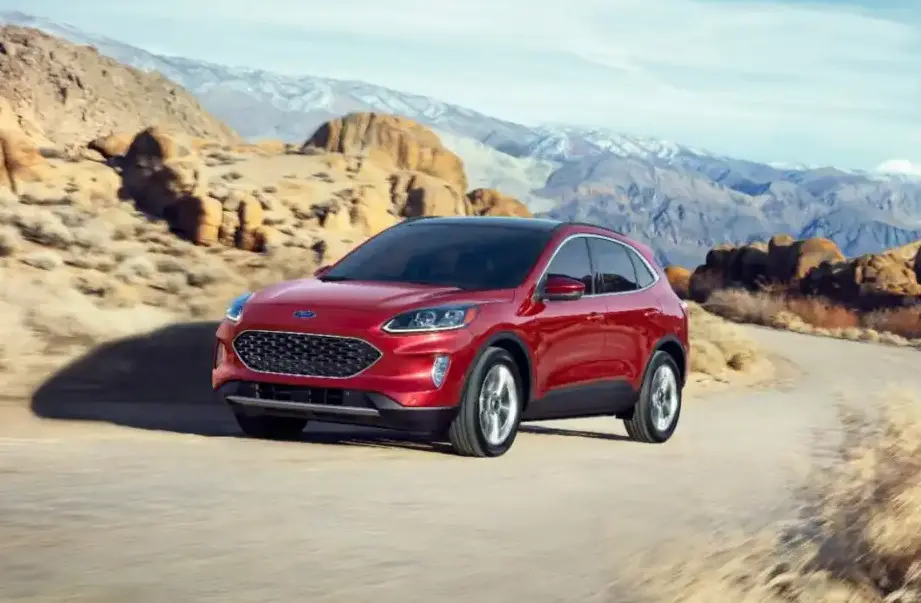
The Ford Escape IV 2.5 Hybrid i-AWD eCVT, produced from 2020 to 2022, represents Ford’s entry into the increasingly competitive compact hybrid SUV segment in North America. This variant occupied a mid-range position within the fourth-generation Escape lineup, offering a balance between fuel efficiency, all-weather capability with its intelligent all-wheel drive system, and a reasonable level of standard equipment. It was designed to appeal to buyers seeking a practical and economical SUV without sacrificing the versatility expected of the Escape model. The Escape IV generation, built on the C2 platform, aimed to modernize the Escape’s design and improve its overall driving experience.
Technical Specifications
| Brand | Ford |
| Model | Escape |
| Generation | Escape IV |
| Type (Engine) | 2.5 (200 Hp) Hybrid i-AWD eCVT |
| Start of production | 2020 |
| End of production | 2022 |
| Powertrain Architecture | FHEV (Full Hybrid Electric Vehicle) |
| Body type | SUV |
| Seats | 5 |
| Doors | 5 |
| Fuel consumption (urban) | 5.5 l/100 km (42.8 US mpg) |
| Fuel consumption (extra urban) | 6.4 l/100 km (36.8 US mpg) |
| Fuel consumption (combined) | 5.9 l/100 km (39.9 US mpg) |
| Fuel Type | Petrol (Gasoline) |
| Weight-to-power ratio | 8.4 kg/Hp |
| Weight-to-torque ratio | 8 kg/Nm |
| Gross battery capacity | 1.1 kWh |
| Battery technology | Lithium-ion (Li-Ion) |
| Electric motor power | 120 Hp |
| System power | 200 Hp @ 6250 rpm |
| Engine Power | 162 Hp |
| Power per litre | 65 Hp/l |
| Torque | 210 Nm @ 4500 rpm (154.89 lb.-ft. @ 4500 rpm) |
| Engine layout | Front, Transverse |
| Engine displacement | 2491 cm3 (152.01 cu. in.) |
| Number of cylinders | 4 |
| Engine configuration | Inline |
| Cylinder Bore | 88.9 mm (3.5 in.) |
| Piston Stroke | 100.08 mm (3.94 in.) |
| Compression ratio | 13:1 |
| Number of valves per cylinder | 4 |
| Fuel injection system | Multi-port manifold injection |
| Engine aspiration | Naturally aspirated engine |
| Valvetrain | DOHC, IVCT |
| Engine oil capacity | 5.4 l (5.71 US qt | 4.75 UK qt) |
| Coolant capacity | 9.1 l (9.62 US qt | 8.01 UK qt) |
| Kerb Weight | 1681 kg (3705.97 lbs.) |
| Trunk (boot) space – minimum | 869 l (30.69 cu. ft.) |
| Trunk (boot) space – maximum | 1722 l (60.81 cu. ft.) |
| Fuel tank capacity | 54 l (14.27 US gal | 11.88 UK gal) |
| Length | 4585 mm (180.51 in.) |
| Width | 1882 mm (74.09 in.) |
| Width with mirrors folded | 1999 mm (78.7 in.) |
| Width including mirrors | 2174 mm (85.59 in.) |
| Height | 1679 mm (66.1 in.) |
| Wheelbase | 2710 mm (106.69 in.) |
| Front track | 1585 mm (62.4 in.) |
| Rear track | 1570 mm (61.81 in.) |
| Drivetrain Architecture | ICE and electric motor drive front wheels, rear wheels driven via clutch |
| Drive wheel | All wheel drive (4×4) |
| Number of gears | automatic transmission eCVT |
| Front suspension | Independent, McPherson with coil spring and anti-roll bar |
| Rear suspension | Independent multi-link with stabilizer |
| Front brakes | Disc |
| Rear brakes | Disc |
| Steering type | Steering rack and pinion |
| Power steering | Electric |
| Tires size | 225/65 R17 102H |
| Wheel rims size | 17 |
INTRODUCTION
The 2020-2022 Ford Escape 2.5 Hybrid i-AWD eCVT is a five-passenger compact SUV that represents a significant step forward in Ford’s hybrid technology. It’s part of the fourth generation of the Escape (introduced in 2019), which saw a complete redesign focused on improved fuel economy, technology, and driving dynamics. The “i-AWD” designation signifies Ford’s intelligent all-wheel drive system, which automatically engages the rear wheels when needed for enhanced traction. This particular variant, with its 2.5-liter hybrid powertrain and continuously variable transmission (eCVT), was positioned as a practical and efficient choice for families and commuters seeking a versatile SUV.
Powertrain & Engine Architecture
At the heart of the Escape Hybrid is a 2.5-liter Atkinson-cycle inline-four cylinder gasoline engine. This engine, designated as part of the Ford “Gen IV” engine family, produces 162 horsepower. The Atkinson cycle prioritizes efficiency over outright power, achieving this by delaying the closing of the intake valves, allowing for more complete combustion. Supplementing the gasoline engine is an electric motor capable of producing 120 horsepower, bringing the total system output to 200 horsepower at 6250 rpm. The combined torque output is 210 Nm (154.89 lb-ft) at 4500 rpm. The engine utilizes multi-port fuel injection and a double overhead camshaft (DOHC) valvetrain with intelligent variable camshaft timing (IVCT). The eCVT (electronically controlled continuously variable transmission) seamlessly blends the power from the gasoline engine and electric motor, providing smooth and efficient acceleration. The 1.1 kWh lithium-ion battery pack is relatively small, prioritizing weight savings and packaging efficiency over extended all-electric range.
Driving Characteristics
The Escape 2.5 Hybrid i-AWD delivers a comfortable and refined driving experience. The eCVT, while not offering the traditional gear changes of a conventional automatic, provides smooth and linear acceleration. Compared to the 1.5L EcoBoost turbocharged engine option, the hybrid feels less responsive in initial acceleration, but the combined output provides adequate power for everyday driving situations. The i-AWD system operates seamlessly, providing enhanced traction in slippery conditions without noticeable intervention. The hybrid system allows for short periods of all-electric driving at lower speeds, further enhancing fuel efficiency. The steering is light and precise, making the Escape easy to maneuver in urban environments. While not a sporty SUV, the Escape Hybrid offers a composed and predictable ride quality.
Equipment & Trim Levels
The 2.5 Hybrid i-AWD typically came standard with features such as Ford’s SYNC 3 infotainment system with an 8-inch touchscreen, Apple CarPlay and Android Auto compatibility, a rearview camera, automatic climate control, and a suite of driver-assistance technologies including automatic emergency braking, lane-keeping assist, and blind-spot monitoring. Interior upholstery was typically cloth, with available upgrades to leather. Optional extras included a panoramic sunroof, a premium audio system, and adaptive cruise control. Trim levels varied slightly depending on the model year, but generally included options like SE, SEL, and Titanium, with each successive trim adding more luxury and convenience features.
Chassis & Braking
The Escape IV utilizes an independent front suspension with McPherson struts and a coil spring, coupled with an independent multi-link rear suspension. This setup provides a comfortable ride and good handling characteristics. The i-AWD system adds a rear differential and clutch pack to distribute torque to the rear wheels as needed. All four wheels are equipped with disc brakes, providing ample stopping power. The braking system is assisted by ABS (Anti-lock Braking System) and electronic brake-force distribution. The suspension tuning is geared towards comfort and practicality, rather than outright performance. Stabilizer bars are present on both the front and rear axles to reduce body roll during cornering.
Market Reception & Comparison
The Ford Escape Hybrid i-AWD was generally well-received by critics, who praised its fuel efficiency, comfortable ride, and user-friendly technology. Compared to the non-hybrid Escape models, the hybrid offered significantly improved fuel economy, making it an attractive option for environmentally conscious buyers. Compared to competitors like the Toyota RAV4 Hybrid and Honda CR-V Hybrid, the Escape Hybrid offered a competitive level of features and performance, although some reviewers noted that its interior materials weren’t quite as premium as those found in some rivals. The hybrid powertrain also proved to be reliable, with few widespread reports of major mechanical issues.
Legacy
The Ford Escape IV 2.5 Hybrid i-AWD represents a pivotal moment in Ford’s electrification strategy. The powertrain, while not groundbreaking, proved to be durable and efficient. On the used car market, these Escapes hold their value reasonably well, particularly those with lower mileage and well-maintained service records. The combination of fuel efficiency, all-wheel drive capability, and a comfortable interior continues to make it a popular choice for buyers seeking a practical and economical compact SUV. The success of this hybrid variant paved the way for Ford to expand its hybrid and electric vehicle offerings in subsequent years.