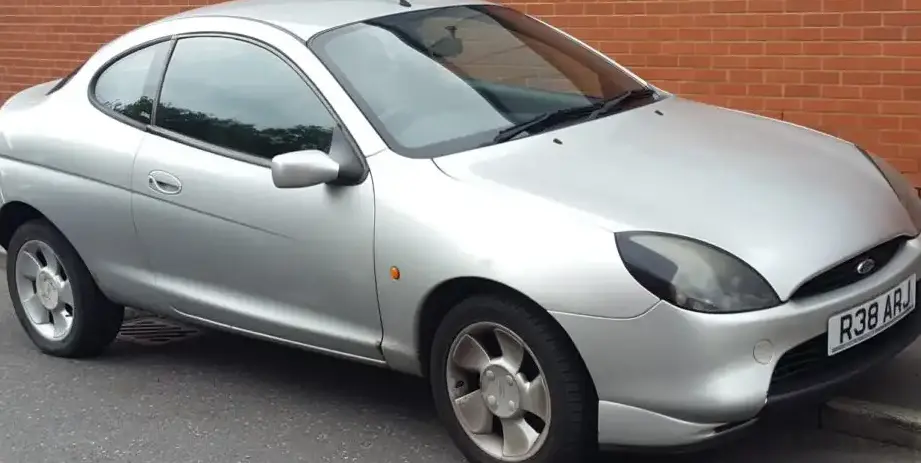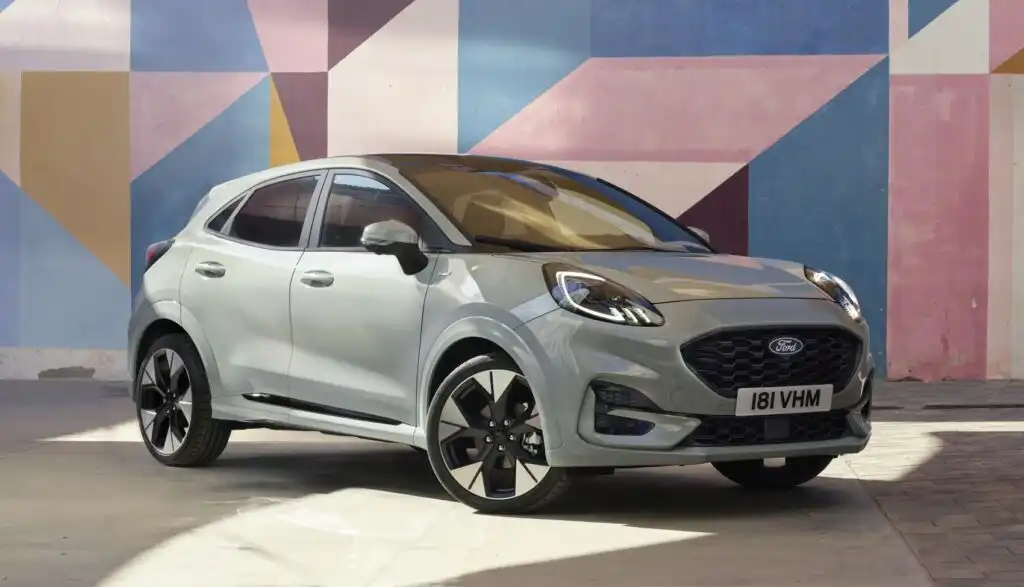
The Ford Puma 1.0 EcoBoost 95 hp model, produced from September 2020 to December 2021, represents an entry-level offering within the revived Puma lineup. Positioned as a fuel-efficient and accessible crossover SUV, it aimed to attract buyers seeking a practical and affordable vehicle with modern styling. This variant played a key role in re-establishing the Puma nameplate, originally a popular coupe from the 1990s, as a contemporary subcompact SUV for the European market and beyond. The Puma, built on Ford’s B2E platform, was intended to compete with vehicles like the Renault Captur, Peugeot 2008, and Volkswagen T-Cross.
Technical Specifications
| Brand | Ford |
| Model | Puma |
| Generation | Puma |
| Type (Engine) | 1.0 EcoBoost (95 Hp) |
| Start of production | September, 2020 |
| End of production | December, 2021 |
| Powertrain Architecture | Internal Combustion engine |
| Body type | SUV, Crossover |
| Seats | 5 |
| Doors | 5 |
| Fuel consumption (urban) | 5.4-5.5 l/100 km (43.6 – 42.8 US mpg) |
| Fuel consumption (extra urban) | 4.0-4.1 l/100 km (58.8 – 57.4 US mpg) |
| Fuel consumption (combined) | 4.5-4.6 l/100 km (52.3 – 51.1 US mpg) |
| CO2 emissions | 102-105 g/km |
| Fuel Type | Petrol (Gasoline) |
| Acceleration 0 – 100 km/h | 11.9 sec |
| Acceleration 0 – 62 mph | 11.9 sec |
| Acceleration 0 – 60 mph | 11.3 sec |
| Maximum speed | 175 km/h (108.74 mph) |
| Emission standard | Euro 6d-ISC-FCM |
| Weight-to-power ratio | 13.5 kg/Hp |
| Weight-to-torque ratio | 7.5 kg/Nm |
| Power | 95 Hp @ 4000 rpm |
| Torque | 170 Nm @ 1750-3900 rpm (125.39 lb.-ft.) |
| Engine layout | Front, Transverse |
| Engine Model/Code | M0JA |
| Engine displacement | 999 cm3 (60.96 cu. in.) |
| Number of cylinders | 3 |
| Engine configuration | Inline |
| Number of valves per cylinder | 4 |
| Fuel injection system | Direct injection |
| Engine aspiration | Turbocharger, Intercooler |
| Valvetrain | DOHC |
| Engine oil capacity | 4.6 l (4.86 US qt | 4.05 UK qt) |
| Coolant capacity | 5.6 l (5.92 US qt | 4.93 UK qt) |
| Kerb Weight | 1280 kg (2821.92 lbs.) |
| Max. weight | 1770 kg (3902.18 lbs.) |
| Max load | 490 kg (1080.27 lbs.) |
| Trunk (boot) space – minimum | 456 l (16.1 cu. ft.) |
| Trunk (boot) space – maximum | 1216 l (42.94 cu. ft.) |
| Length | 4186 mm (164.8 in.) |
| Width with mirrors folded | 1805 mm (71.06 in.) |
| Width including mirrors | 1930 mm (75.98 in.) |
| Height | 1536 mm (60.47 in.) |
| Wheelbase | 2588 mm (101.89 in.) |
| Front overhang | 850 mm (33.46 in.) |
| Rear overhang | 748 mm (29.45 in.) |
| Ride height (ground clearance) | 166 mm (6.54 in.) |
| Minimum turning circle | 10.3 m (33.79 ft.) |
| Drivetrain | Front wheel drive |
| Number of gears | 6 |
| Gearbox type | Manual transmission |
| Front brakes | Disc |
| Rear brakes | Disc |
| Tires size | 205/65 R16 |
| Wheel rims size | 6J x 16 |
Powertrain & Engine Architecture
The heart of the Puma 1.0 EcoBoost 95 hp is the Ford M0JA engine, a 1.0-liter, three-cylinder turbocharged gasoline engine. This engine is part of Ford’s EcoBoost family, known for its combination of small displacement, turbocharging, and direct fuel injection. The M0JA utilizes a single-scroll turbocharger and high-pressure direct injection to deliver improved efficiency and responsiveness. The engine features a double overhead camshaft (DOHC) valvetrain with four valves per cylinder, optimizing airflow for enhanced performance. The 95 hp output is achieved at 4000 rpm, while peak torque of 170 Nm (125 lb-ft) is available from 1750 to 3900 rpm. This engine is paired with a six-speed manual transmission, providing a balance between fuel economy and driver engagement. Ford also incorporated Start & Stop technology and a particulate filter to reduce emissions and improve fuel efficiency.
Driving Characteristics
The 1.0 EcoBoost 95 hp Puma offers adequate performance for everyday driving. Acceleration from 0-60 mph takes around 11.3 seconds, and the top speed is 175 km/h (108.74 mph). While not particularly sporty, the engine provides sufficient power for merging onto highways and navigating city streets. The turbocharger provides a noticeable boost in power, but the engine can feel somewhat strained when fully loaded or climbing hills. The six-speed manual transmission is well-matched to the engine, offering precise shifts and allowing drivers to keep the engine in its optimal power band. Compared to higher-output EcoBoost variants (like the 125 hp version), the 95 hp model feels less energetic, but it compensates with improved fuel economy. The gear ratios are tuned for efficiency, prioritizing fuel savings over outright acceleration.
Equipment & Trim Levels
The 95 hp Puma typically came with a reasonable level of standard equipment. Base models included features such as air conditioning, a 8-inch touchscreen infotainment system with Apple CarPlay and Android Auto compatibility, Ford’s SYNC 3 system, and a suite of safety features including lane-keeping assist, pre-collision assist with pedestrian and cyclist detection, and automatic emergency braking. Interior upholstery was typically cloth, and the dashboard featured a simple, functional design. Optional extras included alloy wheels, a panoramic sunroof, rear parking sensors, and a premium sound system. Higher trim levels, such as Titanium and ST-Line, offered more luxurious features and sporty styling cues, but the 95 hp engine remained available as an entry-level option.
Chassis & Braking
The Puma’s chassis is tuned for comfort and stability. It utilizes independent front suspension with MacPherson struts and a twist-beam rear suspension. The front brakes are discs, while the rear brakes are also discs on most variants. The steering is an electric power-assisted steering (EPAS) system, providing light and precise steering feel. The suspension setup is geared towards absorbing bumps and providing a comfortable ride, rather than offering sporty handling. Stabilizer bars are fitted to both the front and rear axles to reduce body roll during cornering. The 1280 kg (2821.92 lbs) kerb weight contributes to a stable and predictable driving experience.
Market Reception & Comparison
The Ford Puma 1.0 EcoBoost 95 hp was generally well-received by critics as a practical and affordable crossover. Reviewers praised its fuel efficiency, comfortable ride, and modern features. However, some criticized its relatively modest performance and the somewhat basic interior materials in base models. Compared to the 125 hp EcoBoost variant, the 95 hp model offered better fuel economy but lacked the same level of performance. It was often seen as a sensible choice for buyers prioritizing economy and practicality over driving excitement. The Puma’s fuel economy figures of 4.5-4.6 l/100 km (52.3 – 51.1 US mpg) were competitive within its segment.
Legacy
The Ford Puma 1.0 EcoBoost 95 hp has proven to be a relatively reliable powertrain. The EcoBoost engine, while complex, has generally demonstrated good durability when properly maintained. Common issues reported include occasional turbocharger problems and potential issues with the timing chain. However, these are not widespread concerns. On the used car market, the 95 hp Puma represents a good value proposition for buyers seeking an affordable and fuel-efficient crossover. Its lower price point compared to higher-spec models makes it an attractive option for first-time buyers or those on a budget. The Puma’s revival as a crossover SUV has been successful, and the 1.0 EcoBoost 95 hp variant played a significant role in establishing its presence in the market.