
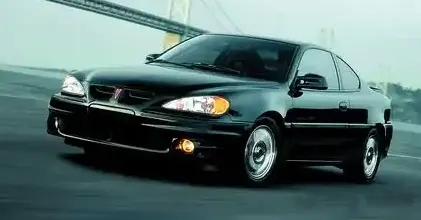
The Pontiac Grand Am Coupe (H) with the 3.1i V6 engine and automatic transmission represents a significant iteration of Pontiac’s popular compact car, produced from 1991 through 1998. This variant occupied a middle ground within the Grand Am lineup, offering a balance between affordability and performance. It was positioned above the base four-cylinder models and below the more performance-oriented trims. The “H” designation refers to the second generation of the Grand Am coupe, built on the N-body platform, which was shared with other GM vehicles like the Buick Skylark and Oldsmobile Cutlass Supreme. This generation aimed to modernize the Grand Am’s styling and improve its overall refinement.
Technical Specifications
| Brand | Pontiac |
| Model | Grand AM |
| Generation | Grand AM Coupe (H) |
| Type (Engine) | 3.1i V6 (155 Hp) Automatic |
| Start of production | 1991 |
| End of production | 1998 |
| Powertrain Architecture | Internal Combustion engine |
| Body type | Coupe |
| Seats | 5 |
| Doors | 2 |
| Fuel consumption (urban) | 9.8 l/100 km (24 US mpg) |
| Fuel consumption (extra urban) | 7.3 l/100 km (32.2 US mpg) |
| Fuel consumption (combined) | 8.4 l/100 km (28 US mpg) |
| Fuel Type | Petrol (Gasoline) |
| Maximum speed | 190 km/h (118.06 mph) |
| Weight-to-power ratio | 9 kg/Hp |
| Weight-to-torque ratio | 5.6 kg/Nm |
| Power | 155 Hp @ 5200 rpm |
| Power per litre | 49.4 Hp/l |
| Torque | 251 Nm @ 4000 rpm (185.13 lb.-ft. @ 4000 rpm) |
| Engine layout | Front, Transverse |
| Engine Model/Code | L82 |
| Engine displacement | 3135 cm3 (191.31 cu. in.) |
| Number of cylinders | 6 |
| Engine configuration | V-engine |
| Cylinder Bore | 89 mm (3.5 in.) |
| Piston Stroke | 84 mm (3.31 in.) |
| Compression ratio | 9.6:1 |
| Number of valves per cylinder | 2 |
| Fuel injection system | Multi-port manifold injection |
| Engine aspiration | Naturally aspirated engine |
| Engine oil capacity | 4.3 l (4.54 US qt | 3.78 UK qt) |
| Coolant capacity | 12.9 l (13.63 US qt | 11.35 UK qt) |
| Kerb Weight | 1395 kg (3075.45 lbs.) |
| Trunk (boot) space (minimum) | 415 l (14.66 cu. ft.) |
| Fuel tank capacity | 54 l (14.27 US gal | 11.88 UK gal) |
| Length | 4750 mm (187.01 in.) |
| Width | 1730 mm (68.11 in.) |
| Height | 1360 mm (53.54 in.) |
| Wheelbase | 2630 mm (103.54 in.) |
| Front track | 1500 mm (59.06 in.) |
| Rear track | 1500 mm (59.06 in.) |
| Drivetrain Architecture | Front wheel drive |
| Number of gears | 4 |
| Gearbox type | Automatic transmission |
| Front suspension | Spring Strut |
| Rear suspension | Spring Strut |
| Front brakes | Ventilated discs |
| Rear brakes | Drum |
| Assisting systems | ABS (Anti-lock braking system) |
| Steering type | Steering rack and pinion |
| Power steering | Hydraulic Steering |
| Tires size | 215/60 R15 |
Powertrain & Engine Architecture
The heart of this Grand Am variant is the 3.1-liter (191 cubic inch) L82 V6 engine. This engine is a 60-degree V6, known for its relatively smooth operation and decent power output for its displacement. The L82 utilizes multi-port fuel injection, a significant improvement over earlier throttle-body injection systems, contributing to better fuel efficiency and throttle response. The engine features a two-valve-per-cylinder configuration and a 9.6:1 compression ratio. The 4L40-E four-speed automatic transmission was the standard pairing for this engine. This transmission is electronically controlled, offering smoother shifts and improved adaptability compared to older hydraulic automatics. The 4L40-E was a common transmission across various GM platforms during this era, known for its reliability when properly maintained.
Driving Characteristics
The 155 horsepower and 185 lb-ft of torque provided by the 3.1L V6 and 4L40-E automatic combination resulted in adequate, but not exhilarating, performance. Acceleration from 0 to 60 mph typically took around 9-10 seconds. The automatic transmission, while providing convenience, did detract somewhat from the engine’s potential. The gear ratios were tuned for fuel economy and smooth cruising rather than aggressive acceleration. Compared to the five-speed manual transmission option, the automatic resulted in a noticeable decrease in responsiveness. However, for everyday driving and commuting, the automatic offered a comfortable and user-friendly experience. The front-wheel-drive configuration provided predictable handling, although it lacked the dynamic finesse of rear-wheel-drive vehicles.
Equipment & Trim Levels
The 3.1i V6 automatic Grand Am typically came standard with features like air conditioning, power steering, power brakes, and an AM/FM stereo. Higher trim levels, such as the SE, added features like upgraded interior fabrics, alloy wheels, a more comprehensive sound system, and optional features like a sunroof and cruise control. Interior upholstery was typically cloth, with options for upgraded velour or leatherette. The dashboard layout was functional and straightforward, with easy-to-read gauges. Optional extras included a CD player, upgraded speakers, and a rear window defogger.
Chassis & Braking
The Grand Am Coupe (H) utilized a front-wheel-drive chassis with independent front suspension featuring MacPherson struts and a multi-link rear suspension. This suspension setup provided a reasonable balance between ride comfort and handling. The front brakes were ventilated discs, offering good stopping power, while the rear brakes were drum brakes, a cost-saving measure. Anti-lock brakes (ABS) were available as an option, enhancing safety by preventing wheel lockup during hard braking. Steering was handled by a rack-and-pinion system with hydraulic power assist, providing light and responsive steering feel.
Market Reception & Comparison
The 3.1i V6 automatic Grand Am was generally well-received by consumers as a practical and affordable mid-size coupe. Critics noted its comfortable ride, spacious interior, and decent fuel economy. However, some reviewers found the engine’s performance to be somewhat underwhelming, particularly compared to competitors offering more powerful V6 options. The automatic transmission was praised for its smoothness but criticized for its lack of sportiness. Compared to the four-cylinder Grand Am, the V6 offered a significant improvement in acceleration and overall driving experience. Compared to the higher-performance Grand Am GT, the 3.1i V6 offered a more economical and comfortable ride, appealing to a different segment of buyers.
Legacy
The 3.1L V6 engine and 4L40-E automatic transmission combination proved to be relatively reliable, although regular maintenance is crucial for longevity. Common issues include oil leaks, intake manifold gasket failures, and transmission solenoid problems. Today, the Grand Am Coupe (H) with this powertrain is a relatively affordable used car option. While not a collector’s item, it remains a popular choice for those seeking a practical and reliable coupe. Parts availability is generally good, thanks to the widespread use of GM components. The Grand Am’s legacy lies in its role as a mainstream, affordable, and comfortable coupe that provided a solid transportation solution for a generation of drivers.
