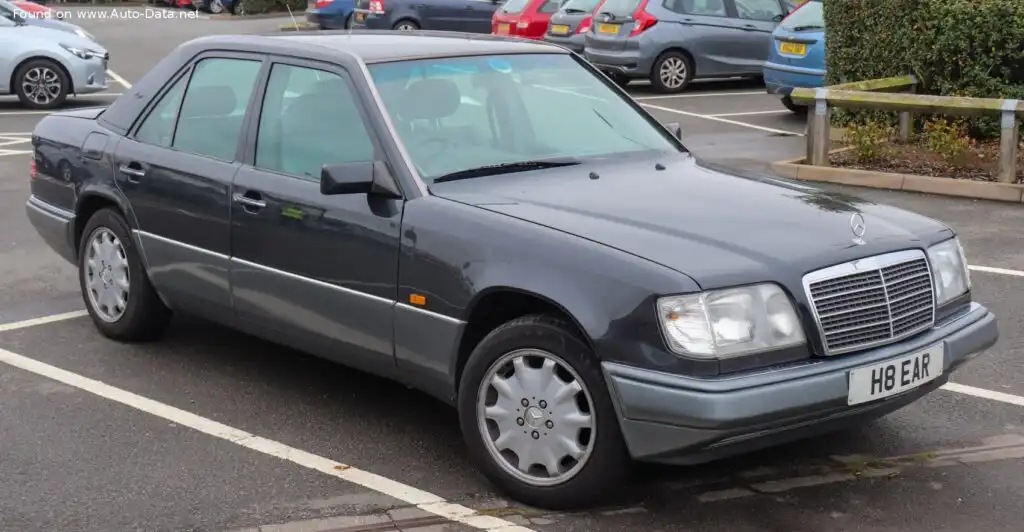
The Mercedes-Benz W124 E 300 Turbodiesel 4MATIC Automatic, produced from July 1993 to March 1995, represents a compelling blend of luxury, durability, and all-weather capability within the iconic W124 series. This variant occupied a unique position in the E-Class lineup, offering a diesel-powered, all-wheel-drive option for buyers seeking efficiency and enhanced traction. It was positioned as a premium offering, bridging the gap between the base diesel models and the more powerful, gasoline-fueled E 320 variants. The W124 platform, renowned for its robust engineering and build quality, provided a solid foundation for this sophisticated sedan.
Technical Specifications
| Brand | Mercedes-Benz |
| Model | E-class |
| Generation | E-class (W124) |
| Type | E 300 Turbodiesel (147 Hp) 4MATIC Automatic |
| Start of production | July, 1993 |
| End of production | March, 1995 |
| Powertrain Architecture | Internal Combustion engine |
| Body type | Sedan |
| Seats | 5 |
| Doors | 4 |
| Fuel consumption (urban) | 10.4 l/100 km (22.6 US mpg) |
| Fuel consumption (extra urban) | 7 l/100 km (33.6 US mpg) |
| Fuel Type | Diesel |
| Acceleration 0 – 100 km/h | 11.8 sec |
| Acceleration 0 – 62 mph | 11.8 sec |
| Acceleration 0 – 60 mph | 11.2 sec |
| Maximum speed | 198 km/h (123.03 mph) |
| Weight-to-power ratio | 11 kg/Hp |
| Weight-to-torque ratio | 5.9 kg/Nm |
| Power | 147 Hp @ 4600 rpm |
| Torque | 273 Nm @ 2400 rpm (201.35 lb.-ft. @ 2400 rpm) |
| Engine layout | Front, Longitudinal |
| Engine Model/Code | OM 603 D 30 A / 603.963 |
| Engine displacement | 2996 cm3 (182.83 cu. in.) |
| Number of cylinders | 6 |
| Engine configuration | Inline |
| Cylinder Bore | 87 mm (3.43 in.) |
| Piston Stroke | 84 mm (3.31 in.) |
| Compression ratio | 22:1 |
| Number of valves per cylinder | 2 |
| Fuel injection system | Precombustion chamber injection |
| Engine aspiration | Turbocharger |
| Valvetrain | SOHC |
| Engine oil capacity | 7.5 l (7.93 US qt | 6.6 UK qt) |
| Coolant capacity | 9 l (9.51 US qt | 7.92 UK qt) |
| Kerb Weight | 1610 kg (3549.44 lbs.) |
| Max. weight | 2175 kg (4795.05 lbs.) |
| Max load | 565 kg (1245.61 lbs.) |
| Trunk (boot) space – minimum | 520 l (18.36 cu. ft.) |
| Fuel tank capacity | 70 l (18.49 US gal | 15.4 UK gal) |
| Length | 4740 mm (186.61 in.) |
| Width | 1740 mm (68.5 in.) |
| Height | 1452 mm (57.17 in.) |
| Wheelbase | 2800 mm (110.24 in.) |
| Front track | 1497 mm (58.94 in.) |
| Rear track | 1485 mm (58.46 in.) |
| Drivetrain Architecture | All wheel drive (4×4) |
| Number of gears | 4 |
| Gearbox type | automatic transmission |
| Front suspension | Wishbone |
| Rear suspension | Independent multi-link suspension |
| Front brakes | Ventilated discs |
| Rear brakes | Disc |
| Assisting systems | ABS (Anti-lock braking system) |
| Steering type | Cone worm with recirculation balls |
| Power steering | Hydraulic |
| Tires size | 195/65 R15 |
| Wheel rims size | 6.5J x 15 |
Powertrain & Engine Architecture
The heart of the E 300 Turbodiesel 4MATIC is the OM 603 D 30 A inline-six cylinder diesel engine. This 2.996-liter engine benefits from a turbocharger and precombustion chamber fuel injection, producing 147 horsepower at 4600 rpm and a substantial 273 Nm (201 lb-ft) of torque at 2400 rpm. The precombustion chamber design, common in Mercedes-Benz diesels of this era, aids in efficient combustion and reduces engine noise. The engine features a single overhead camshaft (SOHC) valvetrain. The four-speed automatic transmission, a robust unit designed to handle the engine’s torque, provides smooth shifts and contributes to the car’s comfortable driving experience. This transmission was not known for being particularly sporty, prioritizing smoothness and reliability over rapid gear changes.
Driving Characteristics
The E 300 Turbodiesel 4MATIC Automatic delivers a characteristically smooth and refined driving experience. While not a performance-oriented vehicle, the combination of turbocharging and the automatic transmission provides adequate acceleration for everyday driving. The 0-60 mph time of around 11.2 seconds is respectable for a vehicle of this size and weight. The all-wheel-drive system significantly enhances traction, particularly in inclement weather conditions, making it a capable and sure-footed vehicle. Compared to the manual transmission versions, the automatic offers greater convenience, but at the expense of some responsiveness. The higher-output E 320 models, with their gasoline engines, offered considerably more power and a sportier driving experience, but lacked the fuel efficiency and all-weather capability of the E 300 Turbodiesel 4MATIC.
Equipment & Trim Levels
The E 300 Turbodiesel 4MATIC Automatic typically came well-equipped, reflecting its position as a premium model. Standard features included power windows, power locks, central locking, and a sunroof. The interior was typically finished in high-quality cloth upholstery, with leather options available as an upgrade. The dashboard layout was typical of the W124 series, characterized by its functional design and durable materials. Optional extras included automatic climate control, heated seats, and a premium sound system. The 4MATIC models often included upgraded suspension components to handle the added weight and complexity of the all-wheel-drive system.
Chassis & Braking
The W124 chassis provides a solid and stable platform for the E 300 Turbodiesel 4MATIC. The front suspension utilizes a wishbone design, while the rear features an independent multi-link suspension, offering a comfortable ride and good handling characteristics. The braking system consists of ventilated discs at the front and solid discs at the rear, providing adequate stopping power. Anti-lock braking system (ABS) was standard, enhancing safety and control. The 4MATIC system adds weight, necessitating slightly stiffer spring rates and dampers to maintain handling balance.
Market Reception & Comparison
The E 300 Turbodiesel 4MATIC Automatic was generally well-received by critics and buyers alike. It was praised for its fuel efficiency, comfortable ride, and all-weather capability. However, some critics noted that the automatic transmission could feel sluggish at times, and the engine, while torquey, lacked the outright power of its gasoline counterparts. Compared to the rear-wheel-drive E 300 Turbodiesel, the 4MATIC version offered superior traction and stability, but at a higher price point. Fuel economy was a strong point, consistently achieving around 22-33 mpg in real-world driving.
Legacy
The W124 E 300 Turbodiesel 4MATIC Automatic has earned a reputation for exceptional durability and reliability. The OM 603 engine is known for its longevity, and many examples have surpassed 300,000 miles with proper maintenance. Today, these cars are sought after by enthusiasts and collectors who appreciate their build quality and classic Mercedes-Benz styling. While maintenance can be more complex and expensive than with more modern vehicles, the robust engineering of the W124 ensures that it remains a viable and rewarding classic car for years to come. The 4MATIC system, while adding complexity, has proven to be reliable and continues to provide enhanced traction for owners in regions with challenging weather conditions.