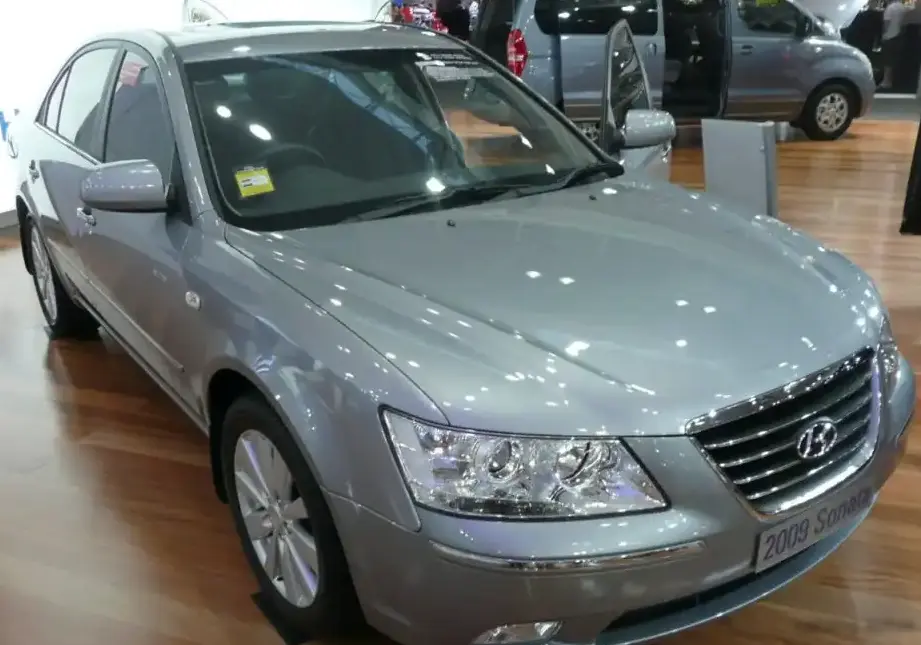
The Hyundai Sonata V (NF facelift), produced from 2008 to 2009, represented a significant refresh of the fifth-generation Sonata. This iteration, particularly the 2.0-liter variant producing 165 horsepower, aimed to offer a balance of fuel efficiency and acceptable performance for the mainstream family sedan market, primarily targeting North American and Asian consumers. Positioned as a mid-range offering within the Sonata V lineup, it slotted between the base 2.4-liter engine and the more powerful 3.3-liter V6 options. The facelift brought revised styling cues, improved interior materials, and updated safety features, enhancing the Sonata’s overall appeal.
Technical Specifications
| Brand | Hyundai |
| Model | Sonata |
| Generation | Sonata V (NF, facelift 2008) |
| Type (Engine) | 2.0 (165 Hp) |
| Start of production | 2008 |
| End of production | 2009 |
| Powertrain Architecture | Internal Combustion engine |
| Body type | Sedan |
| Seats | 5 |
| Doors | 4 |
| Fuel consumption (urban) | 10.1 l/100 km (23.3 US mpg) |
| Fuel consumption (extra urban) | 6.3 l/100 km (37.3 US mpg) |
| Fuel consumption (combined) | 7.7 l/100 km (30.5 US mpg) |
| Fuel Type | Petrol (Gasoline) |
| Acceleration 0 – 100 km/h | 9.9 sec |
| Acceleration 0 – 62 mph | 9.9 sec |
| Acceleration 0 – 60 mph | 9.4 sec |
| Maximum speed | 207 km/h (128.62 mph) |
| Weight-to-power ratio | 9 kg/Hp |
| Weight-to-torque ratio | 7.5 kg/Nm |
| Power | 165 Hp @ 6200 rpm |
| Torque | 197 Nm @ 4600 rpm (145.3 lb.-ft. @ 4600 rpm) |
| Engine layout | Front, Transverse |
| Engine Model/Code | Theta II / G4KD |
| Engine displacement | 1998 cm3 (121.93 cu. in.) |
| Number of cylinders | 4 |
| Engine configuration | Inline |
| Cylinder Bore | 86 mm (3.39 in.) |
| Piston Stroke | 86 mm (3.39 in.) |
| Compression ratio | 10.5:1 |
| Number of valves per cylinder | 4 |
| Fuel injection system | Multi-port manifold injection |
| Engine aspiration | Naturally aspirated engine |
| Valvetrain | DOHC, CVVT |
| Engine oil capacity | 3.9 l (4.12 US qt | 3.43 UK qt) |
| Coolant capacity | 6.2 l (6.55 US qt | 5.46 UK qt) |
| Kerb Weight | 1478 kg (3258.43 lbs.) |
| Max. weight | 2030 kg (4475.38 lbs.) |
| Max load | 552 kg (1216.95 lbs.) |
| Trunk (boot) space – minimum | 523 l (18.47 cu. ft.) |
| Fuel tank capacity | 70 l (18.49 US gal | 15.4 UK gal) |
| Length | 4800 mm (188.98 in.) |
| Width | 1832 mm (72.13 in.) |
| Height | 1475 mm (58.07 in.) |
| Wheelbase | 2730 mm (107.48 in.) |
| Front track | 1565 mm (61.61 in.) |
| Rear (Back) track | 1550 mm (61.02 in.) |
| Drag coefficient (Cd) | 0.32 |
| Minimum turning circle | 12 m (39.37 ft.) |
| Drivetrain Architecture | Front wheel drive |
| Number of gears | 5 |
| Gearbox type | Manual transmission |
| Front suspension | Independent, McPherson with coil spring and anti-roll bar |
| Rear suspension | Independent multi-link suspension |
| Front brakes | Ventilated discs |
| Rear brakes | Disc |
| Assisting systems | ABS (Anti-lock braking system) |
| Steering type | Steering rack and pinion |
| Tires size | 215/60 R16 |
| Wheel rims size | 16 |
Powertrain & Engine Architecture
The heart of the 2008-2009 Hyundai Sonata 2.0 was the Theta II inline-four cylinder engine, specifically the G4KD variant. This 1.998-liter engine featured a cast iron block and an aluminum cylinder head, incorporating Hyundai’s Continuously Variable Valve Timing (CVVT) technology on both intake and exhaust camshafts. This system optimized valve timing for improved fuel efficiency and power delivery across the rev range. Fuel delivery was handled by a multi-point fuel injection system. The engine produced 165 horsepower at 6200 rpm and 197 Nm (145.3 lb-ft) of torque at 4600 rpm. The engine was transversely mounted in the front of the vehicle. The standard transmission for this variant was a 5-speed manual gearbox, offering a relatively direct driving experience. While an automatic transmission was available, it was typically a 4-speed unit, which impacted acceleration and fuel economy compared to the manual.
Driving Characteristics
The Sonata 2.0 with the 5-speed manual transmission provided adequate, though not exhilarating, performance. Acceleration to 60 mph took approximately 9.4 seconds, making it competitive with other mid-size sedans of the era. The engine felt responsive enough for everyday driving, with sufficient torque for merging onto highways and passing slower vehicles. The 5-speed manual allowed drivers to keep the engine in its optimal power band. The automatic transmission, while offering convenience, noticeably dulled performance due to its fewer gears and less efficient power transfer. The suspension, tuned for comfort, provided a relatively smooth ride, but handling was not particularly sporty. Steering feel was light and lacked significant feedback.
Equipment & Trim Levels
The 2.0-liter Sonata typically came equipped with standard features such as air conditioning, power windows and locks, a basic audio system, and ABS brakes. Higher trim levels added features like alloy wheels, a sunroof, upgraded audio systems, and cruise control. Interior upholstery was typically cloth, with optional leather available on higher trims. The dashboard layout was functional and straightforward, prioritizing ease of use over stylistic flair. Optional extras included a navigation system, heated seats, and automatic climate control.
Chassis & Braking
The Sonata V utilized a front-wheel-drive layout with an independent McPherson strut suspension in the front and an independent multi-link suspension in the rear. This setup aimed to balance ride comfort and handling. Front brakes were ventilated discs, providing adequate stopping power, while rear brakes were solid discs. The ABS system helped to maintain steering control during hard braking. The chassis was designed to provide a stable and predictable driving experience, prioritizing comfort over sporty handling characteristics.
Market Reception & Comparison
The 2008-2009 Hyundai Sonata 2.0 received generally positive reviews, particularly for its value proposition. Critics praised its spacious interior, comfortable ride, and competitive price point. However, the engine was sometimes criticized for lacking refinement and the automatic transmission for its sluggish performance. Compared to the 2.4-liter Sonata, the 2.0 offered slightly better fuel economy but less power. The V6 models provided significantly more performance but came at a higher price and with reduced fuel efficiency. The 1.8L automatic was often seen as a good choice for budget-conscious buyers prioritizing fuel economy and ease of use.
Legacy
The Theta II engine proved to be a relatively reliable powertrain, although some owners have reported issues with oil consumption over time. The Sonata V, in general, established Hyundai as a serious contender in the mid-size sedan segment. Today, used examples of the 2008-2009 Sonata 2.0 are readily available and represent an affordable transportation option. While not known for its performance or cutting-edge technology, it remains a practical and dependable vehicle for those seeking a budget-friendly family sedan.