
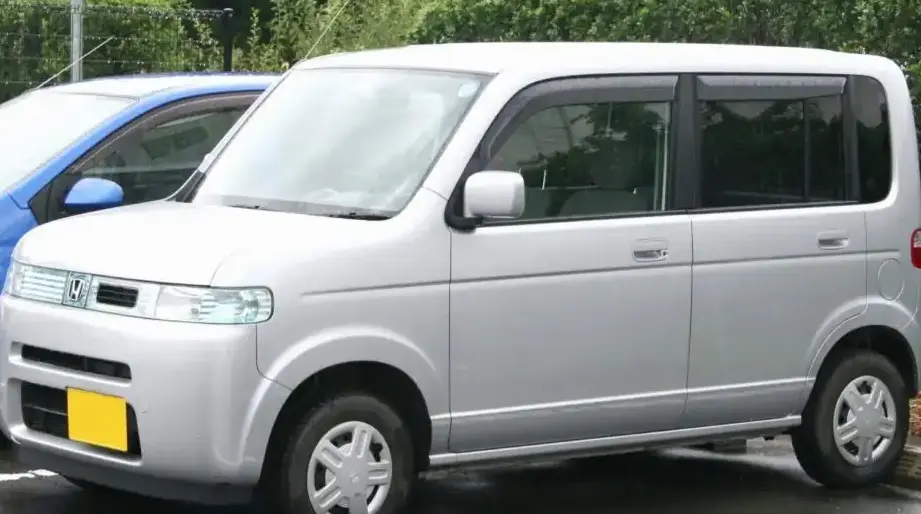
The Honda That’s (JA-IV) 0.7 i 12V, producing 52 horsepower, was a compact, entry-level minivan produced by Honda between 2003 and 2007. Positioned as the most affordable variant within the fourth generation (JA-IV) That’s lineup, it served as an accessible and economical transportation option, primarily targeted at urban drivers and small families. The That’s, known as the Honda Jazz in many international markets, represented Honda’s attempt to maximize interior space within a subcompact footprint, utilizing a unique “Ultra Seat” system. This particular 0.7-liter engine and 3-speed automatic transmission combination was largely exclusive to certain markets, including Japan, where it filled a niche for highly fuel-efficient and maneuverable city cars.
Technical Specifications
| Brand | Honda |
| Model | That’s |
| Generation | That’s (JA-IV) |
| Type (Engine) | 0.7 i 12V (52 Hp) |
| Start of production | 2003 |
| End of production | 2007 |
| Powertrain Architecture | Internal Combustion engine |
| Body type | Minivan |
| Seats | 4 |
| Doors | 5 |
| Fuel Type | Petrol (Gasoline) |
| Weight-to-power ratio | 15.8 kg/Hp, 63.4 Hp/tonne |
| Weight-to-torque ratio | 13.4 kg/Nm, 74.4 Nm/tonne |
| Power | 52 Hp @ 7200 rpm |
| Power per litre | 79.3 Hp/l |
| Torque | 61 Nm @ 4500 rpm, 44.99 lb.-ft. @ 4500 rpm |
| Engine layout | Front, Transverse |
| Engine displacement | 656 cm3, 40.03 cu. in. |
| Number of cylinders | 3 |
| Engine configuration | Inline |
| Cylinder Bore | 66 mm, 2.6 in. |
| Piston Stroke | 64 mm, 2.52 in. |
| Compression ratio | 10.5:1 |
| Number of valves per cylinder | 4 |
| Fuel injection system | Multi-port manifold injection |
| Engine aspiration | Naturally aspirated engine |
| Valvetrain | OHC |
| Kerb Weight | 820 kg, 1807.79 lbs |
| Max. weight | 1040 kg, 2292.81 lbs |
| Max load | 220 kg, 485.02 lbs |
| Fuel tank capacity | 31 l, 8.19 US gal | 6.82 UK gal |
| Length | 3395 mm, 133.66 in. |
| Width | 1475 mm, 58.07 in. |
| Height | 1620 mm, 63.78 in. |
| Wheelbase | 2360 mm, 92.91 in. |
| Front track | 1305 mm, 51.38 in. |
| Rear (Back) track | 1295 mm, 50.98 in. |
| Minimum turning circle | 9 m, 29.53 ft. |
| Drivetrain Architecture | The Internal combustion engine (ICE) drives the front wheels of the vehicle. |
| Drive wheel | Front wheel drive |
| Number of gears and type of gearbox | 3 gears, automatic transmission |
| Front suspension | Spring Strut |
| Rear suspension | Suspension De-Dion |
| Front brakes | Disc |
| Rear brakes | Drum |
| Assisting systems | ABS (Anti-lock braking system) |
| Steering type | Steering rack and pinion |
| Power steering | Hydraulic Steering |
| Tires size | 145/80 R12 |
Powertrain & Engine Architecture
The heart of this That’s variant is the Honda G10A engine, a 656cc inline-3 cylinder engine. This engine utilizes a single overhead camshaft (OHC) design and a multi-point fuel injection system. The 12-valve configuration (4 valves per cylinder) helps optimize breathing for its small displacement. The G10A is known for its simplicity and reliability, characteristics prioritized in this entry-level application. Paired with this engine is a 3-speed automatic transmission, a relatively basic unit designed for smooth, if not particularly sporty, operation. This transmission was chosen for its ease of use and affordability, catering to the target demographic who likely preferred convenience over performance. The engine’s relatively low compression ratio of 10.5:1 contributes to its ability to run on regular unleaded gasoline.
Driving Characteristics
The 52 horsepower and 61 Nm (45 lb-ft) of torque produced by this combination result in modest, but adequate, performance for city driving. Acceleration is slow, and highway merging requires careful planning. The 3-speed automatic transmission has widely spaced gear ratios, prioritizing fuel economy over rapid acceleration. Compared to the manual transmission versions of the That’s, or those equipped with the larger 1.3 or 1.5-liter engines, this variant feels significantly underpowered. However, its lightweight construction (820 kg / 1808 lbs) helps mitigate some of the performance deficit. The focus is on smooth, predictable driving rather than spirited performance. The automatic transmission contributes to a relaxed driving experience, particularly in stop-and-go traffic.
Equipment & Trim Levels
The 0.7 i 12V automatic trim level was typically the base model in the That’s range. Standard equipment generally included power steering, air conditioning (often optional), and basic audio system. Interior upholstery was typically a simple cloth material. Safety features were limited, with ABS being a notable inclusion, but airbags were often optional or limited to the driver. Optional extras included power windows, central locking, and upgraded audio systems. The interior design was functional and focused on maximizing space, reflecting the vehicle’s overall practicality.
Chassis & Braking
The That’s utilizes a front-wheel-drive layout with a MacPherson strut suspension in the front and a De-Dion rear suspension. This configuration provides a reasonable balance of ride comfort and handling. The front brakes are discs, while the rear brakes are drums, a cost-saving measure common in this segment. The relatively narrow 145/80 R12 tires contribute to a comfortable ride but offer limited grip. The hydraulic power steering provides light and easy steering, making it ideal for maneuvering in tight urban environments.
Market Reception & Comparison
The 0.7-liter That’s automatic was generally well-received as an affordable and fuel-efficient city car. Critics praised its spacious interior and clever “Ultra Seat” system, which allowed for a variety of seating configurations. However, the engine’s lack of power was a common criticism. Compared to the 1.3 and 1.5-liter variants, fuel economy was similar, but performance was noticeably inferior. The 1.3-liter manual transmission version offered a better balance of performance and fuel efficiency, making it a popular alternative for drivers who prioritized driving enjoyment. Reliability was generally good, typical of Honda products.
Legacy
The Honda That’s 0.7 i 12V automatic, while not a performance icon, remains a popular choice in the used car market, particularly in regions where fuel efficiency and affordability are paramount. The G10A engine is known for its durability and relatively low maintenance costs. Common issues are typically limited to age-related wear and tear, such as oil leaks and worn suspension components. The 3-speed automatic transmission is generally reliable, but regular fluid changes are essential for longevity. Today, these vehicles are often sought after by first-time car buyers or those seeking a simple, economical, and reliable mode of transportation. The That’s, in all its variants, helped establish Honda’s reputation for building practical and well-engineered small cars.
