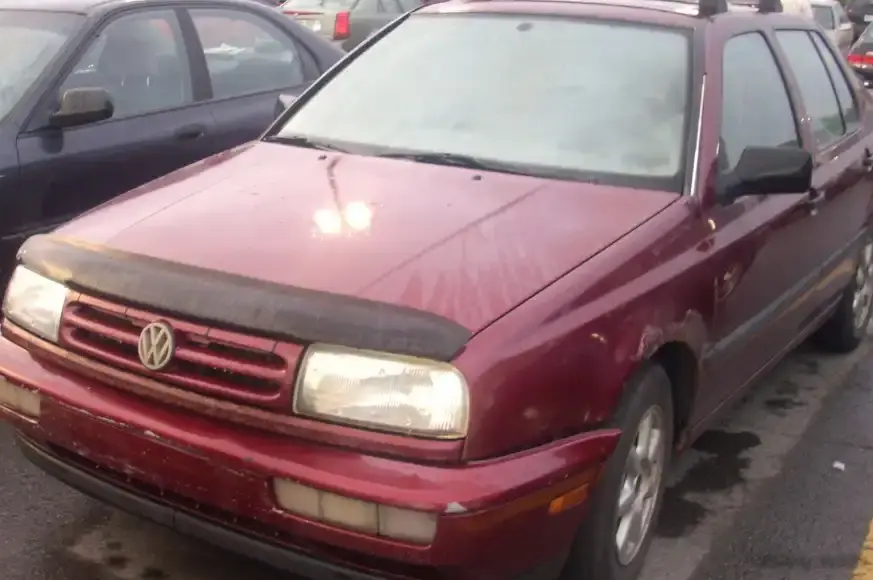
The Volkswagen Jetta III 1.8 (90 hp) Automatic, produced between 1994 and 1998, represented an entry-level offering within the third generation Jetta (Typ 1HX0/A3) lineup. Positioned as a more affordable and fuel-efficient option, it catered to buyers prioritizing practicality and ease of use over outright performance. This variant was particularly significant in European markets, where compact sedans were highly popular, and also found a niche in North America as a budget-friendly alternative to more powerful Jetta trims and competing models. It served as a stepping stone into the Jetta range, offering a comfortable and reliable driving experience for everyday commuting.
Technical Specifications
| Brand | Volkswagen |
| Model | Jetta |
| Generation | Jetta III |
| Type (Engine) | 1.8 (90 Hp) Automatic |
| Start of production | 1994 |
| End of production | 1998 |
| Powertrain Architecture | Internal Combustion engine |
| Body type | Sedan |
| Seats | 5 |
| Doors | 4 |
| Fuel consumption (urban) | 11.1 l/100 km (21.2 US mpg) |
| Fuel consumption (extra urban) | 6.9 l/100 km (34.1 US mpg) |
| Fuel consumption (combined) | 8.5 l/100 km (27.7 US mpg) |
| Fuel Type | Petrol (Gasoline) |
| Acceleration 0 – 100 km/h | 14.5 sec |
| Acceleration 0 – 62 mph | 14.5 sec |
| Acceleration 0 – 60 mph | 13.8 sec |
| Maximum speed | 175 km/h (108.74 mph) |
| Weight-to-power ratio | 13.1 kg/Hp |
| Weight-to-torque ratio | 8.1 kg/Nm |
| Power | 90 Hp @ 5500 rpm |
| Torque | 145 Nm @ 2500 rpm (106.95 lb.-ft. @ 2500 rpm) |
| Engine layout | Front, Transverse |
| Engine Model/Code | GX, JN, ACC |
| Engine displacement | 1781 cm3 (108.68 cu. in.) |
| Number of cylinders | 4 |
| Engine configuration | Inline |
| Cylinder Bore | 81 mm (3.19 in.) |
| Piston Stroke | 86.4 mm (3.4 in.) |
| Compression ratio | 10:1 |
| Number of valves per cylinder | 2 |
| Fuel injection system | Single-point injection |
| Engine aspiration | Naturally aspirated engine |
| Valvetrain | OHC |
| Engine oil capacity | 4 l (4.23 US qt | 3.52 UK qt) |
| Kerb Weight | 1180 kg (2601.45 lbs.) |
| Max. weight | 1590 kg (3505.35 lbs.) |
| Max load | 410 kg (903.9 lbs.) |
| Trunk (boot) space – minimum | 425 l (15.01 cu. ft.) |
| Trunk (boot) space – maximum | 885 l (31.25 cu. ft.) |
| Fuel tank capacity | 55 l (14.53 US gal | 12.1 UK gal) |
| Length | 4380 mm (172.44 in.) |
| Width | 1695 mm (66.73 in.) |
| Height | 1425 mm (56.1 in.) |
| Wheelbase | 2475 mm (97.44 in.) |
| Front track | 1464 mm (57.64 in.) |
| Rear (Back) track | 1448 mm (57.01 in.) |
| Drivetrain Architecture | The Internal combustion engine (ICE) drives the front wheels of the vehicle. |
| Drive wheel | Front wheel drive |
| Number of gears and type of gearbox | 4 gears, automatic transmission |
| Front suspension | Wishbone |
| Rear suspension | Suspension with traction connecting levers |
| Front brakes | Disc |
| Rear brakes | Drum |
| Assisting systems | ABS (Anti-lock braking system) |
| Steering type | Steering rack and pinion |
| Power steering | Hydraulic Steering |
| Tires size | 185/60 R14 |
| Wheel rims size | 14 |
Powertrain & Engine Architecture
The heart of the Jetta III 1.8 Automatic was the Volkswagen EA827 engine family, specifically the GX, JN, or ACC engine code variants. This 1.8-liter inline-four cylinder engine featured a single overhead camshaft (OHC) and two valves per cylinder. The engine utilized a single-point fuel injection system (Bosch Mono-Jetronic was common), which, while simpler and less efficient than multi-point injection, contributed to the car’s affordability. The 90 horsepower output at 5500 rpm and 145 Nm (107 lb-ft) of torque at 2500 rpm were modest, but adequate for everyday driving. The automatic transmission was typically a four-speed unit, designed for smooth operation and ease of use. This transmission wasn’t known for its sportiness, prioritizing comfort and fuel economy over rapid acceleration.
Driving Characteristics
The 1.8L Automatic Jetta offered a comfortable, if uninspiring, driving experience. Acceleration was noticeably slower than the manual transmission versions or those equipped with the larger 2.0-liter engine. The four-speed automatic transmission had relatively widely spaced gear ratios, which meant the engine often felt strained during quick acceleration. However, for cruising on the highway or navigating city traffic, the automatic provided a relaxed and convenient driving experience. The steering was light and easy, making it maneuverable in urban environments. The suspension, tuned for comfort, absorbed bumps reasonably well, but didn’t offer particularly sporty handling.
Equipment & Trim Levels
The 1.8 Automatic Jetta typically came with a base level of equipment. Standard features generally included power steering, central locking, and a basic stereo system. Interior upholstery was typically cloth, and the dashboard featured a functional, if somewhat plain, design. Optional extras included air conditioning, power windows, and upgraded audio systems. Higher trim levels, such as the GL, offered additional features like alloy wheels, upgraded interior trim, and a sunroof. The base model was deliberately stripped down to offer a competitive price point.
Chassis & Braking
The Jetta III utilized a front-wheel-drive layout with a MacPherson strut front suspension and a torsion beam rear suspension. The front brakes were disc brakes, providing adequate stopping power, while the rear brakes were typically drum brakes, a cost-saving measure for the entry-level model. Anti-lock Braking System (ABS) was often an optional extra, rather than standard equipment. The chassis was designed to provide a comfortable ride, prioritizing stability and predictability over sporty handling. Stabilizer bars were present, but were relatively thin compared to those found on higher-performance Jetta models.
Market Reception & Comparison
The Jetta III 1.8 Automatic was generally well-received as a practical and affordable family sedan. Critics acknowledged its fuel efficiency and comfortable ride, but often noted its lack of performance. Compared to the more powerful Jetta GLX with the 2.0-liter engine or the sporty VR6 models, the 1.8 Automatic was significantly slower. However, it offered better fuel economy than these higher-output variants. Against competitors like the Ford Escort, Honda Civic, and Toyota Corolla, the Jetta offered a European driving experience and a reputation for build quality, but often at a slightly higher price point.
Legacy
The Volkswagen Jetta III 1.8 Automatic, while not a performance icon, proved to be a reliable and durable vehicle. The EA827 engine, despite its single-point injection, was generally robust and capable of high mileage with proper maintenance. The automatic transmission, while not particularly sophisticated, was also known for its longevity. Today, these cars are relatively affordable on the used car market, making them attractive options for budget-conscious buyers. However, potential buyers should be aware of the age-related issues common to vehicles of this era, such as corrosion and wear and tear on rubber components. The 1.8 Automatic Jetta represents a practical and accessible entry point into the Volkswagen brand, offering a blend of German engineering and everyday usability.