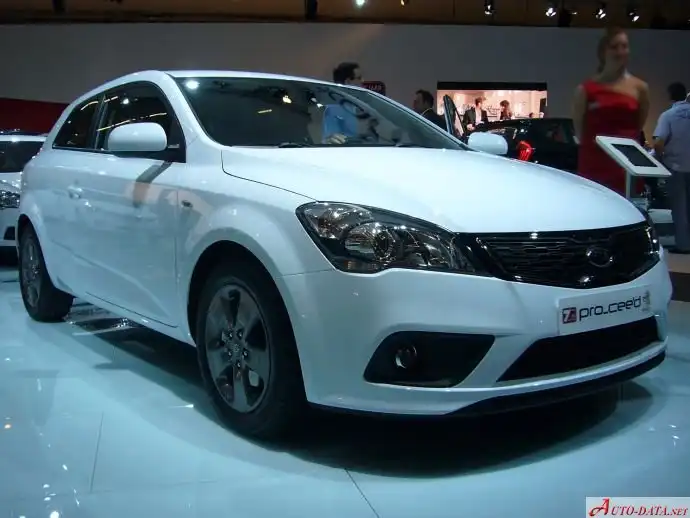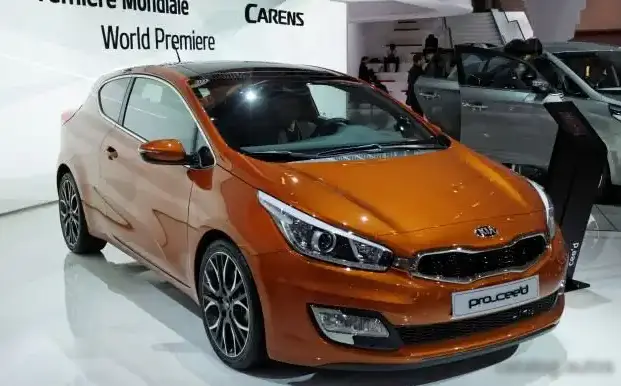
The Kia Pro Cee’d II 1.6D 16V CRDi HPE Automatic, produced between 2013 and 2015, represents a significant offering in the European compact hatchback market. Positioned as a stylish and practical three-door variant of the second-generation Pro Cee’d (JD), this model aimed to appeal to buyers seeking a blend of fuel efficiency, reasonable performance, and the convenience of an automatic transmission. It was part of the broader Pro Cee’d II range, which itself was based on the 1HX0 platform shared with the Hyundai i30. The “HPE” trim level denoted a mid-range specification, offering a balance of features and affordability.
Technical Specifications
| Brand | Kia |
| Model | Pro Cee’d |
| Generation | Pro Cee’d II |
| Type (Engine) | 1.6D 16V CRDi (128 Hp) HPE Automatic |
| Start of production | 2013 |
| End of production | 2015 |
| Powertrain Architecture | Internal Combustion engine |
| Body type | Hatchback |
| Seats | 5 |
| Doors | 3 |
| Fuel consumption (urban) | 7.2 l/100 km (32.7 US mpg) |
| Fuel consumption (extra urban) | 4.5 l/100 km (52.3 US mpg) |
| Fuel consumption (combined) | 5.5 l/100 km (42.8 US mpg) |
| CO2 emissions | 145 g/km |
| Fuel Type | Diesel |
| Acceleration 0 – 100 km/h | 11.7 sec |
| Acceleration 0 – 62 mph | 11.7 sec |
| Acceleration 0 – 60 mph | 11.1 sec |
| Maximum speed | 190 km/h (118.06 mph) |
| Emission standard | Euro 5 |
| Power | 128 Hp |
| Torque | 260 Nm @ 1900 rpm (191.77 lb.-ft. @ 1900 rpm) |
| Engine layout | Front, Transverse |
| Engine Model/Code | D4FB |
| Engine displacement | 1582 cm3 (96.54 cu. in.) |
| Number of cylinders | 4 |
| Engine configuration | Inline |
| Number of valves per cylinder | 4 |
| Fuel injection system | Diesel Commonrail |
| Engine aspiration | Turbocharger, Intercooler |
| Engine oil capacity | 5.3 l (5.6 US qt | 4.66 UK qt) |
| Coolant capacity | 6.9 l (7.29 US qt | 6.07 UK qt) |
| Trunk (boot) space (minimum) | 380 l (13.42 cu. ft.) |
| Fuel tank capacity | 53 l (14 US gal | 11.66 UK gal) |
| Length | 4310 mm (169.69 in.) |
| Width | 1780 mm (70.08 in.) |
| Height | 1430 mm (56.3 in.) |
| Wheelbase | 2650 mm (104.33 in.) |
| Minimum turning circle | 10.6 m (34.78 ft.) |
| Drivetrain | Front wheel drive |
| Number of gears | 6 |
| Gearbox type | Automatic transmission |
| Front brakes | Ventilated discs |
| Rear brakes | Disc |
Powertrain & Engine Architecture
The heart of the Pro Cee’d II 1.6D HPE Automatic is the D4FB engine, a 1.6-liter inline-four cylinder diesel. This engine is a member of Kia/Hyundai’s U-line diesel family, known for its relatively compact size and efficiency. It utilizes a common-rail direct injection system, delivering fuel at extremely high pressure for optimized combustion. A turbocharger with an intercooler is employed to boost power output and improve torque across the rev range. The engine features 16 valves (four per cylinder) and is designed to meet Euro 5 emission standards, incorporating a diesel particulate filter (DPF) to reduce soot emissions. The automatic transmission is a conventional six-speed torque converter unit, chosen for its smoothness and ease of use, although it doesn’t offer the outright efficiency of a dual-clutch transmission.
Driving Characteristics
The 128 horsepower and 260 Nm (192 lb-ft) of torque produced by the 1.6D engine, when paired with the six-speed automatic, resulted in a comfortable, if not particularly sporty, driving experience. Acceleration from 0-60 mph took around 11.1 seconds, and top speed was rated at 118 mph. The automatic transmission, while smooth, did exhibit some hesitation during quick acceleration, and the gear ratios were tuned more for fuel economy than outright performance. Compared to the manual transmission version of the same engine, the automatic offered slightly reduced fuel economy and slower acceleration. Higher-output versions of the Pro Cee’d, such as those equipped with the 1.6-liter gasoline engine or the more powerful diesel variants, provided significantly more spirited performance.
Equipment & Trim Levels
The HPE trim level for the Pro Cee’d II 1.6D Automatic offered a good level of standard equipment. Typically, this included air conditioning, electric front and rear windows, a USB and auxiliary input for the audio system, Bluetooth connectivity, and alloy wheels. Interior upholstery was generally cloth, with a dark color scheme. Optional extras available for this trim could include a panoramic sunroof, rear parking sensors, and a more advanced infotainment system with navigation. The three-door body style itself was considered a more youthful and sporty option compared to the five-door Pro Cee’d.
Chassis & Braking
The Pro Cee’d II utilized a MacPherson strut front suspension and a coupled torsion beam rear suspension. This setup provided a good balance between ride comfort and handling. The front brakes were ventilated discs, offering good stopping power, while the rear brakes were solid discs. Anti-lock Braking System (ABS) was standard. The steering was electrically assisted, providing light and precise control. Stabilizer bars were fitted to both the front and rear axles to reduce body roll during cornering. The suspension tuning was generally geared towards comfort, making it a pleasant vehicle for everyday driving.
Market Reception & Comparison
The Kia Pro Cee’d II 1.6D HPE Automatic was generally well-received by automotive critics as a practical and well-equipped hatchback. Its fuel economy was a strong point, with combined figures around 42.8 US mpg. However, some reviewers noted that the automatic transmission could feel sluggish at times, and the engine lacked the punch of some of its competitors. Compared to other diesel hatchbacks in its class, such as the Volkswagen Golf or Ford Focus, the Pro Cee’d offered a competitive price point and a generous warranty, but didn’t quite match their refinement or driving dynamics. Reliability was generally considered good, with few major issues reported.
Legacy
The Kia Pro Cee’d II 1.6D Automatic has proven to be a relatively reliable vehicle in the used car market. The D4FB engine, while not without its potential issues (such as DPF clogging if not properly maintained), is generally durable. The automatic transmission, if serviced regularly, is also known to be dependable. Today, these vehicles represent an affordable and fuel-efficient option for buyers seeking a compact hatchback. Their relatively low running costs and Kia’s reputation for reliability continue to make them a popular choice in the used car segment. However, potential buyers should be aware of the importance of maintaining the DPF and ensuring regular servicing to avoid costly repairs.