
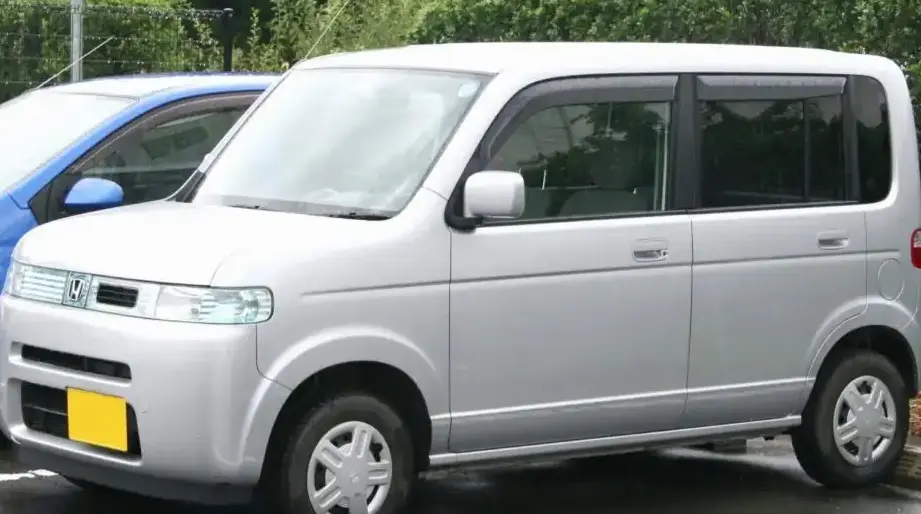
The Honda That’S (JA-IV) 0.7 i 12V Turbo 4WD, produced between 2003 and 2007, represents a unique offering within the compact Japanese minivan, or “kei car,” segment. This particular variant, equipped with a turbocharged 656cc inline-three engine and a three-speed automatic transmission, was designed to provide all-wheel-drive capability and reasonable performance within the constraints of Japanese kei car regulations. The That’S, in general, aimed to blend practicality, fuel efficiency, and a degree of style into a small package, appealing to urban drivers and small families. This 0.7L Turbo 4WD trim sat as a mid-range option, offering more performance and capability than the naturally aspirated base models, but without the higher price tag of some of the more fully-equipped versions.
Technical Specifications
| Brand | Honda |
| Model | That’S |
| Generation | That’S (JA-IV) |
| Type (Engine) | 0.7 i 12V Turbo 4WD (64 Hp) |
| Start of production | 2003 |
| End of production | 2007 |
| Powertrain Architecture | Internal Combustion engine |
| Body type | Minivan |
| Seats | 4 |
| Doors | 5 |
| Fuel Type | Petrol (Gasoline) |
| Weight-to-power ratio | 14.4 kg/Hp |
| Hp/tonne | 69.6 Hp/tonne |
| Weight-to-torque ratio | 9.9 kg/Nm |
| Nm/tonne | 101.1 Nm/tonne |
| Power | 64 Hp @ 6000 rpm |
| Power per litre | 97.6 Hp/l |
| Torque | 93 Nm @ 4000 rpm |
| Torque (lb.-ft.) | 68.59 lb.-ft. @ 4000 rpm |
| Engine layout | Front, Transverse |
| Engine displacement | 656 cm3 |
| Engine displacement (cu. in.) | 40.03 cu. in. |
| Number of cylinders | 3 |
| Engine configuration | Inline |
| Cylinder Bore | 66 mm |
| Cylinder Bore (in.) | 2.6 in. |
| Piston Stroke | 64 mm |
| Piston Stroke (in.) | 2.52 in. |
| Compression ratio | 8.5:1 |
| Number of valves per cylinder | 4 |
| Fuel injection system | Multi-port manifold injection |
| Engine aspiration | Turbocharger, Intercooler |
| Valvetrain | OHC |
| Kerb Weight | 920 kg |
| Kerb Weight (lbs.) | 2028.25 lbs. |
| Max. weight | 1140 kg |
| Max. weight (lbs.) | 2513.27 lbs. |
| Max load | 220 kg |
| Max load (lbs.) | 485.02 lbs. |
| Fuel tank capacity | 31 l |
| Fuel tank capacity (US gal) | 8.19 US gal |
| Fuel tank capacity (UK gal) | 6.82 UK gal |
| Length | 3395 mm |
| Length (in.) | 133.66 in. |
| Width | 1475 mm |
| Width (in.) | 58.07 in. |
| Height | 1620 mm |
| Height (in.) | 63.78 in. |
| Wheelbase | 2360 mm |
| Wheelbase (in.) | 92.91 in. |
| Front track | 1305 mm |
| Front track (in.) | 51.38 in. |
| Rear (Back) track | 1295 mm |
| Rear (Back) track (in.) | 50.98 in. |
| Minimum turning circle | 9 m |
| Minimum turning circle (ft.) | 29.53 ft. |
| Drive wheel | All wheel drive (4×4) |
| Number of gears | 3 |
| Gearbox type | automatic transmission |
| Front suspension | Spring Strut |
| Rear suspension | Suspension De-Dion |
| Front brakes | Disc |
| Rear brakes | Drum |
| Assisting systems | ABS (Anti-lock braking system) |
| Steering type | Steering rack and pinion |
| Power steering | Hydraulic Steering |
| Tires size | 155/65 R13 |
Powertrain & Engine Architecture
The heart of the That’S 0.7 i Turbo 4WD is the Honda P07A engine, a 656cc inline-three cylinder powerplant. This engine utilizes a single overhead camshaft (OHC) and multi-point fuel injection. The addition of a turbocharger and intercooler significantly boosted power output for its size, allowing it to produce 64 horsepower and 93 Nm (68.59 lb-ft) of torque. The engine code is crucial for identifying specific parts and maintenance requirements. The three-speed automatic transmission, while providing ease of use, was a relatively simple unit designed for efficiency rather than outright performance. It featured standard torque converter technology and was geared towards maximizing fuel economy in urban driving conditions.
Driving Characteristics
The 0.7L Turbo 4WD That’S offered a surprisingly capable driving experience for its size and engine displacement. The turbocharger provided a noticeable boost in acceleration, particularly at lower speeds. However, the three-speed automatic transmission limited overall performance, with gear changes being relatively slow and lacking the responsiveness of a manual gearbox. Compared to the naturally aspirated versions of the That’S, the turbo model offered significantly more pulling power, making it better suited for carrying passengers or cargo. The all-wheel-drive system provided enhanced traction in slippery conditions, a valuable asset in regions with inclement weather. The power delivery was fairly linear, but the engine did exhibit some turbo lag, a common characteristic of smaller turbocharged engines.
Equipment & Trim Levels
The 0.7 i Turbo 4WD trim typically included features such as air conditioning, power windows, and a basic audio system. Interior upholstery was generally cloth, with a simple and functional dashboard layout. Optional extras could include upgraded audio systems, alloy wheels, and a sunroof. The overall interior design prioritized practicality and space efficiency over luxury. The trim level aimed to provide a balance between affordability and features, appealing to buyers who wanted a well-equipped kei car without paying a premium price.
Chassis & Braking
The That’S utilized a front strut and rear De-Dion suspension setup, a configuration chosen for its compact design and ability to provide a comfortable ride. The front brakes were disc brakes, while the rear brakes were drum brakes, a common cost-saving measure in this class of vehicle. Anti-lock Braking System (ABS) was included as a standard safety feature. The steering was rack and pinion with hydraulic power assistance, providing relatively light and precise steering feel. The relatively lightweight construction of the vehicle, at around 920 kg (2028.25 lbs), helped to offset the limited power output.
Market Reception & Comparison
The Honda That’S 0.7 i Turbo 4WD was generally well-received in the Japanese market. Critics praised its practicality, fuel efficiency, and surprisingly capable performance. Compared to other kei car models, the That’S offered a good balance of features and value. The turbo engine provided a noticeable performance advantage over the naturally aspirated models, but the three-speed automatic transmission was sometimes criticized for its lack of responsiveness. Fuel economy was a strong point, with the vehicle achieving respectable mileage for a turbocharged engine. Reliability was generally good, typical of Honda products.
Legacy
The Honda That’S, and particularly the 0.7 i Turbo 4WD variant, has developed a modest following among enthusiasts of Japanese kei cars. The P07A engine is known for its durability and relatively simple maintenance requirements. While not a high-performance vehicle, the That’S offers a unique and charming driving experience. In the used car market, these models are generally affordable and can be a good option for those seeking a small, practical, and fuel-efficient vehicle. Parts availability can be a challenge outside of Japan, but a dedicated community of enthusiasts helps to keep these vehicles on the road.
