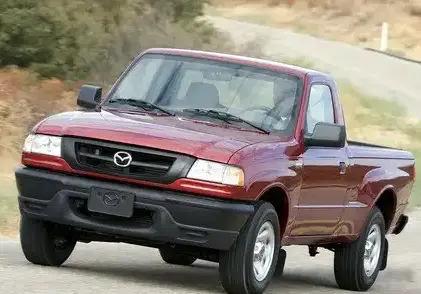
The Mazda B-Series VII 2.3, produced from 2006 onwards, represents the final iteration of Mazda’s long-running compact pickup truck. This generation, largely based on the Ford Ranger platform due to Mazda’s partnership with Ford at the time, was primarily sold in markets outside of North America. The 2.3-liter variant, producing 143 horsepower, occupied a middle ground in the B-Series VII lineup, offering a balance between affordability, fuel economy, and capability for light-duty tasks. It served as a workhorse for small businesses, farmers, and individuals needing a practical and reliable vehicle.
Technical Specifications
| Brand | Mazda |
| Model | B-series |
| Generation | B-Series VII |
| Type (Engine) | 2.3 (143 Hp) |
| Start of production | 2006 |
| Powertrain Architecture | Internal Combustion engine |
| Body type | Pick-up |
| Seats | 2 |
| Doors | 2 |
| Fuel Type | Petrol (Gasoline) |
| Emission standard | Euro 4 |
| Power | 143 Hp @ 5250 rpm |
| Power per litre | 63.3 Hp/l |
| Torque | 290 Nm @ 3750 rpm |
| Torque (lb-ft) | 213.89 lb.-ft. @ 3750 rpm |
| Engine layout | Front, Longitudinal |
| Engine displacement | 2260 cm3 |
| Engine displacement (cu. in.) | 137.91 cu. in. |
| Number of cylinders | 4 |
| Engine configuration | Inline |
| Number of valves per cylinder | 4 |
| Fuel injection system | Multi-port manifold injection |
| Engine aspiration | Naturally aspirated engine |
| Fuel tank capacity | 63 l |
| Fuel tank capacity (US gal) | 16.64 US gal |
| Fuel tank capacity (UK gal) | 13.86 UK gal |
| Length | 4763 mm |
| Length (in.) | 187.52 in. |
| Width | 1763 mm |
| Width (in.) | 69.41 in. |
| Height | 1648 mm |
| Height (in.) | 64.88 in. |
| Wheelbase | 2835 mm |
| Wheelbase (in.) | 111.61 in. |
| Front track | 1488 mm |
| Front track (in.) | 58.58 in. |
| Rear track | 1455 mm |
| Rear track (in.) | 57.28 in. |
| Drivetrain Architecture | Rear wheel drive |
| Drive wheel | Rear wheel drive |
| Number of gears | 5 |
| Gearbox type | Manual transmission |
| Front brakes | Ventilated discs |
| Rear brakes | Drum |
| Tires size | 225/70 R15 |
| Wheel rims size | 15 |
Powertrain & Engine Architecture
The heart of the B-Series VII 2.3 is a 2.3-liter inline-four cylinder gasoline engine. This engine, while sharing some design elements with Ford’s Duratec family, was tuned specifically for Mazda’s application. It utilizes a multi-port fuel injection system, delivering fuel directly into the intake ports just before the intake valves. The engine features a single overhead camshaft (SOHC) design with four valves per cylinder, contributing to its respectable power output for its displacement. The engine code is often found as F2, and it’s known for its relative simplicity and durability. The 5-speed manual transmission paired with this engine provides a fairly direct driving experience, although it isn’t known for particularly quick shifts. The longitudinal engine layout, common in rear-wheel-drive trucks, contributes to a balanced weight distribution.
Driving Characteristics
The 143 horsepower and 290 Nm (214 lb-ft) of torque offered by the 2.3-liter engine provide adequate performance for everyday driving and light hauling. Acceleration is not brisk, but sufficient for merging onto highways and maintaining speed. The manual transmission allows for greater driver control and engagement compared to the automatic options available in other B-Series VII trims. The gear ratios are tuned for practicality rather than performance, prioritizing fuel economy and low-end torque. Compared to the higher-output 2.5-liter engine offered in some markets, the 2.3 feels noticeably less powerful, especially when fully loaded. However, it offers a more economical driving experience. The rear-wheel-drive configuration provides a traditional truck feel, with predictable handling and good traction in dry conditions.
Equipment & Trim Levels
The B-Series VII 2.3 typically came with a fairly basic level of equipment, reflecting its position as a value-oriented work truck. Standard features generally included power steering, air conditioning, and a basic audio system. Interior upholstery was typically vinyl or a durable cloth material. Higher trim levels, when available, might add features such as power windows and locks, upgraded audio systems, and alloy wheels. The dashboard layout is functional and straightforward, prioritizing usability over aesthetics. Optional extras often included a limited-slip differential, a tow package, and various accessories for the cargo bed.
Chassis & Braking
The B-Series VII utilizes a body-on-frame construction, providing a robust and durable platform. The front suspension consists of independent double wishbones with coil springs and stabilizer bar, while the rear suspension employs leaf springs. This setup provides a comfortable ride quality, although it can feel somewhat bouncy when unloaded. The braking system features ventilated discs on the front wheels and drum brakes on the rear. While adequate for normal driving conditions, the braking performance is not particularly strong, especially when hauling heavy loads. The 15-inch steel wheels were standard, with alloy wheels available as an option on higher trim levels.
Market Reception & Comparison
The Mazda B-Series VII 2.3 was generally well-received as a practical and affordable pickup truck. Critics praised its reliability and durability, but noted its relatively basic interior and lack of refinement compared to some of its competitors. Compared to the larger Ford Ranger, the B-Series offered a more compact size, making it easier to maneuver in urban environments. The 2.3-liter engine provided reasonable fuel economy, but its performance was noticeably less impressive than the larger engine options. In terms of reliability, the 2.3-liter engine proved to be quite robust, with few major issues reported. However, like all older vehicles, regular maintenance is crucial to ensure long-term reliability.
Legacy
The Mazda B-Series VII 2.3 remains a popular choice in the used car market, particularly in regions where pickup trucks are in high demand. Its simple mechanical design and robust construction make it relatively easy and inexpensive to maintain. The 2.3-liter engine is known for its longevity, and parts are generally readily available. While it may not offer the same level of comfort or technology as more modern pickup trucks, the B-Series VII 2.3 continues to provide a practical and reliable transportation solution for those seeking a no-frills workhorse. Its enduring appeal lies in its simplicity, durability, and affordability.