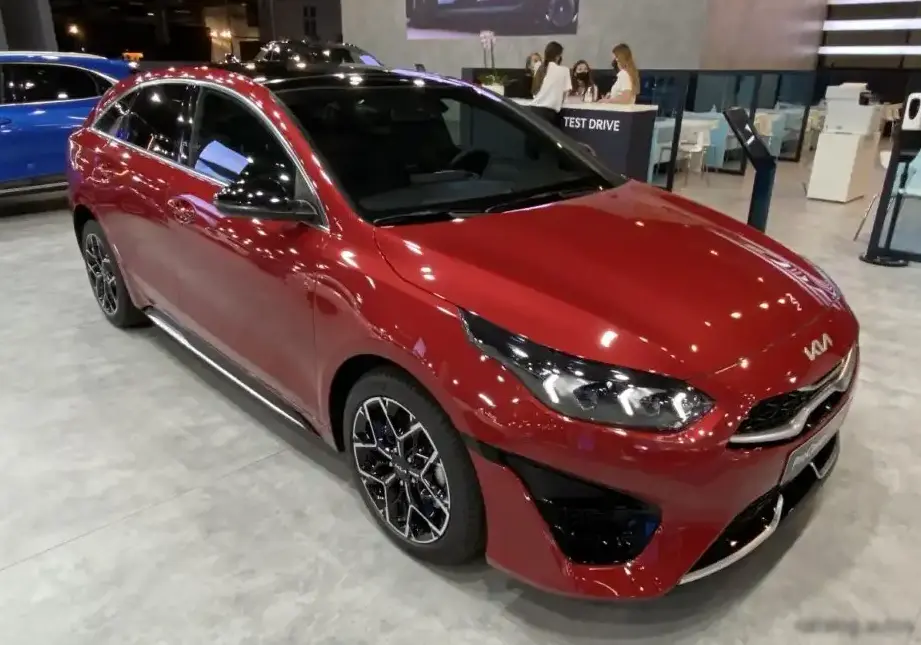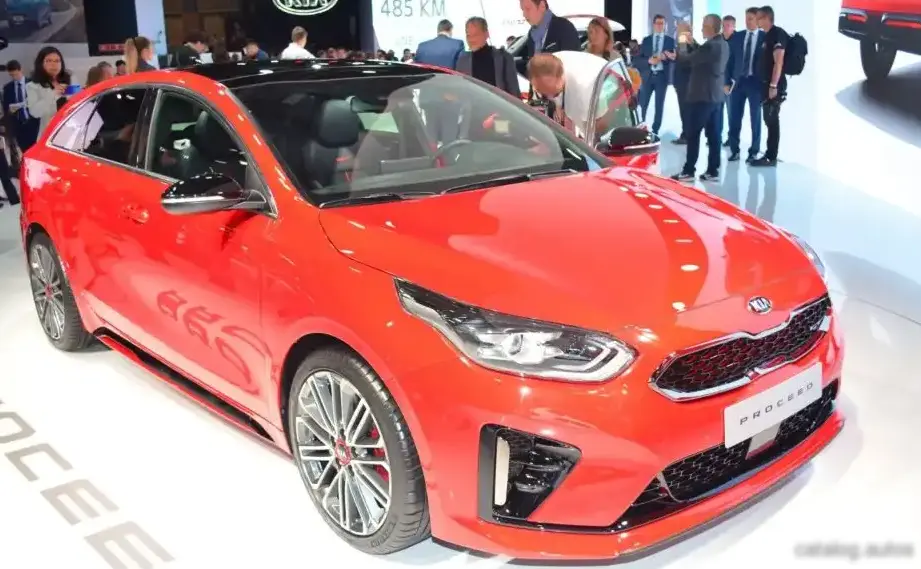
The Kia ProCeed III 1.4 T-GDI (140 hp) DCT represents a compelling offering within the third generation of Kia’s ProCeed model, produced from June 2018 to March 2021. Positioned as a stylish and practical shooting brake (estate) variant, it aimed to bridge the gap between traditional hatchbacks and larger wagons. This specific configuration, combining a turbocharged gasoline engine with a dual-clutch transmission, was a key part of Kia’s strategy to appeal to European buyers seeking efficiency and a more engaging driving experience. The ProCeed III was built on the 1HX0 platform, shared with the Hyundai i30, and represented a significant step up in terms of design, technology, and refinement compared to its predecessors.
| Brand | Kia |
| Model | ProCeed |
| Generation | ProCeed III |
| Type (Engine) | 1.4 T-GDI (140 Hp) DCT |
| Start of production | June, 2018 |
| End of production | March, 2021 |
| Powertrain Architecture | Internal Combustion engine |
| Body type | Station wagon (estate) |
| Seats | 5 |
| Doors | 5 |
| Fuel consumption (urban) | 6.6-6.7 l/100 km (35.6 – 35.1 US mpg) |
| Fuel consumption (extra urban) | 4.8-5 l/100 km (49 – 47 US mpg) |
| Fuel consumption (combined) | 5.5-5.7 l/100 km (42.8 – 41.3 US mpg) |
| CO2 emissions | 125-129 g/km |
| Fuel Type | Petrol (Gasoline) |
| Acceleration 0 – 100 km/h | 9.4 sec |
| Acceleration 0 – 62 mph | 9.4 sec |
| Acceleration 0 – 60 mph | 8.9 sec |
| Maximum speed | 205 km/h (127.38 mph) |
| Emission standard | Euro 6d-TEMP |
| Weight-to-power ratio | 9.5 kg/Hp |
| Weight-to-torque ratio | 5.5 kg/Nm |
| Power | 140 Hp @ 6000 rpm |
| Torque | 242 Nm @ 1500-3200 rpm (178.49 lb.-ft.) |
| Engine layout | Front, Transverse |
| Engine Model/Code | Kappa II / G4LD |
| Engine displacement | 1353 cm3 (82.57 cu. in.) |
| Number of cylinders | 4 |
| Engine configuration | Inline |
| Cylinder Bore | 71.6 mm (2.82 in.) |
| Piston Stroke | 84 mm (3.31 in.) |
| Compression ratio | 10:1 |
| Number of valves per cylinder | 4 |
| Fuel injection system | Direct injection |
| Engine aspiration | Turbocharger, Intercooler |
| Valvetrain | DOHC |
| Engine oil capacity | 4.2 l (4.44 US qt | 3.7 UK qt) |
| Coolant capacity | 6.1 l (6.45 US qt | 5.37 UK qt) |
| Kerb Weight | 1330-1436 kg (2932.15 – 3165.84 lbs.) |
| Max. weight | 1870 kg (4122.64 lbs.) |
| Max load | 434-540 kg (956.81 – 1190.5 lbs.) |
| Trunk (boot) space – minimum | 594 l (20.98 cu. ft.) |
| Trunk (boot) space – maximum | 1545 l (54.56 cu. ft.) |
| Fuel tank capacity | 50 l (13.21 US gal | 11 UK gal) |
| Max. roof load | 80 kg (176.37 lbs.) |
| Permitted trailer load with brakes (12%) | 1410 kg (3108.52 lbs.) |
| Permitted trailer load without brakes | 600 kg (1322.77 lbs.) |
| Permitted towbar download | 75 kg (165.35 lbs.) |
| Length | 4605 mm (181.3 in.) |
| Width | 1800 mm (70.87 in.) |
| Width including mirrors | 2055 mm (80.91 in.) |
| Height | 1422 mm (55.98 in.) |
| Wheelbase | 2650 mm (104.33 in.) |
| Front track | 1555-1559 mm (61.22 – 61.38 in.) |
| Rear track | 1563-1567 mm (61.54 – 61.69 in.) |
| Front overhang | 885 mm (34.84 in.) |
| Rear overhang | 1070 mm (42.13 in.) |
| Ride height (ground clearance) | 135 mm (5.31 in.) |
| Minimum turning circle | 10 m (32.81 ft.) |
| Drivetrain Architecture | Front wheel drive |
| Number of gears and type of gearbox | 7 gears, automatic transmission DCT |
| Front suspension | Independent, type McPherson with coil spring and anti-roll bar |
| Rear suspension | Independent multi-link spring suspension with stabilizer |
| Front brakes | Ventilated discs, 305×25 mm |
| Rear brakes | Disc, 284×10 mm |
| Tires size | 225/45 R17; 225/40 ZR18 |
| Wheel rims size | 7J x 17; 7.5J x 18 |
Powertrain & Engine Architecture
At the heart of the ProCeed 1.4 T-GDI DCT lies Kia’s Kappa II engine family, specifically the G4LD 1.4-liter turbocharged four-cylinder. This engine is a key component of Hyundai-Kia’s efforts to downsize and improve fuel efficiency without sacrificing performance. The G4LD utilizes direct fuel injection, a twin-scroll turbocharger, and an intercooler to deliver a balance of power and economy. The engine produces 140 horsepower at 6000 rpm and 242 Nm (178.49 lb-ft) of torque between 1500 and 3200 rpm. The engine features a DOHC (Dual Overhead Camshaft) valvetrain and a compression ratio of 10:1. The engine also incorporates a start/stop system and a particulate filter to meet stringent Euro 6d-TEMP emissions standards.
The ‘DCT’ in the name refers to the 7-speed dual-clutch transmission. This transmission offers quicker and smoother gear changes compared to a traditional automatic, contributing to a more responsive driving experience. The DCT is designed to optimize fuel efficiency and provide a sporty feel. The transmission’s gear ratios are tuned to balance acceleration and fuel economy, with a relatively tall final drive to aid in highway cruising.
Driving Characteristics
The 1.4 T-GDI DCT ProCeed offers a comfortable and refined driving experience. While not a performance-oriented variant, the 140 hp engine provides adequate power for everyday driving and occasional highway overtaking. Acceleration from 0 to 60 mph takes approximately 8.9 seconds, and the car has a top speed of 205 km/h (127.38 mph). The DCT transmission contributes to a smooth and responsive feel, although some drivers may notice slight hesitation at low speeds. Compared to the more powerful ProCeed GT models, this variant prioritizes fuel efficiency and comfort over outright performance. The steering is light and precise, making it easy to maneuver in urban environments. The suspension is tuned for comfort, absorbing bumps and imperfections in the road well.
Equipment & Trim Levels
The ProCeed 1.4 T-GDI DCT typically came equipped with a generous amount of standard features. These included air conditioning, a touchscreen infotainment system with Apple CarPlay and Android Auto compatibility, Bluetooth connectivity, and a suite of safety features such as autonomous emergency braking, lane keeping assist, and a driver attention warning system. Higher trim levels offered additional features such as a larger touchscreen display, a panoramic sunroof, leather upholstery, and a premium sound system. Interior upholstery was typically cloth on base models, with leather options available on higher trims. Dashboard configuration was modern and driver-focused, with a clean and intuitive layout.
Chassis & Braking
The ProCeed III utilizes an independent suspension setup on both the front and rear axles. The front suspension employs a McPherson strut design with a coil spring and anti-roll bar, while the rear suspension features a multi-link setup with a stabilizer bar. This configuration provides a good balance of ride comfort and handling. The braking system consists of ventilated discs on the front wheels and solid discs on the rear. ABS (Anti-lock Braking System) is standard, enhancing safety and control during emergency braking situations. The ProCeed’s chassis is designed to provide a stable and predictable driving experience, with a focus on comfort and refinement.
Market Reception & Comparison
The Kia ProCeed III 1.4 T-GDI DCT was generally well-received by automotive critics. It was praised for its stylish design, spacious interior, and good fuel economy. The combination of the turbocharged engine and DCT transmission was seen as a positive, offering a more engaging driving experience than some of its competitors. However, some critics noted that the engine could feel strained when fully loaded or during steep climbs. Compared to other trims in the ProCeed lineup, such as the diesel variants, the 1.4 T-GDI offered a more refined and responsive driving experience, albeit with slightly higher fuel consumption. Its fuel economy figures of 5.5-5.7 l/100 km (42.8 – 41.3 US mpg) were competitive within its segment.
Legacy
The Kia ProCeed III 1.4 T-GDI DCT has proven to be a reliable and durable vehicle. The Kappa II engine is generally considered to be a robust unit, and the DCT transmission has also demonstrated good reliability with proper maintenance. In the used car market, these models are often sought after for their combination of style, practicality, and fuel efficiency. Regular maintenance, including oil changes and transmission fluid checks, is crucial to ensure the long-term health of the powertrain. The ProCeed III represents a significant step forward for Kia in terms of design, technology, and overall quality, and the 1.4 T-GDI DCT variant remains a popular choice for buyers seeking a well-rounded and affordable estate car.