Technical Specifications
| Brand | Audi |
| Model | A5 |
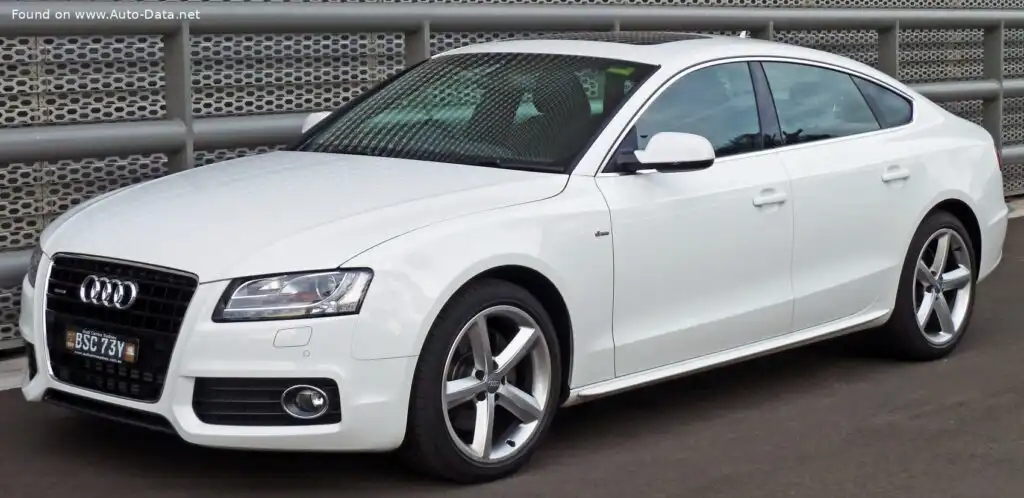
| Generation | A5 Sportback (8TA) |
| Type (Engine) | 2.7 TDI V6 (190 Hp) |
| Start of production | 2009 |
| End of production | 2011 |
| Powertrain Architecture | Internal Combustion engine |
| Body type | Fastback |
| Seats | 4 |
| Doors | 5 |
| Fuel consumption (urban) | 8.1 l/100 km (29 US mpg, 34.9 UK mpg, 12.3 km/l) |
| Fuel consumption (extra urban) | 4.8 l/100 km (49 US mpg, 58.9 UK mpg, 20.8 km/l) |
| Fuel consumption (combined) | 6 l/100 km (39.2 US mpg, 47.1 UK mpg, 16.7 km/l) |
| CO2 emissions | 159 g/km |
| Fuel Type | Diesel |
| Acceleration 0 – 100 km/h | 8.2 sec |
| Acceleration 0 – 62 mph | 8.2 sec |
| Acceleration 0 – 60 mph | 7.8 sec |
| Maximum speed | 235 km/h (146.02 mph) |
| Emission standard | Euro 5 |
| Weight-to-power ratio | 8.5 kg/Hp, 117.3 Hp/tonne |
| Weight-to-torque ratio | 4.1 kg/Nm, 246.9 Nm/tonne |
| Power | 190 Hp @ 3500-4400 rpm |
| Power per litre | 70.4 Hp/l |
| Torque | 400 Nm @ 1400-3250 rpm (295.02 lb.-ft. @ 1400-3250 rpm) |
| Engine layout | Front, Longitudinal |
| Engine Model/Code | CAMA, CGKA |
| Engine displacement | 2698 cm3 (164.64 cu. in.) |
| Number of cylinders | 6 |
| Engine configuration | V-engine |
| Cylinder Bore | 83 mm (3.27 in.) |
| Piston Stroke | 83.1 mm (3.27 in.) |
| Compression ratio | 16.8:1 |
| Number of valves per cylinder | 4 |
| Fuel injection system | Diesel Commonrail |
| Engine aspiration | Turbocharger, Intercooler |
| Valvetrain | DOHC |
| Engine oil capacity | 6.9 l (7.29 US qt | 6.07 UK qt) |
| Kerb Weight | 1620 kg (3571.49 lbs.) |
| Max. weight | 2150 kg (4739.94 lbs.) |
| Max load | 530 kg (1168.45 lbs.) |
| Trunk (boot) space – minimum | 480 l (16.95 cu. ft.) |
| Trunk (boot) space – maximum | 980 l (34.61 cu. ft.) |
| Fuel tank capacity | 65 l (17.17 US gal | 14.3 UK gal) |
| Max. roof load | 90 kg (198.42 lbs.) |
| Permitted trailer load with brakes (8%) | 1800 kg (3968.32 lbs.) |
| Permitted trailer load with brakes (12%) | 1600 kg (3527.4 lbs.) |
| Permitted trailer load without brakes | 750 kg (1653.47 lbs.) |
| Permitted towbar download | 80 kg (176.37 lbs.) |
| Length | 4711 mm (185.47 in.) |
| Width | 1854 mm (72.99 in.) |
| Height | 1391 mm (54.76 in.) |
| Wheelbase | 2810 mm (110.63 in.) |
| Front track | 1590 mm (62.6 in.) |
| Rear (Back) track | 1575 mm (62.01 in.) |
| Drag coefficient (Cd) | 0.30 |
| Minimum turning circle (turning diameter) | 11.5 m (37.73 ft.) |
| Drivetrain Architecture | The Internal combustion engine (ICE) drives the front wheels of the vehicle. |
| Drive wheel | Front wheel drive |
| Number of gears and type of gearbox | 6 gears, manual transmission |
| Front suspension | Independent multi-link suspension |
| Rear suspension | Independent multi-link spring suspension with stabilizer |
| Front brakes | Ventilated discs |
| Rear brakes | Disc |
| Assisting systems | ABS (Anti-lock braking system) |
| Steering type | Steering rack and pinion |
| Power steering | Electric Steering |
| Tires size | 225/50 R17 |
| Wheel rims size | 7.5J x 17 |
The Audi A5 Sportback 2.7 TDI V6 (8TA) was introduced in 2009 as an extension of the successful A5 coupe and convertible range. It aimed to capture buyers seeking a more practical, five-door body style without sacrificing the A5’s elegant design and premium feel. This variant was particularly popular in Europe, where diesel engines and Sportback configurations were highly favored. The 2.7 TDI engine, a mainstay in Audi’s lineup, provided a balance of performance and fuel efficiency, making it a versatile choice for both daily commuting and longer journeys.
Powertrain & Engine Architecture
At the heart of the A5 Sportback 2.7 TDI lies the CAMA or CGKA engine code, a 2.7-liter V6 turbodiesel. This engine utilizes a common rail direct injection system, delivering fuel directly into the combustion chambers at extremely high pressure for optimized combustion. The engine features a double overhead camshaft (DOHC) valvetrain with four valves per cylinder, enhancing breathing and contributing to its power output. A variable geometry turbocharger (VGT) and intercooler work in tandem to boost performance and manage intake air temperature. The 2.7 TDI is known for its robust construction and relatively straightforward maintenance, although the diesel particulate filter (DPF) requires periodic regeneration. The 6-speed manual transmission was standard, offering precise shifts and a direct connection to the engine.
Driving Characteristics
The 190 horsepower and 400 Nm (295 lb-ft) of torque produced by the 2.7 TDI engine provide brisk acceleration, with a 0-60 mph time of around 7.8 seconds. While not as overtly sporty as the higher-output 3.0 TDI, the 2.7 TDI offers ample power for everyday driving and overtaking maneuvers. The manual transmission’s gear ratios are well-matched to the engine’s torque curve, providing strong pull throughout the rev range. Compared to the 2.0 TDI models, the 2.7 TDI feels significantly more refined and offers a smoother power delivery. The added weight of the V6 engine is noticeable, but the well-tuned suspension and precise steering contribute to a confident and engaging driving experience.
Equipment & Trim Levels
The A5 Sportback 2.7 TDI typically came well-equipped, reflecting Audi’s premium positioning. Standard features included alloy wheels, automatic climate control, a multi-function steering wheel, and an Audi Concert audio system. Higher trim levels, such as SE or S line, added features like leather upholstery, parking sensors, and upgraded infotainment systems. Optional extras included navigation, a panoramic sunroof, and advanced driver assistance systems like adaptive cruise control. Interior upholstery was typically cloth on base models, with leather options available. The dashboard layout was clean and modern, with a focus on ergonomics and ease of use.
Chassis & Braking
The A5 Sportback 2.7 TDI utilizes an independent multi-link suspension system at both the front and rear, providing a comfortable ride and precise handling. The front suspension features coil springs and stabilizer bar, while the rear suspension incorporates a separate spring and damper arrangement. Braking duties are handled by ventilated discs at the front and solid discs at the rear, providing ample stopping power. Anti-lock braking system (ABS) is standard, enhancing safety and stability. The steering is a rack-and-pinion system with electric power assistance, offering a responsive and precise feel.
Market Reception & Comparison
The Audi A5 Sportback 2.7 TDI was generally well-received by automotive critics. It was praised for its stylish design, refined engine, and practical five-door layout. Compared to the 2.0 TDI models, the 2.7 TDI offered a noticeable improvement in performance and refinement, justifying the higher price tag. Fuel economy was also commendable, averaging around 39.2 US mpg in combined driving. However, some critics noted that the manual transmission could feel slightly notchy at times. Compared to competitors like the BMW 3 Series Gran Turismo and the Mercedes-Benz CLS, the A5 Sportback offered a unique blend of style, practicality, and driving dynamics.
Legacy
The 2.7 TDI engine, in general, has proven to be a durable and reliable powertrain when properly maintained. However, like all diesel engines, it is susceptible to issues with the DPF and fuel injectors. Regular servicing and the use of high-quality fuel are essential for long-term reliability. On the used car market, the A5 Sportback 2.7 TDI remains a popular choice, offering a compelling combination of style, performance, and practicality. Values tend to be higher for well-maintained examples with low mileage and a full service history. The 8TA A5 Sportback, and particularly the 2.7 TDI variant, has cemented its place as a desirable and well-rounded premium vehicle.