
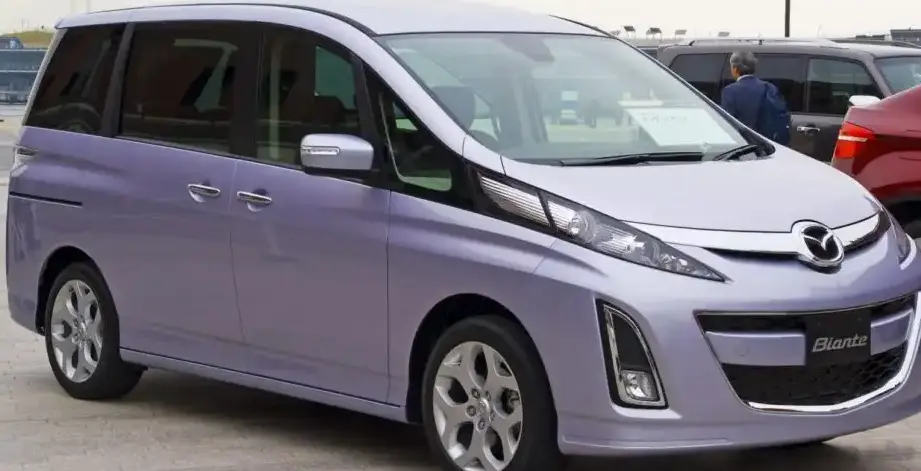
The Mazda Biante 2.0 (151 hp) Automatic, produced from 2008 to 2018, represents a significant offering in the compact minivan segment, primarily targeted towards the Japanese domestic market (JDM). While not officially sold in the United States, the Biante gained a reputation for its spacious interior, practical features, and relatively fuel-efficient powertrain. This particular variant, equipped with the PE-VPS 2.0-liter engine and a five-speed automatic transmission, occupied a mid-range position within the Biante lineup, offering a balance between performance and economy. It served as a popular choice for families seeking a versatile and comfortable vehicle.
Technical Specifications
| Brand | Mazda |
| Model | Biante |
| Generation | Biante |
| Type (Engine) | 2.0 (151 Hp) Automatic |
| Start of production | 2008 |
| End of production | 2018 |
| Powertrain Architecture | Internal Combustion engine |
| Body type | Minivan |
| Seats | 8 |
| Doors | 5 |
| Fuel consumption (combined) | 7.8 l/100 km (30.2 US mpg, 36.2 UK mpg, 12.8 km/l) |
| Fuel Type | Petrol (Gasoline) |
| Weight-to-power ratio | 10.9 kg/Hp, 92.1 Hp/tonne |
| Weight-to-torque ratio | 8.6 kg/Nm, 115.9 Nm/tonne |
| Power | 151 Hp @ 6200 rpm |
| Power per litre | 75.6 Hp/l |
| Torque | 190 Nm @ 4500 rpm (140.14 lb.-ft. @ 4500 rpm) |
| Engine layout | Front, Transverse |
| Engine Model/Code | PE-VPS |
| Engine displacement | 1998 cm3 (121.93 cu. in.) |
| Number of cylinders | 4 |
| Engine configuration | Inline |
| Cylinder Bore | 87.5 mm (3.44 in.) |
| Piston Stroke | 83.1 mm (3.27 in.) |
| Compression ratio | 11.2:1 |
| Number of valves per cylinder | 4 |
| Fuel injection system | Direct injection |
| Engine aspiration | Naturally aspirated engine |
| Valvetrain | DOHC |
| Engine oil capacity | 4.2 l (4.44 US qt | 3.7 UK qt) |
| Coolant | 8 l (8.45 US qt | 7.04 UK qt) |
| Kerb Weight | 1640 kg (3615.58 lbs.) |
| Length | 4715 mm (185.63 in.) |
| Width | 1770 mm (69.69 in.) |
| Height | 1835 mm (72.24 in.) |
| Wheelbase | 2850 mm (112.2 in.) |
| Front track | 1530 mm (60.24 in.) |
| Rear track | 1530 mm (60.24 in.) |
| Minimum turning circle | 10.8 m (35.43 ft.) |
| Drivetrain Architecture | Front wheel drive |
| Number of gears | 5 |
| Gearbox type | Automatic transmission |
| Front suspension | Independent, type McPherson with coil spring and anti-roll bar |
| Rear suspension | Transverse stabilizer |
| Front brakes | Ventilated discs |
| Assisting systems | ABS (Anti-lock braking system) |
| Steering type | Steering rack and pinion |
| Tires size | 205/60 R16 |
| Wheel rims size | 16 |
Powertrain & Engine Architecture
The heart of the Biante 2.0 Automatic is the PE-VPS engine, a 1.998-liter inline-four cylinder gasoline engine. This engine utilizes direct injection technology, contributing to improved fuel efficiency and power output. The PE-VPS features a double overhead camshaft (DOHC) valvetrain with four valves per cylinder, optimizing airflow for enhanced performance. The engine’s 11.2:1 compression ratio further aids in extracting maximum energy from the fuel. The five-speed automatic transmission was chosen for its smooth operation and ease of use, catering to the target demographic of family drivers. While not a performance-oriented transmission, it was tuned for comfortable cruising and adequate acceleration.
Driving Characteristics
The 151 hp and 190 Nm (140 lb-ft) of torque delivered by the PE-VPS engine, coupled with the five-speed automatic, provided adequate, though not exhilarating, performance. Acceleration was sufficient for everyday driving, but overtaking maneuvers required planning. The automatic transmission’s gear ratios were optimized for fuel economy rather than outright speed. Compared to the more powerful 2.3-liter engine option available in some Biante models, the 2.0-liter felt less responsive, particularly when fully loaded with passengers and cargo. However, the automatic transmission offered a smoother and more convenient driving experience than the available manual transmission, making it a popular choice for urban commuting and long-distance family trips.
Equipment & Trim Levels
The Biante 2.0 Automatic typically came standard with features such as air conditioning, power windows and locks, and a basic audio system. Higher trim levels added features like alloy wheels, fog lights, and a more sophisticated infotainment system. Interior upholstery was generally cloth, with optional leather seats available on some trims. The Biante’s defining characteristic was its spacious interior, offering seating for up to eight passengers. The second-row seats often featured individual adjustments and a walk-through function for easy access to the third row. Optional extras included a sunroof, navigation system, and rear-view camera.
Chassis & Braking
The Biante utilized a front-wheel-drive layout with an independent McPherson strut suspension in the front and a transverse stabilizer setup in the rear. This suspension configuration provided a comfortable ride quality, absorbing bumps and irregularities in the road surface effectively. The front brakes were ventilated discs, offering adequate stopping power, while the rear brakes were typically drums. Anti-lock Braking System (ABS) was standard, enhancing safety during emergency braking situations. The steering system employed a rack and pinion setup, providing precise and responsive steering feel.
Market Reception & Comparison
The Mazda Biante 2.0 Automatic was generally well-received in the Japanese market for its practicality, spaciousness, and fuel efficiency. Critics praised its comfortable ride and user-friendly features. Compared to other minivans in its class, such as the Toyota Sienta and Honda Freed, the Biante offered a more stylish design and a slightly more engaging driving experience. However, some reviewers noted that the 2.0-liter engine could feel underpowered when the vehicle was fully loaded. Fuel economy was competitive, averaging around 7.8 l/100 km (30.2 US mpg), making it an attractive option for budget-conscious buyers.
Legacy
The Mazda Biante, while not a mainstream vehicle in North America, has developed a following among enthusiasts who appreciate its unique blend of practicality and style. The PE-VPS engine, when properly maintained, is known for its reliability. Common maintenance items include regular oil changes, timing belt replacements (typically around 100,000 km), and inspection of the direct injection system. In the used car market, the Biante 2.0 Automatic remains a relatively affordable and dependable option for families seeking a spacious and fuel-efficient minivan. Its reputation for reliability and practicality ensures its continued presence on roads, particularly in regions where it was originally sold.
