
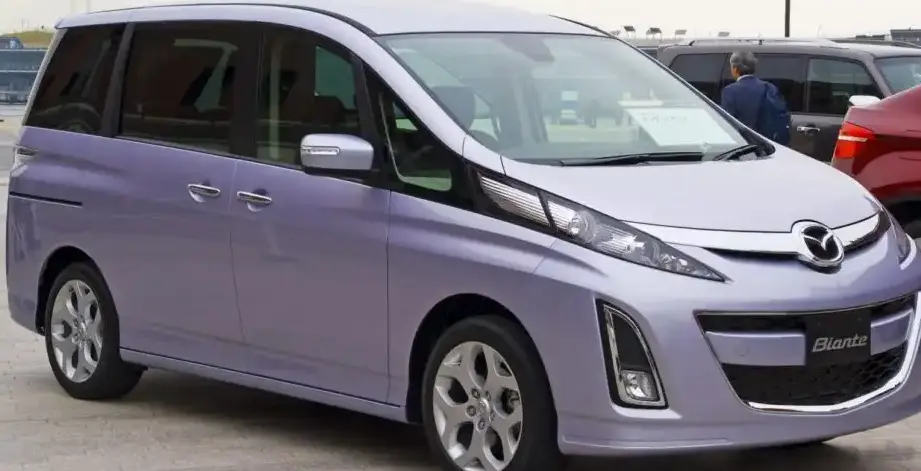
The Mazda Biante 2.3 (165 Hp) Automatic, produced from 2008 to 2018, represents a significant offering in Mazda’s minivan lineup, primarily targeted towards the Asian market, particularly Japan. Positioned as a mid-range trim within the Biante generation (known internally as the BKEP/BK3P series), this variant aimed to balance practicality, comfort, and reasonable fuel efficiency for families. The Biante, as a whole, was designed to compete with other compact MPVs like the Toyota Sienta and Honda Freed, offering a spacious interior and versatile seating configurations. This specific 2.3-liter engine and automatic transmission combination was a popular choice, offering a step up in performance from the base 2.0-liter models while remaining more accessible than potential future, higher-performance trims.
Technical Specifications
| Brand | Mazda |
| Model | Biante |
| Generation | Biante |
| Type (Engine) | 2.3 (165 Hp) Automatic |
| Start of production | 2008 |
| End of production | 2018 |
| Powertrain Architecture | Internal Combustion engine |
| Body type | Minivan |
| Seats | 8 |
| Doors | 5 |
| Fuel consumption (combined) | 7.8 l/100 km (30.2 US mpg, 36.2 UK mpg, 12.8 km/l) |
| Fuel Type | Petrol (Gasoline) |
| Weight-to-power ratio | 10.6 kg/Hp, 94.3 Hp/tonne |
| Weight-to-torque ratio | 8.3 kg/Nm, 120 Nm/tonne |
| Power | 165 Hp @ 6500 rpm |
| Power per litre | 73 Hp/l |
| Torque | 210 Nm @ 4000 rpm (154.89 lb.-ft. @ 4000 rpm) |
| Engine layout | Front, Transverse |
| Engine displacement | 2260 cm3 (137.91 cu. in.) |
| Number of cylinders | 4 |
| Engine configuration | Inline |
| Cylinder Bore | 87.5 mm (3.44 in.) |
| Piston Stroke | 94 mm (3.7 in.) |
| Compression ratio | 10.6:1 |
| Number of valves per cylinder | 4 |
| Fuel injection system | Multi-port manifold injection |
| Engine aspiration | Naturally aspirated engine |
| Valvetrain | DOHC |
| Kerb Weight | 1750 kg (3858.09 lbs.) |
| Length | 4715 mm (185.63 in.) |
| Width | 1770 mm (69.69 in.) |
| Height | 1835 mm (72.24 in.) |
| Wheelbase | 2850 mm (112.2 in.) |
| Front track | 1530 mm (60.24 in.) |
| Rear track | 1530 mm (60.24 in.) |
| Minimum turning circle | 10.8 m (35.43 ft.) |
| Drivetrain Architecture | Front wheel drive, Internal Combustion engine (ICE) |
| Number of gears | 5 |
| Gearbox type | Automatic transmission |
| Front suspension | Independent, McPherson with coil spring and anti-roll bar |
| Rear suspension | Transverse stabilizer |
| Front brakes | Ventilated discs |
| Assisting systems | ABS (Anti-lock braking system) |
| Steering type | Steering rack and pinion |
| Tires size | 215/50 R17 |
| Wheel rims size | 17 |
Powertrain & Engine Architecture
The heart of the Biante 2.3 Automatic is Mazda’s L3-VDT engine, a 2.3-liter inline-four cylinder gasoline engine. This engine utilizes a naturally aspirated configuration, relying on displacement and optimized airflow rather than forced induction for its power output. The L3-VDT features a double overhead camshaft (DOHC) valvetrain with four valves per cylinder, contributing to efficient cylinder filling and exhaust scavenging. Fuel delivery is managed by a multi-port fuel injection system, providing precise fuel metering for optimal combustion. The engine’s 10.6:1 compression ratio strikes a balance between power and fuel efficiency. Paired with this engine is a five-speed automatic transmission. This transmission, while not the most modern in terms of gear count compared to some contemporary offerings, was known for its smooth operation and reliability. The automatic transmission was selected to provide ease of use, particularly appealing to family buyers who prioritized convenience over sporty driving dynamics.
Driving Characteristics
The Biante 2.3 Automatic delivers a comfortable and predictable driving experience. With 165 horsepower and 210 Nm (155 lb-ft) of torque, acceleration is adequate for everyday driving situations, though it won’t provide particularly brisk performance. The five-speed automatic transmission is tuned for smooth shifts and prioritizes fuel economy over aggressive downshifts. Compared to the base 2.0-liter Biante, the 2.3-liter engine offers noticeably improved responsiveness, especially when fully loaded with passengers and cargo. However, it doesn’t match the performance of potential higher-spec trims that might have been offered in some markets. The front-wheel-drive configuration provides predictable handling, and the suspension is tuned for comfort, absorbing bumps and imperfections in the road well. The steering is light and easy to use, making maneuvering in tight spaces straightforward.
Equipment & Trim Levels
The Biante 2.3 Automatic typically came equipped with a respectable array of standard features. These generally included power windows and locks, air conditioning, a basic audio system with CD player, and ABS brakes. Higher trim levels, often denoted with suffixes like “Sport” or “Luxury,” added features such as alloy wheels, fog lights, a more advanced audio system with navigation, and upgraded interior upholstery. Interior materials were generally durable and practical, reflecting the vehicle’s family-oriented focus. Seating configurations were a key selling point, with options for seven or eight passengers and flexible folding arrangements to maximize cargo space. Optional extras could include a sunroof, leather seats, and rear parking sensors.
Chassis & Braking
The Biante utilizes a front-engine, front-wheel-drive layout. The front suspension employs an independent McPherson strut design with coil springs and an anti-roll bar, providing a good balance of ride comfort and handling stability. The rear suspension features a torsion beam setup, which is a cost-effective and space-efficient solution for a minivan. Braking duties are handled by ventilated disc brakes at the front and drum brakes at the rear. While the front discs provide adequate stopping power, the rear drums were a cost-saving measure and didn’t offer the same level of performance as rear discs. ABS (Anti-lock Braking System) was standard, enhancing safety by preventing wheel lockup during hard braking.
Market Reception & Comparison
The Mazda Biante 2.3 Automatic was generally well-received in its target markets. Critics praised its spacious interior, comfortable ride, and practical features. The 2.3-liter engine was considered a good compromise between performance and fuel economy. Compared to the base 2.0-liter model, the 2.3-liter version offered a noticeable improvement in drivability, making it a more appealing option for those who frequently carried passengers or cargo. Fuel economy was respectable for a minivan, averaging around 7.8 l/100 km (30.2 US mpg). However, some reviewers noted that the interior design was somewhat conservative compared to some competitors. Reliability was generally good, with few widespread issues reported.
Legacy
The Mazda Biante, and specifically the 2.3 Automatic variant, has established a reputation for reliability and practicality in the used car market. The L3-VDT engine is known to be durable and relatively easy to maintain, provided regular servicing is performed. While not a performance icon, the Biante 2.3 Automatic remains a viable option for families seeking a spacious, comfortable, and affordable minivan. Parts availability is generally good, and the vehicle’s relatively simple mechanical design makes it accessible to independent mechanics. Today, well-maintained examples continue to offer good value, particularly for those seeking a dependable and versatile people carrier.
