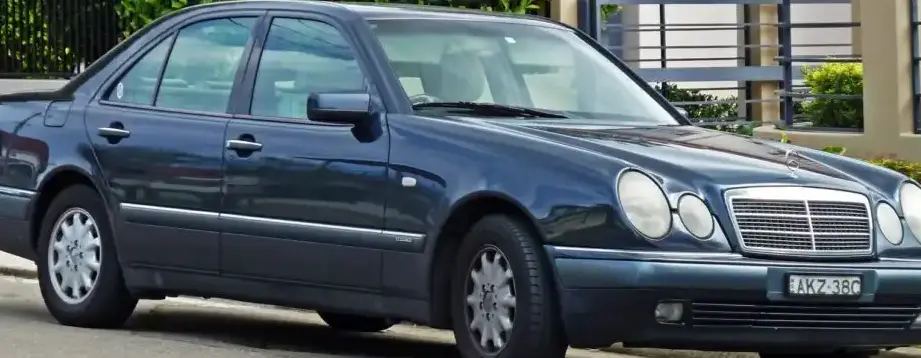
The Mercedes-Benz E 200 (W210), produced between August 1996 and July 1999, represented the entry point into the significantly redesigned W210 E-Class range. Positioned as a more accessible alternative to the higher-performance E 230 and E 280 models, and the diesel-powered E 290 TD, the E 200 with the automatic transmission aimed for buyers prioritizing comfort and fuel efficiency over outright speed. It was a key model in the North American and European markets, offering a blend of Mercedes-Benz luxury and practicality. The W210 generation marked a substantial leap forward in safety and technology for the brand, and the E 200 benefitted from these advancements while remaining relatively affordable.
Technical Specifications
| Brand | Mercedes-Benz |
| Model | E-class |
| Generation | E-class (W210) |
| Type (Engine) | E 200 (136 Hp) Automatic |
| Start of production | August, 1996 |
| End of production | July, 1999 |
| Powertrain Architecture | Internal Combustion engine |
| Body type | Sedan |
| Seats | 5 |
| Doors | 4 |
| Fuel consumption (urban) | 10.5 l/100 km (22.4 US mpg) |
| Fuel consumption (extra urban) | 6.1 l/100 km (38.6 US mpg) |
| Fuel Type | Petrol (Gasoline) |
| Acceleration 0 – 100 km/h | 11.8 sec |
| Acceleration 0 – 62 mph | 11.8 sec |
| Acceleration 0 – 60 mph | 11.2 sec |
| Maximum speed | 202 km/h (125.52 mph) |
| Weight-to-power ratio | 10.6 kg/Hp |
| Weight-to-torque ratio | 7.6 kg/Nm |
| Power | 136 Hp @ 5500 rpm |
| Torque | 190 Nm @ 4000 rpm (140.14 lb.-ft. @ 4000 rpm) |
| Engine layout | Front, Longitudinal |
| Engine Model/Code | M 111 E 20 / 111.942 |
| Engine displacement | 1998 cm3 (121.93 cu. in.) |
| Number of cylinders | 4 |
| Engine configuration | Inline |
| Cylinder Bore | 89.9 mm (3.54 in.) |
| Piston Stroke | 78.7 mm (3.1 in.) |
| Compression ratio | 9.6:1 |
| Number of valves per cylinder | 4 |
| Fuel injection system | Multi-port manifold injection |
| Engine aspiration | Naturally aspirated engine |
| Valvetrain | DOHC |
| Engine oil capacity | 5.5 l (5.81 US qt | 4.84 UK qt) |
| Coolant | 8.5 l (8.98 US qt | 7.48 UK qt) |
| Kerb Weight | 1440 kg (3174.66 lbs.) |
| Max. weight | 1940 kg (4276.97 lbs.) |
| Max load | 500 kg (1102.31 lbs.) |
| Fuel tank capacity | 65 l (17.17 US gal | 14.3 UK gal) |
| Length | 4795 mm (188.78 in.) |
| Width | 1799 mm (70.83 in.) |
| Height | 1436 mm (56.54 in.) |
| Wheelbase | 2833 mm (111.54 in.) |
| Front track | 1542 mm (60.71 in.) |
| Rear track | 1536 mm (60.47 in.) |
| Drivetrain Architecture | Rear wheel drive |
| Number of gears | 5 |
| Gearbox type | automatic transmission |
| Front suspension | Double wishbone |
| Rear suspension | Independent multi-link spring suspension with stabilizer |
| Front brakes | Ventilated discs |
| Rear brakes | Disc |
| Assisting systems | ABS (Anti-lock braking system) |
| Steering type | Steering rack and pinion |
| Power steering | Hydraulic Steering |
| Tires size | 195/65 R15 |
| Wheel rims size | 6.5J x 15 |
Powertrain & Engine Architecture
The E 200 utilized the M111 E 20 engine, a 1.998-liter (121.93 cubic inches) inline-four cylinder powerplant. This engine was a significant departure from the older CIS-E fuel injection systems found in earlier Mercedes-Benz models, employing a modern multi-port fuel injection system. The M111 featured a double overhead camshaft (DOHC) valvetrain with four valves per cylinder, contributing to its relatively high output for its displacement. The engine code, 111.942, identifies specific variations within the M111 family. Paired with the engine was a 5-speed automatic transmission, a common choice for buyers seeking a comfortable and effortless driving experience. This transmission was designed for smooth shifts and optimized for fuel economy, rather than aggressive performance.
Driving Characteristics
The E 200 Automatic offered a comfortable and refined driving experience, but it wasn’t designed for sporty performance. With 136 horsepower and 190 Nm (140 lb-ft) of torque, acceleration was adequate for everyday driving, but noticeably slower than the E 230 or E 280. The automatic transmission, while smooth, contributed to a slight loss of power compared to the available manual transmission. Gear ratios were tuned for fuel efficiency and relaxed cruising, meaning quick downshifts for overtaking required a deliberate push of the accelerator. The rear-wheel drive configuration provided balanced handling, but the relatively soft suspension setup prioritized ride comfort over sharp cornering.
Equipment & Trim Levels
The E 200 typically came standard with features expected of a mid-size luxury sedan in the late 1990s. This included power windows, power locks, central locking, air conditioning, and a basic audio system. Interior upholstery was typically cloth, although leather was available as an option. Dashboard trim was often wood veneer, adding to the car’s luxurious feel. Common optional extras included a sunroof, upgraded audio systems, automatic climate control, and heated seats. Safety features, a key selling point for the W210, were comprehensive and included ABS anti-lock brakes, airbags, and a robust safety cell construction.
Chassis & Braking
The W210 E-Class featured a double wishbone front suspension and an independent multi-link rear suspension, providing a comfortable ride and good handling characteristics. The E 200, being the entry-level model, generally came equipped with ventilated disc brakes at the front and solid disc brakes at the rear. Stabilizer bars were fitted to both the front and rear axles to reduce body roll during cornering. The hydraulic power steering provided light and precise steering feel. The suspension was tuned to prioritize comfort, resulting in a softer ride compared to the sportier E 280 models.
Market Reception & Comparison
The E 200 Automatic was generally well-received as a practical and affordable entry point into the W210 E-Class range. Critics praised its comfortable ride, spacious interior, and comprehensive safety features. However, its performance was often criticized as being underwhelming, particularly compared to the more powerful engine options. Fuel economy was a strong point, making it an attractive option for drivers covering long distances. Compared to the E 230, the E 200 offered a lower purchase price but sacrificed performance. The E 200 also provided a more refined and comfortable experience than the diesel-powered E 290 TD, but at the cost of fuel efficiency.
Legacy
The M111 engine, in general, proved to be a reliable and durable powerplant. The E 200 Automatic, while not the most sought-after W210 variant, remains a relatively affordable and practical classic car today. Common maintenance issues include wear and tear on the automatic transmission, potential oil leaks from the engine, and corrosion in areas prone to rust. However, parts availability is generally good, and the car’s relatively simple mechanical design makes it accessible for DIY repairs. The E 200 represents a significant step forward in Mercedes-Benz engineering, offering a blend of luxury, safety, and reliability that continues to appeal to enthusiasts and classic car buyers.