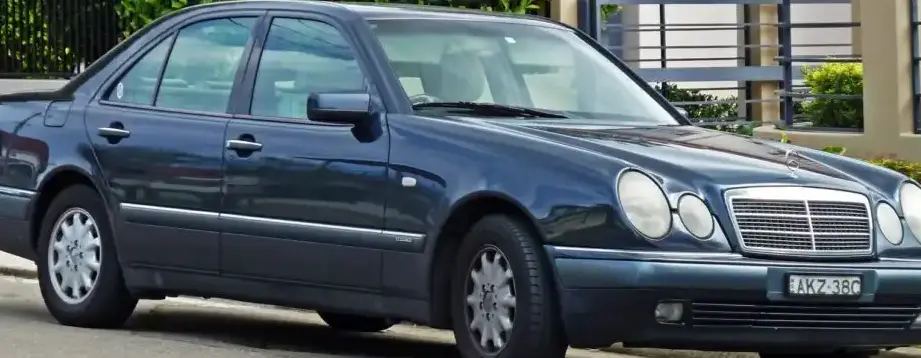
The Mercedes-Benz E 200 CDI Automatic, produced between June 1998 and July 1999, was a key variant within the W210 E-Class range. Positioned as an entry-level diesel offering in many European markets, it aimed to provide the comfort and prestige associated with the E-Class at a more accessible price point. This model represented Mercedes-Benz’s continued commitment to diesel technology, offering a blend of fuel efficiency and respectable performance. It was primarily sold in Europe, where diesel engines held a significantly larger market share than in the United States.
Technical Specifications
| Brand | Mercedes-Benz |
| Model | E-class |
| Generation | E-class (W210) |
| Type (Engine) | E 200 CDI (102 Hp) Automatic |
| Start of production | June, 1998 |
| End of production | July, 1999 |
| Powertrain Architecture | Internal Combustion engine |
| Body type | Sedan |
| Seats | 5 |
| Doors | 4 |
| Fuel consumption (urban) | 9.8 l/100 km (24 US mpg, 28.8 UK mpg, 10.2 km/l) |
| Fuel consumption (extra urban) | 6.9 l/100 km (34.1 US mpg, 40.9 UK mpg, 14.5 km/l) |
| Fuel Type | Diesel |
| Acceleration 0 – 100 km/h | 14 sec |
| Acceleration 0 – 62 mph | 14 sec |
| Acceleration 0 – 60 mph | 13.3 sec |
| Maximum speed | 183 km/h (113.71 mph) |
| Weight-to-power ratio | 15.1 kg/Hp, 66.2 Hp/tonne |
| Weight-to-torque ratio | 6.6 kg/Nm, 152.6 Nm/tonne |
| Power | 102 Hp @ 4200 rpm |
| Power per litre | 47.4 Hp/l |
| Torque | 235 Nm @ 1500 rpm (173.33 lb.-ft. @ 1500 rpm) |
| Engine layout | Front, Longitudinal |
| Engine Model/Code | OM 611 DE 22 LA LR / 611.960 |
| Engine displacement | 2151 cm3 (131.26 cu. in.) |
| Number of cylinders | 4 |
| Engine configuration | Inline |
| Cylinder Bore | 88 mm (3.46 in.) |
| Piston Stroke | 88.4 mm (3.48 in.) |
| Compression ratio | 19:1 |
| Number of valves per cylinder | 4 |
| Fuel injection system | Diesel Commonrail |
| Engine aspiration | Turbocharger, Intercooler |
| Valvetrain | DOHC |
| Engine oil capacity | 6 l (6.34 US qt | 5.28 UK qt) |
| Coolant | 8 l (8.45 US qt | 7.04 UK qt) |
| Kerb Weight | 1540 kg (3395.12 lbs.) |
| Max. weight | 2040 kg (4497.43 lbs.) |
| Max load | 500 kg (1102.31 lbs.) |
| Trunk (boot) space – minimum | 520 l (18.36 cu. ft.) |
| Fuel tank capacity | 65 l (17.17 US gal | 14.3 UK gal) |
| Length | 4795 mm (188.78 in.) |
| Width | 1799 mm (70.83 in.) |
| Height | 1436 mm (56.54 in.) |
| Wheelbase | 2833 mm (111.54 in.) |
| Front track | 1542 mm (60.71 in.) |
| Rear (Back) track | 1536 mm (60.47 in.) |
| Drivetrain Architecture | The Internal combustion engine (ICE) drives the rear wheels of the vehicle. |
| Drive wheel | Rear wheel drive |
| Number of gears and type of gearbox | 4 gears, automatic transmission |
| Front suspension | Double wishbone |
| Rear suspension | Independent multi-link spring suspension with stabilizer |
| Front brakes | Ventilated discs |
| Rear brakes | Disc |
| Assisting systems | ABS (Anti-lock braking system) |
| Steering type | Steering rack and pinion |
| Power steering | Hydraulic Steering |
| Tires size | 195/65 HR 15 |
| Wheel rims size | 6.5J x 15 |
Powertrain & Engine Architecture
The E 200 CDI was powered by the OM 611 DE 22 LA LR engine, a 2.2-liter inline-four cylinder diesel. This engine was a significant step forward for Mercedes-Benz, incorporating common rail direct injection technology. The common rail system, operating at extremely high pressures, allowed for finer control over fuel delivery, resulting in improved combustion efficiency, reduced noise, and lower emissions compared to older diesel injection systems. The engine featured a turbocharger with an intercooler, boosting power output to 102 horsepower and 235 Nm (173 lb-ft) of torque. The four-speed automatic transmission, a standard feature, was designed to provide smooth and comfortable gear changes, prioritizing ease of driving over outright performance. This transmission was a conventional hydraulic automatic, lacking the more advanced electronic controls found in later models.
Driving Characteristics
The E 200 CDI Automatic offered a comfortable, albeit not particularly sporty, driving experience. Acceleration from 0 to 60 mph took around 13.3 seconds, and top speed was limited to 113.71 mph. The automatic transmission, while smooth, did contribute to a slight loss of responsiveness compared to the available manual transmission. The engine’s torque peak at 1500 rpm provided adequate pulling power for everyday driving, making it suitable for highway cruising and city commutes. However, the relatively low horsepower meant that overtaking maneuvers required careful planning. The gear ratios were optimized for fuel efficiency rather than rapid acceleration, resulting in a relaxed and refined driving style.
Equipment & Trim Levels
The E 200 CDI Automatic typically came equipped with a respectable level of standard features, reflecting the E-Class’s positioning as a premium vehicle. These included power windows, central locking, air conditioning, and an AM/FM radio. Interior upholstery was typically cloth, although leather was available as an optional extra. Dashboard trim was generally wood veneer, adding to the luxurious feel. Common optional extras included a sunroof, upgraded audio system, and automatic climate control. Safety features such as ABS (Anti-lock Braking System) and airbags were standard.
Chassis & Braking
The W210 E-Class featured a double wishbone front suspension and an independent multi-link rear suspension, providing a comfortable and controlled ride. The E 200 CDI, due to its lower weight compared to higher-powered variants, generally had a slightly softer suspension setup. Braking duties were handled by ventilated discs at the front and solid discs at the rear. The ABS system helped to maintain steering control during hard braking. Stabilizer bars were fitted to both the front and rear axles to reduce body roll during cornering.
Market Reception & Comparison
The E 200 CDI Automatic was generally well-received by automotive critics as a practical and economical choice within the E-Class range. It was praised for its fuel efficiency and comfortable ride, but criticized for its relatively modest performance. Compared to the more powerful E 280 or E 320 models, the E 200 CDI offered significantly less horsepower and acceleration. However, it also consumed considerably less fuel and was more affordable to purchase. Compared to other diesel variants, such as the E 300 Turbodiesel, the E 200 CDI offered a more refined driving experience thanks to the common rail injection system.
Legacy
The OM 611 engine family, including the DE 22 LA variant found in the E 200 CDI, proved to be remarkably durable and reliable. These engines are known for their longevity, and well-maintained examples can still be found on the road today. The E 200 CDI Automatic has become a popular choice among enthusiasts seeking a classic Mercedes-Benz that is relatively affordable to maintain and operate. While parts availability can be a concern for older vehicles, the widespread use of the OM 611 engine in other Mercedes-Benz models ensures that many components remain readily accessible. The W210 E-Class, and the E 200 CDI in particular, represents a pivotal moment in Mercedes-Benz’s diesel engine development, paving the way for the advanced diesel technologies found in modern vehicles.