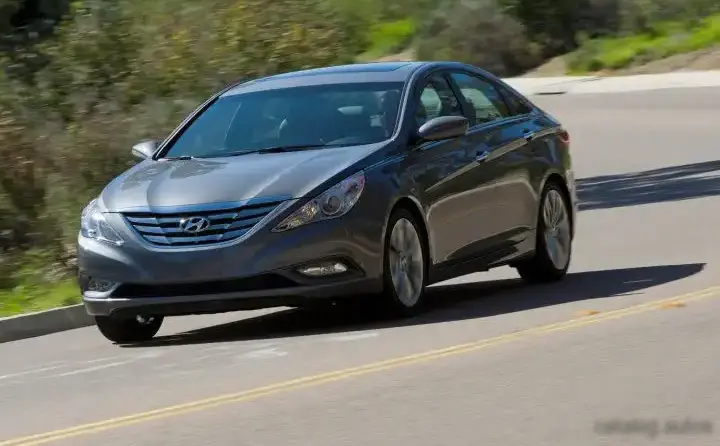
The Hyundai Sonata VI (YF), produced from 2009 to 2012, represented a significant step forward for the South Korean automaker in the mid-size sedan segment. The YF generation, replacing the NF Sonata, aimed to offer a more sophisticated and European-inspired design, along with improved performance and features. Within the YF lineup, the 2.4 GDI (Gasoline Direct Injection) variant, producing 201 horsepower, occupied a key position as a balance between affordability and performance. It served as the mainstream offering, positioned above the base 2.0L engine and below the more powerful 2.0T turbocharged model. This version was primarily targeted at buyers seeking a comfortable, well-equipped, and reasonably efficient family sedan.
Technical Specifications
| Brand | Hyundai |
| Model | Sonata |
| Generation | Sonata VI (YF) |
| Type (Engine) | 2.4 GDI (201 Hp) |
| Start of production | 2009 |
| End of production | 2012 |
| Powertrain Architecture | Internal Combustion engine |
| Body type | Sedan |
| Seats | 5 |
| Doors | 4 |
| Fuel consumption (urban) | 11.8 l/100 km (19.9 US mpg) |
| Fuel consumption (extra urban) | 5.8 l/100 km (40.6 US mpg) |
| Fuel consumption (combined) | 8 l/100 km (29.4 US mpg) |
| CO2 emissions | 191 g/km |
| Fuel Type | Petrol (Gasoline) |
| Acceleration 0 – 100 km/h | 8.5 sec |
| Acceleration 0 – 62 mph | 8.5 sec |
| Acceleration 0 – 60 mph | 8.1 sec |
| Maximum speed | 210 km/h (130.49 mph) |
| Weight-to-power ratio | 7.3 kg/Hp |
| Weight-to-torque ratio | 5.8 kg/Nm |
| Power | 201 Hp @ 6300 rpm |
| Torque | 250 Nm @ 4250 rpm (184.39 lb.-ft. @ 4250 rpm) |
| Engine layout | Front, Transverse |
| Engine Model/Code | Theta II / G4KJ |
| Engine displacement | 2359 cm3 (143.96 cu. in.) |
| Number of cylinders | 4 |
| Engine configuration | Inline |
| Cylinder Bore | 88 mm (3.46 in.) |
| Piston Stroke | 97 mm (3.82 in.) |
| Compression ratio | 11.3:1 |
| Number of valves per cylinder | 4 |
| Fuel injection system | Direct injection |
| Engine aspiration | Naturally aspirated engine |
| Valvetrain | DOHC, CVVT |
| Engine oil capacity | 4.8 l (5.07 US qt | 4.22 UK qt) |
| Coolant capacity | 6.6 l (6.97 US qt | 5.81 UK qt) |
| Kerb Weight | 1458 kg (3214.34 lbs.) |
| Max. weight | 2030 kg (4475.38 lbs.) |
| Max load | 572 kg (1261.04 lbs.) |
| Trunk (boot) space – minimum | 523 l (18.47 cu. ft.) |
| Fuel tank capacity | 70 l (18.49 US gal | 15.4 UK gal) |
| Length | 4820 mm (189.76 in.) |
| Width | 1835 mm (72.24 in.) |
| Height | 1470 mm (57.87 in.) |
| Wheelbase | 2795 mm (110.04 in.) |
| Front track | 1597 mm (62.87 in.) |
| Rear (Back) track | 1597 mm (62.87 in.) |
| Drag coefficient (Cd) | 0.28 |
| Minimum turning circle | 10.9 m (35.76 ft.) |
| Drivetrain Architecture | Front wheel drive |
| Drive wheel | Front wheel drive |
| Number of gears | 6 |
| Type of gearbox | Manual transmission |
| Front suspension | Independent, type McPherson with coil spring and anti-roll bar |
| Rear suspension | Independent multi-link suspension |
| Front brakes | Ventilated discs |
| Rear brakes | Disc |
| Assisting systems | ABS (Anti-lock braking system) |
| Steering type | Steering rack and pinion |
| Tires size | 215/55 R17 |
| Wheel rims size | 6.5J x 17 |
Powertrain & Engine Architecture
The heart of the Sonata 2.4 GDI is the Hyundai Theta II engine, specifically the G4KJ code. This 2.4-liter inline-four engine utilizes Gasoline Direct Injection (GDI) technology, a key feature that contributes to its improved power and efficiency compared to earlier Hyundai engines. GDI allows for more precise fuel delivery, resulting in a more complete combustion process. The engine features a double overhead camshaft (DOHC) valvetrain with continuously variable valve timing (CVVT) on both intake and exhaust camshafts, further optimizing performance and fuel economy. The 6-speed manual transmission was standard, offering drivers a more engaging driving experience. The engine produces 201 horsepower at 6300 rpm and 250 Nm (184 lb-ft) of torque at 4250 rpm. The engine’s design prioritized a balance between power and fuel efficiency, making it suitable for everyday driving.
Driving Characteristics
The 2.4 GDI-equipped Sonata offered a noticeable improvement in acceleration and responsiveness compared to the base 2.0L engine. While not a sports sedan, the 201 hp engine provided adequate power for highway merging and passing maneuvers. The 6-speed manual transmission allowed for precise gear selection and a more connected feel to the engine. The gear ratios were tuned for a balance of acceleration and fuel economy. Compared to the 2.0T turbocharged version, the 2.4 GDI lacked the same level of outright performance, but it offered a smoother, more linear power delivery. The manual transmission, while appreciated by enthusiasts, wasn’t as popular as the available automatic transmission in the US market.
Equipment & Trim Levels
The 2.4 GDI Sonata typically came standard with features such as air conditioning, power windows and locks, a CD/MP3 stereo system, and basic safety equipment like airbags and ABS. Higher trim levels added features like a sunroof, leather upholstery, heated seats, a navigation system, and a premium sound system. Interior upholstery was typically cloth on the base models, with leather available on higher trims. Dashboard configurations were generally consistent across the 2.4 GDI models, featuring a modern and user-friendly design for the time. Optional extras included a backup camera and keyless entry.
Chassis & Braking
The YF Sonata utilized a McPherson strut front suspension and a multi-link rear suspension, providing a comfortable and controlled ride. The suspension was tuned to prioritize ride comfort over sporty handling. Front brakes were ventilated discs, while rear brakes were solid discs. ABS (Anti-lock Braking System) was standard. The Sonata’s chassis was designed to provide a stable and predictable driving experience. Stabilizer bars were included both front and rear to reduce body roll during cornering.
Market Reception & Comparison
The 2.4 GDI Sonata was generally well-received by critics as a competent and stylish mid-size sedan. It was praised for its spacious interior, comfortable ride, and improved fuel economy compared to its predecessor. However, some reviewers noted that the interior materials weren’t quite as premium as those found in some of its competitors, such as the Honda Accord and Toyota Camry. Compared to the 2.0L base model, the 2.4 GDI offered a significant performance upgrade for a relatively modest price increase. The 2.0T turbocharged version provided even more performance, but at a higher cost. Fuel economy was competitive within the mid-size sedan segment.
Legacy
The Theta II engine, including the G4KJ 2.4 GDI variant, proved to be a relatively reliable powertrain. While some early Theta II engines experienced issues with oil consumption, these were generally addressed through updated engine designs and software calibrations. Today, used YF Sonatas with the 2.4 GDI engine are generally considered to be a good value, offering a comfortable and reliable transportation option. Maintenance costs are typically reasonable, and parts availability is good. The YF Sonata helped to establish Hyundai as a serious contender in the mid-size sedan market, paving the way for the brand’s continued success in North America.