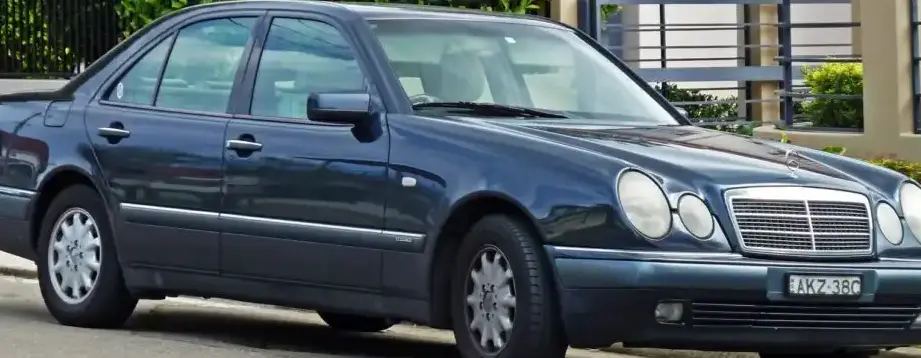
The Mercedes-Benz E 240, produced between April 1996 and July 1999, was a key variant within the W210 E-Class range. Representing a blend of luxury and performance, the E 240 occupied a middle ground in the lineup, positioned above the entry-level E 220 and below the more powerful E 320 and E 420 models. It was primarily aimed at buyers seeking a comfortable and refined executive sedan with a respectable level of performance, without the higher price tag of the flagship models. The W210 generation, introduced in 1995, marked a significant evolution for the E-Class, incorporating numerous technological advancements and a more contemporary design language compared to its W124 predecessor.
Technical Specifications
| Brand | Mercedes-Benz |
| Model | E-class |
| Generation | E-class (W210) |
| Type (Engine) | E 240 (170 Hp) Automatic |
| Start of production | April, 1996 |
| End of production | July, 1999 |
| Powertrain Architecture | Internal Combustion engine |
| Body type | Sedan |
| Seats | 5 |
| Doors | 4 |
| Fuel consumption (urban) | 14.8 l/100 km (15.9 US mpg, 19.1 UK mpg, 6.8 km/l) |
| Fuel consumption (extra urban) | 7.6 l/100 km (30.9 US mpg, 37.2 UK mpg, 13.2 km/l) |
| Fuel consumption (combined) | 10.3 l/100 km (22.8 US mpg, 27.4 UK mpg, 9.7 km/l) |
| Fuel Type | Petrol (Gasoline) |
| Acceleration 0 – 100 km/h | 10.2 sec |
| Acceleration 0 – 62 mph | 10.2 sec |
| Acceleration 0 – 60 mph | 9.7 sec |
| Maximum speed | 222 km/h (137.94 mph) |
| Weight-to-power ratio | 8.8 kg/Hp, 113.3 Hp/tonne |
| Weight-to-torque ratio | 6.7 kg/Nm, 150 Nm/tonne |
| Power | 170 Hp @ 5900 rpm |
| Power per litre | 70.9 Hp/l |
| Torque | 225 Nm @ 3000 rpm (165.95 lb.-ft. @ 3000 rpm) |
| Engine layout | Front, Longitudinal |
| Engine Model/Code | M 112 E 24 / 112.911 |
| Engine displacement | 2397 cm3 (146.27 cu. in.) |
| Number of cylinders | 6 |
| Engine configuration | V-engine |
| Cylinder Bore | 83.2 mm (3.28 in.) |
| Piston Stroke | 73.5 mm (2.89 in.) |
| Compression ratio | 10:1 |
| Number of valves per cylinder | 3 |
| Fuel injection system | Multi-port manifold injection |
| Engine aspiration | Naturally aspirated engine |
| Valvetrain | SOHC |
| Engine oil capacity | 8 l (8.45 US qt | 7.04 UK qt) |
| Coolant | 10 l (10.57 US qt | 8.8 UK qt) |
| Kerb Weight | 1500 kg (3306.93 lbs.) |
| Max. weight | 2000 kg (4409.25 lbs.) |
| Max load | 500 kg (1102.31 lbs.) |
| Trunk (boot) space – minimum | 520 l (18.36 cu. ft.) |
| Fuel tank capacity | 65 l (17.17 US gal | 14.3 UK gal) |
| Length | 4795 mm (188.78 in.) |
| Width | 1799 mm (70.83 in.) |
| Height | 1436 mm (56.54 in.) |
| Wheelbase | 2833 mm (111.54 in.) |
| Front track | 1542 mm (60.71 in.) |
| Rear (Back) track | 1536 mm (60.47 in.) |
| Drivetrain Architecture | The Internal combustion engine (ICE) drives the rear wheels of the vehicle. |
| Drive wheel | Rear wheel drive |
| Number of gears and type of gearbox | 5 gears, automatic transmission |
| Front suspension | Double wishbone |
| Rear suspension | Independent multi-link spring suspension with stabilizer |
| Front brakes | Ventilated discs |
| Rear brakes | Disc |
| Assisting systems | ABS (Anti-lock braking system) |
| Steering type | Steering rack and pinion |
| Power steering | Hydraulic Steering |
| Tires size | 205/65 R15 |
| Wheel rims size | 7J x 15 |
Powertrain & Engine Architecture
The E 240 was powered by the M112 E 24 engine, a 2.4-liter naturally aspirated V6. This engine was a significant departure from the inline-six engines previously used in the E-Class. The M112 featured all-aluminum construction, three valves per cylinder (two intake, one exhaust), and a single overhead camshaft (SOHC). Fuel delivery was handled by a multi-port fuel injection system, providing precise control over the air-fuel mixture. The engine produced 170 horsepower at 5900 rpm and 225 Nm (166 lb-ft) of torque at 3000 rpm. Paired with the engine was a 5-speed automatic transmission, offering smooth and convenient gear changes. This transmission was designed for comfort and refinement, prioritizing ease of use over outright performance.
Driving Characteristics
The E 240 Automatic offered a comfortable and composed driving experience. While not particularly sporty, the V6 engine provided adequate power for everyday driving and highway cruising. Acceleration from 0 to 60 mph took around 9.7 seconds, and the car had a top speed of 222 km/h (138 mph). The automatic transmission, while smooth, did contribute to a slight reduction in responsiveness compared to the available manual transmission. Gear ratios were tuned for fuel efficiency and relaxed cruising, rather than aggressive acceleration. The E 240 felt more refined and less engaging than the higher-performance E 320 or the diesel-powered E 300 TDI.
Equipment & Trim Levels
The E 240 typically came standard with features such as automatic climate control, power windows and locks, a sunroof, and a premium sound system. Interior upholstery was typically cloth, with leather options available as an upgrade. Dashboard configuration was consistent across the W210 range, featuring a classic Mercedes-Benz design with wood trim accents. Optional extras included heated seats, a navigation system, and upgraded audio equipment. The E 240 often served as a platform for buyers to customize their vehicle with a range of optional features.
Chassis & Braking
The W210 E-Class featured a double wishbone front suspension and an independent multi-link rear suspension, providing a comfortable ride and good handling characteristics. The E 240, being a mid-range model, typically came equipped with ventilated disc brakes at the front and solid disc brakes at the rear. Anti-lock braking system (ABS) was standard. The suspension was tuned for comfort, prioritizing a smooth ride over sporty handling. Stabilizer bars were fitted to both the front and rear axles to reduce body roll during cornering.
Market Reception & Comparison
The E 240 was generally well-received by automotive critics as a balanced and refined executive sedan. It offered a good compromise between performance, comfort, and fuel economy. Compared to the E 220, the E 240 provided a noticeable increase in power and performance. However, the E 320 offered significantly more power and a sportier driving experience, albeit at a higher price point. Fuel economy was respectable for its class, averaging around 22.8 US mpg in combined driving. Reliability was generally good, although some owners reported issues with the electronic systems and the automatic transmission over the long term.
Legacy
The M112 engine family, including the 2.4-liter version found in the E 240, proved to be a durable and reliable powerplant. While not known for exceptional performance, it offered years of dependable service. Today, the W210 E 240 is a relatively affordable entry point into Mercedes-Benz ownership. Well-maintained examples are still sought after by enthusiasts who appreciate the car’s classic styling, comfortable ride, and solid build quality. The automatic transmission, while generally reliable, may require occasional servicing to ensure smooth operation. Overall, the E 240 remains a respected and capable sedan, representing a significant chapter in the evolution of the Mercedes-Benz E-Class.