
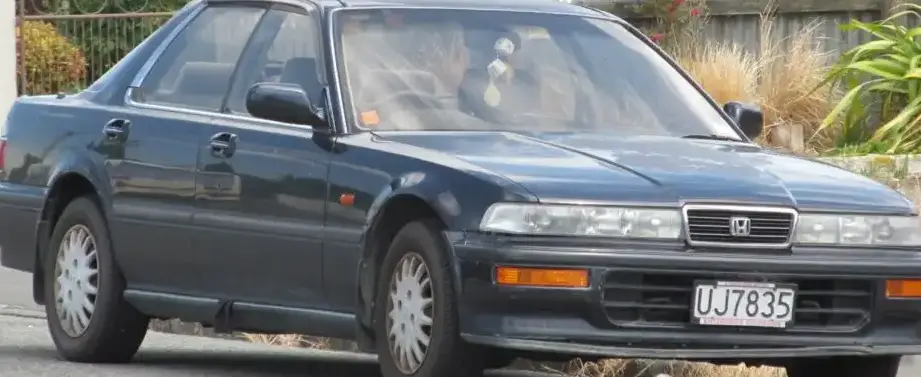
Technical Specifications
| Brand | Honda |
| Model | Vigor |
| Generation | Vigor (CB5) |
| Type (Engine) | 2.5 i 20V S (190 Hp) |
| Start of production | 1989 year |
| End of production | 1995 year |
| Powertrain Architecture | Internal Combustion engine |
| Body type | Sedan |
| Seats | 5 |
| Doors | 4 |
| Fuel consumption (economy) – combined | 7.4 l/100 km |
| Fuel consumption (economy) – combined | 31.8 US mpg |
| Fuel consumption (economy) – combined | 38.2 UK mpg |
| Fuel consumption (economy) – combined | 13.5 km/l |
| Fuel Type | Petrol (Gasoline) |
| Maximum speed | 210 km/h |
| Maximum speed | 130.49 mph |
| Weight-to-power ratio | 7.3 kg/Hp |
| Weight-to-power ratio | 137.7 Hp/tonne |
| Weight-to-torque ratio | 5.8 kg/Nm |
| Weight-to-torque ratio | 171.7 Nm/tonne |
| Power | 190 Hp @ 6500 rpm |
| Power per litre | 77.5 Hp/l |
| Torque | 237 Nm @ 3800 rpm |
| Torque | 174.8 lb.-ft. @ 3800 rpm |
| Engine layout | Front, Longitudinal |
| Engine displacement | 2451 cm3 |
| Engine displacement | 149.57 cu. in. |
| Number of cylinders | 5 |
| Engine configuration | Inline |
| Cylinder Bore | 85 mm |
| Cylinder Bore | 3.35 in. |
| Piston Stroke | 86.4 mm |
| Piston Stroke | 3.4 in. |
| Compression ratio | 9:1 |
| Number of valves per cylinder | 4 |
| Fuel injection system | Multi-port manifold injection |
| Engine aspiration | Naturally aspirated engine |
| Valvetrain | OHC |
| Kerb Weight | 1380 kg |
| Kerb Weight | 3042.38 lbs |
| Trunk (boot) space – minimum | 440 l |
| Trunk (boot) space – minimum | 15.54 cu. ft. |
| Fuel tank capacity | 65 l |
| Fuel tank capacity | 17.17 US gal |
| Fuel tank capacity | 14.3 UK gal |
| Length | 4835 mm |
| Length | 190.35 in. |
| Width | 1780 mm |
| Width | 70.08 in. |
| Height | 1370 mm |
| Height | 53.94 in. |
| Wheelbase | 2805 mm |
| Wheelbase | 110.43 in. |
| Front track | 1520 mm |
| Front track | 59.84 in. |
| Rear (Back) track | 1510 mm |
| Rear (Back) track | 59.45 in. |
| Drivetrain Architecture | The Internal combustion engine (ICE) drives the front wheels of the vehicle. |
| Drive wheel | Front wheel drive |
| Number of gears and type of gearbox | 4 gears, automatic transmission |
| Front suspension | Coil spring |
| Rear suspension | Coil spring |
| Front brakes | Ventilated discs |
| Rear brakes | Disc |
| Assisting systems | ABS (Anti-lock braking system) |
| Steering type | Steering rack and pinion |
| Power steering | Hydraulic Steering |
| Tires size | 205/60 R15 H |
The Honda Vigor CB5, produced between 1989 and 1995, represented Honda’s attempt to create a more upscale and performance-oriented sedan for the Japanese domestic market. It was built on the extended Honda Accord platform (though significantly differentiated), offering a longer wheelbase and a more refined interior. The 2.5 i 20V S variant, with its 190 horsepower engine and four-speed automatic transmission, occupied a mid-to-high position within the Vigor lineup. It catered to drivers who desired a blend of comfort, performance, and advanced features. The CB5 generation was a departure from previous Vigors, embracing a more modern design and sophisticated engineering.
Powertrain & Engine Architecture
The heart of the Vigor 2.5 i 20V S is the G25A inline-five cylinder engine. This engine, a hallmark of the CB5 Vigor, featured a displacement of 2.451 liters (149.57 cubic inches). The “20V” designation refers to the engine’s dual overhead camshafts (DOHC) and four valves per cylinder, contributing to its high output. Fuel delivery is managed by a multi-port fuel injection system, ensuring precise fuel metering for optimal performance and efficiency. The engine’s 9:1 compression ratio strikes a balance between power and reliability. The four-speed automatic transmission, while not offering the direct control of a manual, was chosen for its smoothness and ease of use, aligning with the Vigor’s luxury-oriented positioning. The transmission’s gear ratios were tuned to provide responsive acceleration and comfortable highway cruising.
Driving Characteristics
The Vigor 2.5 i 20V S delivers a refined driving experience. While 190 horsepower might not seem substantial by modern standards, the inline-five engine provides a unique and characterful power delivery. Torque of 174.8 lb.-ft. at 3800 rpm ensures ample pulling power for everyday driving and overtaking maneuvers. Compared to the manual transmission versions of the Vigor, the automatic sacrifices some driver engagement but offers a more relaxed and convenient experience. The automatic transmission’s shift points are generally well-timed, although it may not be as quick to downshift as a manual. The front-wheel-drive layout provides predictable handling, and the relatively lightweight construction (around 3042 lbs) contributes to a nimble feel. The Vigor doesn’t possess the outright sportiness of some rear-wheel-drive competitors, but it offers a comfortable and capable driving experience.
Equipment & Trim Levels
The 2.5 i 20V S trim level of the Honda Vigor was well-equipped for its time. Standard features typically included power windows, power locks, power mirrors, and air conditioning. The interior featured comfortable seating, often upholstered in a combination of cloth and leather. Dashboard design was clean and functional, with a focus on ergonomics. Optional extras could include a premium sound system, sunroof, and upgraded interior trim. The Vigor aimed to provide a luxurious and comfortable cabin environment, setting it apart from more basic sedans.
Chassis & Braking
The Vigor CB5 utilizes a coil spring suspension system at both the front and rear, providing a comfortable ride quality. The front suspension features independent struts, while the rear utilizes a multi-link setup. Ventilated disc brakes are found at the front, providing strong stopping power, while solid discs are used at the rear. An Anti-lock Braking System (ABS) was standard, enhancing safety by preventing wheel lockup during hard braking. The steering system employs a rack-and-pinion setup with hydraulic power assistance, offering precise and responsive steering feel. Tire size is 205/60 R15 H, providing a good balance of grip and ride comfort.
Market Reception & Comparison
The Honda Vigor CB5 was generally well-received in Japan, praised for its refined driving experience, comfortable interior, and advanced features. Critics noted the unique character of the inline-five engine and the overall quality of construction. Compared to other trims in the Vigor lineup, the 2.5 i 20V S offered a significant performance upgrade over the lower-displacement models. Fuel economy was respectable for a vehicle of its class, averaging around 31.8 US mpg in combined driving. Reliability was also a strong point, consistent with Honda’s reputation for building durable vehicles. However, the Vigor’s higher price point limited its appeal to a more discerning clientele.
Legacy
The Honda Vigor CB5, particularly the 2.5 i 20V S variant, has developed a cult following among enthusiasts. The inline-five engine is highly regarded for its unique sound and smooth power delivery. The CB5 Vigor is known for its long-term reliability, with many examples still on the road today. In the used car market, well-maintained examples command a premium, reflecting their rarity and desirability. The Vigor represents a high point in Honda’s engineering history, showcasing the company’s commitment to innovation and quality. It remains a testament to Honda’s ability to create sophisticated and engaging vehicles that appeal to a wide range of drivers.
